Skip to content
fishing forecast

atlantic moonfish

Selene setapinnis · Carangidae · predator

EstuarySea

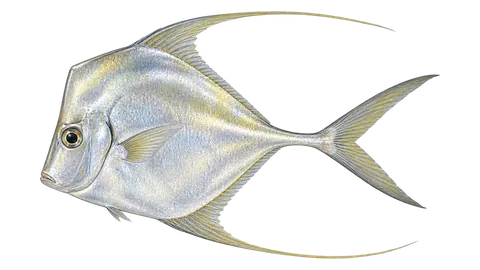
Very deep-bodied, flattened silvery carangid that lives near the bottom off the coast down to about 55 m and forms schools. It takes small bait and reaches the Southeast and South markets fresh.

Also called: galo-verdadeiro, peixe-galo (nome também usado para Selene vomer), fralda-rota, Atlantic moonfish, moonfish

Scientific illustration of Atlantic moonfish
common size
25–45 cm
maximum
60 cm
common weight
0.2–1.0 kg
record/max.
4.6 kg
depth
0–55 m
ideal water
20–28 °C
location

Sample location: choose yours to see the forecast for where you fish.

period

Reading the weather across 3 global models and 31 simulations…

the species

everything about the atlantic moonfish

overview

who is the atlantic moonfish

The galo-verdadeiro is a close relative of the lookdown (Selene vomer) and is often sold under the same name. It lives in the western Atlantic, from Nova Scotia (Canada) to Mar del Plata, Argentina, including the Gulf of Mexico and the Caribbean; in the eastern Atlantic it is replaced by Selene dorsalis, and the two may be the same species. Adults stay near the bottom, from shallow water down to at least 54 m, and sometimes rise in schools toward the surface. Juveniles use the mud bottoms of estuaries and coastal waters. They eat small fish and crustaceans. FishBase gives up to 60 cm and 4.6 kg, but markets in Rio de Janeiro show fish of 37 to 46 cm, weighing 0.75 to 1 kg. It is a commercial and subsistence fish, and in recreational fishing it is a bottom supplement, without the reputation of the jacks.

fun facts

  • In the eastern Atlantic it is replaced by Selene dorsalis; FishBase says the two may be the same species.
  • Specimens bought in markets in Niterói (RJ) in 2012 measured 37 to 46 cm and weighed 0.75 to 1 kg.
  • Juveniles live in muddy-bottom estuaries; adults stay near the bottom, on the coast and on the shelf.
how to recognize it

identification

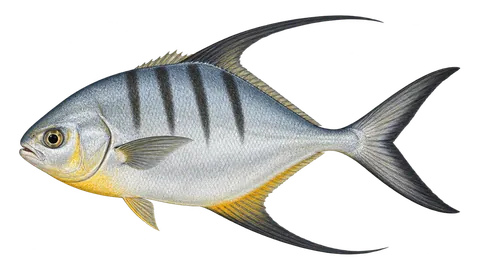
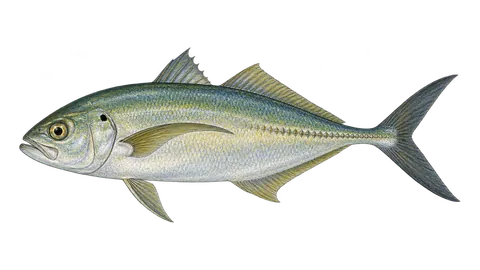
Very high, short and flattened body, silvery, with a bluish back and no stripes or spots. The face profile is almost vertical and concave, the mouth is small, and the pelvic fins are very short. The soft dorsal has 21 rays and the anal fin 17, after 3 spines. The lookdown (Selene vomer) is similar; reliable separation comes from proportions and ray counts, in an identification guide. Jacks (Caranx) are more elongated, and pompanos (Trachinotus) have rounded heads.

distribution

where found

open on the large map

The whole Brazilian coast, on sand and mud bottoms of the coast and inner shelf. FishBase extends the species in the western Atlantic to Mar del Plata (Argentina), and there are records from Uruguay. In Rio de Janeiro it is sold in markets as peixe-galo.

Habitat: Sand and mud bottoms of the coast and inner shelf, from the surf zone down to about 55 m; juveniles enter estuaries and brackish bays.

coast

North CoastNortheast CoastSoutheast CoastSouth Coastcoastalshelf
calendar and clock

when to fish

best season

time of yearbest: Dec–Feb
JanFebSeaAprMayJunJulAugSepOctNovDec

Found all year, but in the Southeast and South fishing is usually better in the warm months, when coastal water warms up. In the Northeast and North it varies little.

best time of day

0h6h12h18h sunrise ~6amsunset ~6pm

Daytime, with peaks at dawn and dusk. Feeds by day, most active at dawn and late afternoon, near the bottom.

weather, water and behavior

what affects the atlantic moonfish
sensitivity The little bars show how much each factor affects this species. Five full: it feels it a lot.

cold and cold fronts

Cold water pushes the school away from the coast in the South; in upwelling it drops to the bottom.

atmospheric pressure

Not very sensitive.

moon

Small effect.

rain

Fresh, muddy water from runoff scatters the school.

water level

Not applicable at sea.

noise

A school near the bottom tolerates an anchored boat; it scatters when a motor passes overhead.

wind

Rough seas make it hard to anchor over the school.

tide

With the tide running, the school moves along channels and bottom edges.

depth

Near the bottom, 3 to 50 m; rises when it feeds in midwater.

technique, gear and bait

how to fish

rod
6'0" to 7'0", 8 to 20 lb
spinning / baitcasting reel
spinning reel 2500 to 4000
line
braided line 10 to 20 lb
leader
fluorocarbon 20 to 30 lb, 1 m
hook
hook no. 1 to 2/0, preferably circle

lures

  • micro jig 10 to 30 g
  • 1/4 oz jig head with a small shad

natural baits

  • shrimp
  • sardine strip
  • squid in thin strips

accessories

  • alicate
  • running sinker 30 to 60 g

tip from an angler

Small bait kept still near the bottom, with the line taut: the mouth is small, and the fish drops the hook if it feels weight.

what the law says

rules for the atlantic moonfish

Summary of the regulations we found, with the source for each. Rules change; before keeping or transporting fish, check with the state environmental agency.
Conservation: Not on the Brazilian national list (Portaria GM/MMA nº 1.667/2026). We found no specific minimum size or federal closed season for the species.

Mexico: up to 5 per species and 10 saltwater fish per day

5 specimens of the species per angler per day, within the limit of 10 saltwater fish

In recreational fishing in Mexican federal waters, each angler may keep up to 10 marine fish per day, no more than 5 of the same species. The galo-verdadeiro has no limit of its own in the rule. Fish over the limit go back into the water alive, and a retained fish may not be sold. Anyone fishing from a boat needs a permit from Conapesca.

Source: Amendment to NOM-017-PESC-1994 (recreational sport fishing in federal waters of Mexico), DOF Nov 25, 2013, items 4.9.1, 4.9.5 and 4.11 (Sagarpa/Conapesca)

catch and release
catch and release Releasing the fish alive, quickly and with a wet hand. During a closed season it isn't always allowed: what the regulation says applies.

Slender body and delicate slime: wet your hands, hold it from below without squeezing, and release it quickly. With a circle hook, the fish is almost always hooked in the corner of the mouth.

in the kitchen

White, tender flesh, good fried whole or baked; FishBase calls it a good table fish, sold fresh. FishBase records ciguatera reports, so on Caribbean reef areas check with local fishers before eating large fish. In Rio de Janeiro, nematode larvae have been found in fish from the markets: cook it well or freeze it before eating it raw.

calculator

how much it weighs without taking it out of the water

Length-weight relationship W = a·Lb (a = 0.01259, b = 2.96; FishBase (relação peso-comprimento bayesiana, estimativa da própria espécie)). It's an average: a fat or lean fish can vary by 10% to 20%.

estimated weight

—

sources and references

The season weights (months), the time of day and the sensitivities (cold, pressure, moon, wind, rain, tide, strong light, murky water and noise) are the app's editorial estimates, based on the literature below and on field experience from anglers and guides. They are not official data or measurements made for this species and may vary by region and year. Closed seasons and legal rules appear in the rules section, with the rule and link. Common sizes and weights are ranges around the common length reported by FishBase, with the weight calculated from the length-weight relationship.

  1. scientific FishBase: Selene setapinnis (ficha da espécie)Size, length-weight, depth, habitat, distribution, biology, and IUCN status. Page checked on Oct 13, 2026.
  2. scientific FishBase: nomes populares de Selene setapinnisNames by country and language. The list mixes names from Portugal and Brazil without indicating the country by name. The app uses galo-verdadeiro, which appears among the Brazilian names in the batch, because peixe-galo already names Selene vomer; peixe-galo appears as this species' name in the Niterói (RJ) literature.
  3. official Portaria GM/MMA nº 1.667, de 27 de abril de 2026: Lista Nacional Oficial de Espécies da Fauna Ameaçadas de Extinção (peixes e invertebrados aquáticos)The species is not on the list. Checked in the DOU of April 28, 2026.
  4. official Instrução Normativa MMA nº 53, de 22 de novembro de 2005: tamanho mínimo de captura de espécies marinhas e estuarinas do litoral Sudeste e SulAnnex II, from ES to RS. Checked Oct 13, 2026: the species is not in Annex II (there is no federal minimum size for it).
  5. official DOF: Modificação da NOM-017-PESC-1994, para regular a pesca deportivo-recreativa em águas de jurisdição federal do México (DOF de 25/11/2013)Daily quotas at sea (item 4.9.1), return of the excess (4.9.5), ban on selling the fish (4.11) and ban on fishing in closed zones and seasons (4.10 a). Text checked Oct 13, 2026.
  6. scientific Fontenelle, G.; Knoff, M.; Felizardo, N. N.; et al. (2015). Anisakidae and Raphidascarididae larvae parasitizing Selene setapinnis (Mitchill, 1815) in the State of Rio de Janeiro, Brazil. Revista Brasileira de Parasitologia Veterinária 24(1)Thirty specimens bought in markets in Niterói (RJ) in 2012, called peixe-galo in the Portuguese summary: 37 to 46 cm and 0.75 to 1 kg. They carry nematode larvae in the fish. Checked on 13/10/2026.
don't confuse

similar species