Skip to content
fishing forecast

jaguar cichlid

Parachromis managuensis · Cichlidae · predator

Freshwater

Predatory cichlid from Central America, with a row of black spots along the flank. It attacks small lures aggressively and has been introduced in several countries, including Mexico.

Also called: guapote-tigre, ciclídeo-jaguar, peixe-jaguar, jaguar guapote

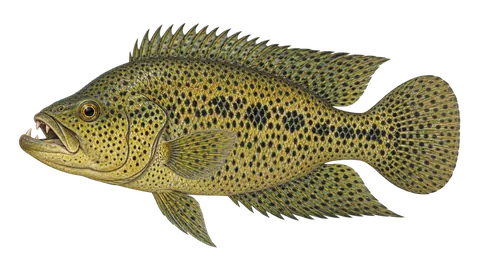
Scientific illustration of Jaguar cichlid
common size
20–35 cm
maximum
55 cm
common weight
0.2–1 kg
record/max.
1.6 kg
depth
0.5–10 m
ideal water
26–32 °C
location

Sample location: choose yours to see the forecast for where you fish.

period

Reading the weather across 3 global models and 31 simulations…

the species

everything about the jaguar cichlid

overview

who is the jaguar cichlid

Predatory cichlid native to the Atlantic slope of Central America, from the Ulúa River (Honduras) to the Matina River (Costa Rica), including Lakes Nicaragua and Managua, which gives it its scientific name. It prefers murky, nutrient-rich lakes, warm low-oxygen floodplain lagoons and mud bottoms. It eats small fish and invertebrates. Highly valued as a table fish, it was spread by aquaculture and the aquarium trade to Mexico, Guatemala, El Salvador, Panama, Cuba, Puerto Rico and other countries, where it is seen as a potential pest. In sport fishing it is smaller than the lagunero guapote, but it strikes crankbaits, spinners and silicone lures with the same fury and fights well on light tackle.

fun facts

  • The scientific name honors Lake Managua in Nicaragua.
  • It tolerates warm, oxygen-poor water, which helps explain its success where it was introduced.
how to recognize it

identification

Large mouth, projecting lower jaw and visible canine teeth. Silver to golden-green body with purple sheen, a row of large black blotches in the middle of the flank and many black spots on the body and fins; black bands from the eye to the edge of the gill cover and a black spot at the base of the tail. The lagunero guapote (Parachromis dovii) is much larger, and males have small, dense spots instead of the row of blotches.

distribution

where found

open on the large map

Not found in Brazil (the name "peixe-jaguar" is used in the aquarium trade, with no wild record confirmed by FishBase). Native to Honduras, Nicaragua and Costa Rica, on the Atlantic slope, including Lakes Nicaragua and Managua. Introduced to Mexico, Guatemala, El Salvador, Panama, Cuba and Puerto Rico.

Habitat: Murky, eutrophic lakes, warm floodplain lagoons, springs and small reservoirs with bottoms of mud, sand and debris; near logs and vegetation.

calendar and clock

when to fish

best season

time of yearbest: Dec–May
JanFebSeaAprMayJunJulAugSepOctNovDec

Fishable all year. It tends to bite best in the dry season, with clearer water and a stable level.

best time of day

0h6h12h18h sunrise ~6amsunset ~6pm

Daytime, with peaks at dawn and dusk. Feeds by day, with peaks at dawn and dusk along the banks and vegetation.

weather, water and behavior

what affects the jaguar cichlid
sensitivity The little bars show how much each factor affects this species. Five full: it feels it a lot.

cold and cold fronts

Rare in the region; cold fronts in areas where it was introduced shut down activity.

atmospheric pressure

Stable weather helps.

moon

Small effect; during spawning the pair guards the nest and strikes lures out of territoriality.

rain

Heavy rain muddies the banks; the fish tolerates murky water better than other cichlids.

water level

A stable level and banks with logs and vegetation are best.

noise

Moderately sensitive; approach quietly near the structure.

wind

Light wind helps along the banks; strong wind hinders the cast.

depth

From 0.5 to 4 m for most of the day.

technique, gear and bait

how to fish

rod
6' to 6'6", fast action, 8 to 17 lb
spinning / baitcasting reel
spinning reel 2000 to 3000 or light low-profile baitcasting reel
line
braided 15 to 20 lb
leader
fluorocarbon 20 to 25 lb (for the teeth)
hook
treble hooks 2 to 4; single hooks 1/0 to 2/0 on the silicone lure

lures

  • small crankbait
  • spinner #2 to 3
  • silicone shad 5 to 8 cm
  • small popper
  • streamer for fly fishing

natural baits

  • small fish or earthworm, where allowed (in Mexico, live fish is prohibited in inland waters)

accessories

  • long-nose pliers
  • polarized glasses

tip from an angler

Run the lure close to logs and vegetation and pause: the tiger guapote tends to strike on the pause.

what the law says

rules for the jaguar cichlid

Summary of the regulations we found, with the source for each. Rules change; before keeping or transporting fish, check with the state environmental agency.
Conservation: In its native range. Considered a potential pest where it was introduced.

Mexico: up to 5 freshwater fish per day, no live fish as bait

5 fish per angler per day

In Mexico's federally governed inland waters, the limit is 5 fish per angler per day, with only one rod in use per angler. Using live fish as bait is prohibited in inland waters, and sport-caught fish may not be sold. Each reservoir committee may reduce the bag limit and set sizes. In Mexico the tiger guapote is exotic.

Source: Amendment to NOM-017-PESC-1994, published in the DOF on Nov 25, 2013, items 4.6 b, 4.7 c and 4.9.2 (Sagarpa/Conapesca)

catch and release
catch and release Releasing the fish alive, quickly and with a wet hand. During a closed season it isn't always allowed: what the regulation says applies.

Hold it by the mouth with pliers or a fish grip (watch the teeth) and release near the structure. Where it is exotic, follow local rules before releasing.

in the kitchen

White, tasty flesh, highly prized in the region; fried whole or as fillets.

calculator

how much it weighs without taking it out of the water

Length-weight relationship W = a·Lb (a = 0.02089, b = 3.05; FishBase). It's an average: a fat or lean fish can vary by 10% to 20%.

estimated weight

—

sources and references

The season weights (months), the time of day and the sensitivities (cold, pressure, moon, wind, rain, tide, strong light, murky water and noise) are the app's editorial estimates, based on the literature below and on the field experience of anglers and guides. They are not official data nor a measurement made for this species, and they may vary by region and year. Closed seasons and legal rules appear in the rules section, with the norm and a link.

  1. scientific FishBase — Parachromis managuensis (ficha da espécie)Names, distribution, biology, length-weight relationship, country list and references. Page checked on Oct 13, 2026.
  2. scientific IUCN Red List — Parachromis managuensis (avaliação global: Pouco Preocupante, LC, 05/02/2020)Global assessment. Link given on the FishBase entry (Red List, version 2025-2).
  3. technical CABI Compendium — Parachromis managuense (jaguar guapote). (2019).Technical sheet on an introduced species. DOI checked on Crossref.
  4. official INPESCA (Nicarágua) — Tallas mínimas de captura permitidas: aguas continentales (2019)Official table with minimum sizes for mojarra, tiger guapote, lagunero guapote, gaspar, snook, roncador and tarpon.
  5. official DOF — Modificação da NOM-017-PESC-1994, para regular a pesca deportivo-recreativa em águas de jurisdição federal do México (publicada em 25/11/2013)Daily limits at sea (item 4.9.1) and in fresh water (4.9.2), one rod in inland waters (4.6 b), ban on live fish as bait in inland waters (4.7 c) and on fishing in closed areas and seasons (4.10).
don't confuse

similar species