Skip to content
fishing forecast

chilean jack mackerel

Trachurus murphyi · Carangidae · predator

Sea

The South Pacific jack mackerel, the base of one of the world's largest fisheries. It comes to schools near the piers and rocks of Chile and Peru and takes jigs, sabiki and natural bait.

Also called: jurel-chileno, jurel, carapau-chileno

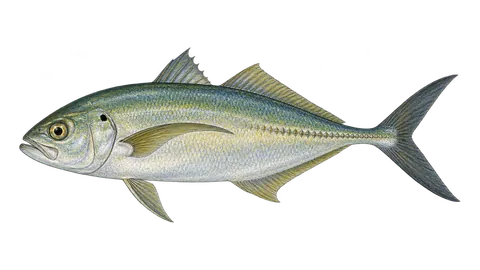
Scientific illustration of Chilean jack mackerel
common size
25–45 cm
maximum
70 cm
common weight
0.2–1 kg
record/max.
2.7 kg
depth
0–70 m
ideal water
15–20 °C
location

Sample location: choose yours to see the forecast for where you fish.

period

Reading the weather across 3 global models and 31 simulations…

the species

everything about the chilean jack mackerel

overview

who is the chilean jack mackerel

The Chilean jack mackerel is a carangid of the genus Trachurus, the genus of the jack mackerels, which lives in the South Pacific, mainly off Peru and Chile, with records from Ecuador, New Zealand and southern Argentina. It forms large schools from the coast out to open sea and eats fish larvae and small crustaceans. It reaches 70 cm and lives up to 16 years, but the usual size near the coast is well below that. It supports an enormous industrial purse-seine fishery, for human consumption and fishmeal, managed in international waters by the South Pacific Regional Fisheries Management Organisation (SPRFMO). For amateur anglers, it turns up at jetties, piers and rocks when the schools come close, and from boats with jigs.

fun facts

  • It can live up to 16 years.
  • The bony scutes on the rear of the lateral line are hard and sharp: hold the fish with a cloth.
how to recognize it

identification

Elongated, slightly compressed body, metallic blue or dark gray back, silvery flanks and belly. Black spot on the upper edge of the gill cover. Lateral line fully covered in scales, which become large, hard scutes at the rear. Long, sickle-shaped pectoral fin; darkened fins. Differs from the xerelete and the greater amberjack in its slimmer body and the line of scutes along the whole lateral line.

distribution

where found

open on the large map

Does not occur in Brazil. South Pacific, mainly off Peru and Chile, with records from Ecuador, southern Argentina and New Zealand.

Habitat: From the coast to open sea, in schools; comes close to jetties, piers, bays and rocky points when the water and bait favor it.

calendar and clock

when to fish

best season

time of yearbest: Nov–Mar
JanFebSeaAprMayJunJulAugSepOctNovDec

The arrival of schools on the coast varies greatly from year to year with sea temperature and El Niño; in central Chile it is usually better in summer and autumn.

best time of day

0h6h12h18h sunrise ~6amsunset ~6pm

Daytime, with peaks at dawn and dusk. Bites by day, with peaks at dawn and late afternoon; at night, light on the water attracts the schools.

weather, water and behavior

what affects the chilean jack mackerel
sensitivity The little bars show how much each factor affects this species. Five full: it feels it a lot.

cold and cold fronts

Strong changes in sea temperature shift the schools.

atmospheric pressure

Rough sea hurts jetty and rock fishing.

moon

Dark nights favor light fishing.

rain

Little effect at sea.

water level

Not applicable at sea.

noise

Not very sensitive when the school is feeding.

wind

Strong wind makes casting light lures difficult.

tide

Moving tide and current at jetty points concentrate the schools.

depth

From the surface to 30 m in amateur fishing.

technique, gear and bait

how to fish

rod
2.4 to 3.6 m for jetty and rock, or 6'6" to 7'0" from a boat, 10 to 20 lb
spinning / baitcasting reel
spinning reel 2500 to 4000
line
braid 12 to 20 lb or monofilament 0.25 to 0.30 mm
leader
fluorocarbon 0.30 to 0.40 mm
hook
hooks sizes 2 to 2/0; sabiki for schools

lures

  • sabiki
  • metal jig, 20 to 60 g
  • colherinha

natural baits

  • anchoveta in pieces
  • squid strips
  • shrimp

accessories

  • alicate
  • bucket with ice

tip from an angler

When the school comes close, a sabiki with a jig on the end can bring in several fish at once; respect the minimum size and release the small ones.

what the law says

rules for the chilean jack mackerel

Summary of the regulations we found, with the source for each. Rules change; before keeping or transporting fish, check with the state environmental agency.
Conservation: Old global assessment. The South Pacific stock is managed by SPRFMO, with annual quotas for industrial fishing.

Peru: minimum size 31 cm

31 cm (total length)

In Peru the minimum catch size for jack mackerel is 31 cm total length, the value from R.M. nº 209-2001-PE, which also appears in the current Ministry of Production table. It is prohibited to extract, transport and sell below the size.

Source: R.M. nº 209-2001-PE, Annex I (Peru); PRODUCE minimum size table

catch and release
catch and release Releasing the fish alive, quickly and with a wet hand. During a closed season it isn't always allowed: what the regulation says applies.

It handles release well if done quickly: remove the hook in the water or with the fish wet, and let it go right away.

in the kitchen

Dark, oily, tasty flesh; fried, grilled, pickled and widely canned.

calculator

how much it weighs without taking it out of the water

Length-weight relationship W = a·Lb (a = 0.01122, b = 2.92; FishBase (estimativa bayesiana com dados da espécie e do gênero, comprimento total); peso máximo calculado por esta relação). It's an average: a fat or lean fish can vary by 10% to 20%.

estimated weight

—

sources and references

The season weights (months), the time of day and the sensitivities (cold, pressure, moon, wind, rain, tide, strong light, murky water and noise) are the app's editorial estimates, based on the literature below and on the field experience of anglers and guides. They are not official data nor a measurement made for this species, and they may vary by region and year. Closed seasons and legal rules appear in the rules section, with the norm and a link.

  1. scientific FishBase — Trachurus murphyi (ficha da espécie)Names, distribution, biology, length-weight relationship, country list and references. Page checked on Oct 13, 2026.
  2. scientific IUCN Red List — Trachurus murphyi (avaliação global: Dados Insuficientes, DD, 30/04/2008)Global assessment. Link given on the FishBase entry (Red List, version 2025-2).
  3. official Resolução Ministerial nº 209-2001-PE (Peru) — tamanhos mínimos de captura e tolerância de juvenis dos principais peixes marinhosCopy of the original text in the FAOLEX database, checked on 13/10/2026. Several values in Annex I were later changed by specific resolutions.
  4. official Ministério da Produção do Peru (PRODUCE) — Pesca y Consumo Responsable: tallas mínimas de capturaOfficial minimum size table for consumers, checked on 13/10/2026. The page does not indicate the rule behind each value.
  5. official Subpesca (Chile) — Informe Técnico R.PESQ. nº 107/2012: revisão da talla mínima do jurelTechnical report from the Subsecretaría de Pesca y Acuicultura, checked on 13/10/2026. Cites D.S. nº 458/1981, with a minimum size of 26 cm fork length.
don't confuse

similar species