Skip to content
fishing forecast

black marlin

Istiompax indica · Istiophoridae · predator

Sea

The giant of the billfishes, with fish over 700 kg. In the American Pacific it is the great trophy of Panama, Costa Rica, Colombia, Ecuador and northern Peru.

Also called: marlim-negro, black marlin

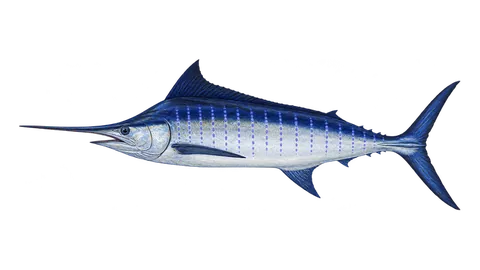
Scientific illustration of Black marlin
common size
250–380 cm
maximum
465 cm
common weight
60–250 kg
record/max.
750.0 kg
depth
0–200 m
ideal water
24–29 °C
location

Sample location: choose yours to see the forecast for where you fish.

period

Reading the weather across 3 global models and 31 simulations…

the species

everything about the black marlin

overview

who is the black marlin

Indo-Pacific tropical and subtropical marlin, which on the American continent appears along the Pacific coast from Mexico to Peru. Unlike other marlins, it tends to stay close to the coast, islands, seamounts and shelf edges, in the layer above the thermocline. It eats small tunas, squid, octopus and other fish. It is the largest marlin, with records over 4.5 m and 750 kg. Its pectoral fins are rigid and do not fold against the body, the surest mark of the species. It is caught trolling live bait (mainly bonito) pulled slowly, from lodges and boats in Panama, Costa Rica, Colombia and Ecuador. Nearly all sport fishing is catch and release.

fun facts

  • The IGFA all-tackle world record for marlin is a black marlin of about 707 kg, caught at Cabo Blanco, Peru, in 1953.
  • The rigid pectoral fins stay open like wings, even on a dead fish.
how to recognize it

identification

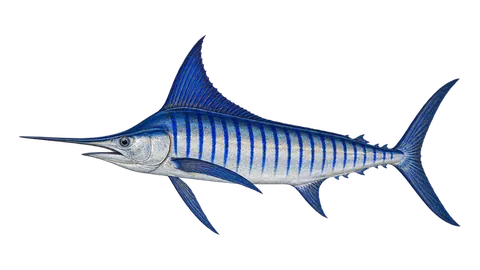
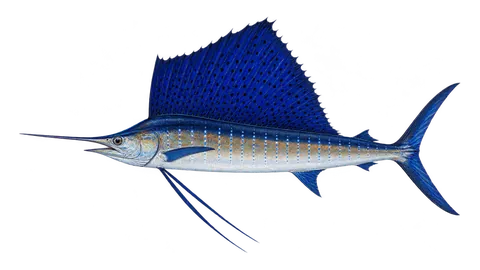
Thick, slightly compressed body, short sturdy bill. The first dorsal fin is low, lower than the body depth. The pectoral fins are rigid and stay open, not folding against the body, even on a dead fish. Dark blue back, silver-white belly, sometimes with light blue stripes. The blue marlin has pectoral fins that fold; the striped marlin has a first dorsal fin taller than the body and well-marked stripes.

distribution

where found

open on the large map

Does not occur regularly in Brazil; in the Atlantic there are only records of stray fish. Tropical and subtropical Indo-Pacific; in the Americas, the Pacific from Mexico to Peru. Classic destinations: Piñas Bay and Hannibal Bank (Panama), Costa Rica, the Pacific coast of Colombia, Ecuador and Cabo Blanco in northern Peru.

Habitat: Surface layer above the thermocline, near the coast, islands, seamounts, shelf edges and banks with schools of bonito and tuna.

calendar and clock

when to fish

best season

time of yearbest: Dec–Apr
JanFebSeaAprMayJunJulAugSepOctNovDec

In the Pacific off Panama and Costa Rica it is fished all year; many operators point to the dry season, December to April, as the best window. The presence of bonito schools over the banks matters more than the month.

best time of day

0h6h12h18h sunrise ~6amsunset ~6pm

Daytime. Strikes all day; tide and current changes over the banks often concentrate the bites.

weather, water and behavior

what affects the black marlin
sensitivity The little bars show how much each factor affects this species. Five full: it feels it a lot.

cold and cold fronts

Water below 22 °C often drives the fish away; look for thermal fronts and warmer blue water.

atmospheric pressure

Little direct effect; a front with rough seas makes fishing hard.

moon

At the dock they say a full moon makes fish feed at night; the effect counts for less than bait and water.

rain

Light rain is no problem; a thunderstorm with lightning at sea: head in.

water level

Does not apply at sea. The equivalent is clear blue water with bait over the bank.

noise

Engine and wake attract; noisy teasers help bring the fish up.

wind

Moderate swell helps the baits; strong wind makes leaving dangerous.

tide

Tide and current changes over banks and seamounts concentrate the strikes.

depth

Hunts from the surface down to about 200 m; fish the edges of banks and seamounts.

technique, gear and bait

how to fish

rod
stand-up or chair rod, 80 to 130 lb, with roller guides
spinning / baitcasting reel
two-speed trolling reel 80 to 130 lb
line
monofilament 80 to 130 lb, 600 m or more; or braided backing with topshot
leader
monofilament 300 to 500 lb, 4.5 to 7 m
hook
circle 14/0 to 18/0 on live bait; single 10/0 to 12/0 on artificials

lures

  • resin heads with 12 to 16 inch skirts
  • chain teasers and dredges

natural baits

  • live bonito, slow-trolled
  • dead bait rigged for trolling

accessories

  • fighting chair or stand-up harness
  • leather gloves for the leader
  • cutting pliers
  • scientific tagging tags

tip from an angler

Find the bonito school over the bank, put a live bait in front of it and pull very slowly. With a circle hook, don't strike: let the line tighten and let the drag do the work.

what the law says

rules for the black marlin

Summary of the regulations we found, with the source for each. Rules change; before keeping or transporting fish, check with the state environmental agency.
Conservation: Highly migratory; stocks are assessed by regional tuna commissions in the Pacific.

Mexico: billfish reserved for sport fishing; 1 per angler per day

1 billfish per angler per day

Within the 50 nautical mile strip off the Mexican coast, marlins, sailfish and swordfish (the billfish) are reserved for recreational sport fishing. The limit is 1 billfish per angler per day, which counts as 5 toward the total limit of 10 marine fish. Filleting billfish on board is prohibited, fish above the quota must be released alive, and fish caught in sport fishing may not be sold.

Source: Amendment to NOM-017-PESC-1994 (recreational sport fishing in federal waters of Mexico), signed Oct 14, 2013 and published in the DOF, item 4.9.1 (Sagarpa/Conapesca)

catch and release
catch and release Releasing the fish alive, quickly and with a wet hand. During a closed season it isn't always allowed: what the regulation says applies.

Release with the fish in the water, cutting the leader near the hook when it cannot be removed safely. Revive it with the boat moving slowly forward. Never haul a large marlin aboard for a photo.

in the kitchen

Good-quality meat, eaten in some countries, but in sport fishing in the Americas the practice is release.

calculator

how much it weighs without taking it out of the water

Length-weight relationship W = a·Lb (a = 0.00447, b = 3.13; FishBase (estimativa bayesiana)). It's an average: a fat or lean fish can vary by 10% to 20%.

estimated weight

—

sources and references

The season weights (months), the time of day and the sensitivities (cold, pressure, moon, wind, rain, tide, strong light, murky water and noise) are the app's editorial estimates, based on the literature below and on the field experience of anglers and guides. They are not official data nor a measurement made for this species, and they may vary by region and year. Closed seasons and legal rules appear in the rules section, with the norm and a link.

  1. scientific FishBase — Istiompax indica (ficha da espécie)Names, distribution, biology, length-weight relationship, country list and references. Page checked on Oct 13, 2026.
  2. scientific IUCN Red List — Istiompax indica (avaliação global: Dados Insuficientes, DD, 01/05/2021)Global assessment. Link given on the FishBase entry (Red List, version 2025-2).
  3. scientific Nakamura, I. (1985). FAO species catalogue. Vol. 5. Billfishes of the world. FAO Fisheries Synopsis 125(5). Roma: FAO.
  4. scientific Domeier, M. L.; Speare, P. (2012). Dispersal of adult black marlin (Istiompax indica) from a Great Barrier Reef spawning aggregation. PLoS ONE 7(2): e31629.DOI checked in Crossref.
  5. official México — Modificación a la Norma Oficial Mexicana NOM-017-PESC-1994, para regular las actividades de pesca deportivo-recreativa (DOF)Official text in the Diario Oficial de la Federación. Items 0.3 (species reserved for sport fishing) and 4.9 (catch limits) checked on Oct 13, 2026.
don't confuse

similar species