Skip to content
catalog Istiophoridae · predator

blue marlin

Makaira nigricans

Seanational list: VU · vulnerable

The biggest trophy of Brazilian offshore fishing. It strikes trolled baits in open sea and fights for hours. Threatened species: catch and release only.

Also called: agulhão-negro, marlim-azul, blue marlin

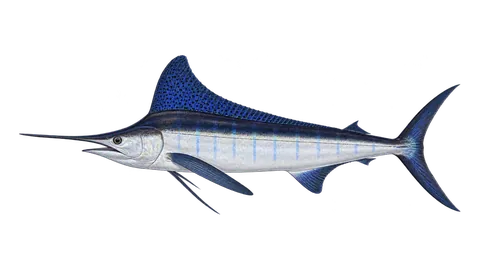
Scientific illustration of Blue marlin
common size
200–330 cm
maximum
500 cm
common weight
70–250 kg
record/max.
636.0 kg
depth
0–200 m
ideal water
25–29 °C
overview

who is the blue marlin

The blue marlin is the heaviest billfish on the Brazilian coast. Males rarely exceed 150 kg; females can top 500 kg. It lives in the warm layer over the slope and the shelf edge, following currents, thermal fronts, and schools of skipjack tuna, dolphinfish, and squid. It uses its bill to stun prey. In Brazil fishing is recreational and always catch and release: the species is on the national list of threatened species, and sale is prohibited. The Vitória-ES season, from October to March, draws boats from all over the country. It requires a boat ready to run 30 to 60 nautical miles out, a trained crew, and heavy tackle. A good day brings one or two strikes; patience is part of the game.

fun facts

  • Females are much larger than males; fish over 150 kg are almost always females.
  • The blue stripes light up when the fish is hunting or excited behind the teasers.
  • In Brazilian commercial fishing it is called agulhão-negro.
how to recognize it

identification

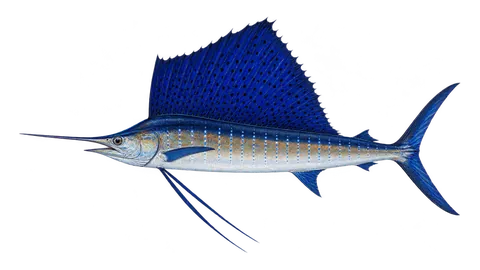
Long, thick bill. The first dorsal fin is pointed at the front and lower than the body depth. Long pectoral fins that fold against the body. Dark cobalt-blue back, silver belly, and pale blue vertical stripes that vanish after death. The white marlin is much smaller, has rounded-tip dorsal and anal fins, and a dorsal with black spots. The sailfish has a sail-shaped dorsal fin, taller than the body, and very long pelvic fins.

how blue marlin fishing looks

Loading the next 7 days…

Each card shows the day's index (0 to 100) and, below it, a strip with the index for each hour, from 0h to 23h. from poor to excellent.

distribution

where found

open on the large map

Warm oceanic waters across the whole Brazilian exclusive economic zone (EEZ), over the slope and the shelf edge. Classic destinations: Vitória-ES, the national capital of blue marlin, with grounds on the shelf edge 30 to 60 nautical miles offshore; Royal Charlotte bank, in southern Bahia (departures from Canavieiras and Belmonte); Cabo Frio and Arraial do Cabo-RJ; Natal-RN; Fernando de Noronha-PE. At Noronha fishing is prohibited inside the Parque Nacional Marinho; outside it, only with a local operator and within ICMBio rules.

Habitat: Surface layer of blue, warm water (0 to 200 m) over bottoms of 200 to 3,000 m. Concentrates at shelf edges, canyons, seamounts, current edges, and sargassum lines with bait.

coast

North CoastNortheast CoastSoutheast CoastSouth Coastoceanic

states

Amapá, Pará, Maranhão, Piauí, Ceará, Rio Grande do Norte, Paraíba, Pernambuco, Alagoas, Sergipe, Bahia, Espírito Santo, Rio de Janeiro, São Paulo, Paraná, Santa Catarina, Rio Grande do Sul

calendar and clock

when to fish

best season

time of yearbest: Nov–Jan
JanFebSeaAprMayJunJulAugSepOctNovDec

At Vitória and Royal Charlotte the season runs from October to March, peaking November to January, when the Brazil Current brings blue water above 25 °C near the shelf edge. In the Northeast it appears all year in open sea, with less predictability.

best time of day

0h6h12h18h sunrise ~6amsunset ~6pm

Daytime. It strikes all day long. Many skippers report peaks in mid-morning and mid-afternoon, and at tide or current turns. Night sport fishing is not practiced.

weather, water and behavior

what affects the blue marlin
sensitivity The little bars show how much each factor affects this species. Five full: it feels it a lot.

cold and cold fronts

Water below 24 °C kills the fishing. Look for the warm edge of the Brazil Current; thermal breaks of 1 to 2 °C concentrate bait and fish.

atmospheric pressure

Little direct effect. The cold front churns the sea and cools the surface; afterward fishing usually stops for 2 to 4 days.

moon

On the dock they say that, at full moon, fish feed at night and get lazy by day. The effect exists, but it counts for less than water and bait.

rain

Light rain doesn't bother. Thunderstorm with lightning in open sea: head back.

water level

Not applicable at sea. The equivalent is the color and clarity of the water: look for blue, clean water and current lines.

noise

Motor and wake attract: the marlin comes up behind the boat out of curiosity. Noisy teasers help.

wind

Moderate light swell helps the baits work. Wind above 20 knots makes going out dangerous and unfeasible for smaller boats.

tide

In open sea the tide matters little; current and current turns matter more.

depth

Hunts from the surface down to about 200 m. Fish over bottoms of 200 to 2,000 m, preferably at shelf edges and canyons.

technique, gear and bait

how to fish

rod
stand-up or chair rod, 50 to 80 lb (130 lb for fish over 300 kg), with roller guides
spinning / baitcasting reel
50 to 80 lb trolling baitcaster, two speeds, lever drag
line
50 to 80 lb monofilament, 600 to 1,000 m; or 100 lb braided backing with monofilament topshot
leader
300 to 400 lb monofilament, 4.5 to 7 m, crimped, with wind-on
hook
10/0 to 12/0 stainless single hook on artificial lures; 12/0 to 16/0 circle hook on natural bait

lures

  • resin heads with 10 to 14 inch skirts
  • large trolling plugs
  • silicone squid teasers in a chain
  • bird and dredge teasers

natural baits

  • live bonito trolled slowly
  • agulhinha or whole squid rigged for trolling

accessories

  • stand-up belt and harness
  • leather gloves for holding the leader
  • cutting pliers and long hook remover
  • scientific tagging tags

tip from an angler

Set a spread of 4 to 6 baits at 7-9 knots, with teasers near the stern. When the fish rises to the teaser, pull the teaser and put the bait in front of it. With a circle hook, don't strike: let the line tighten and let the drag do the work.

what the law says

rules for the blue marlin

Summary of the regulations we found, with the source for each. Rules change; before keeping or transporting fish, check with the state environmental agency.
Conservation: It was EN under Portaria MMA 148/2022. ICCAT maintains a recovery plan for the Atlantic stock, which is considered overfished (Rec. 19-05).

Live marlin goes back to the sea; sale prohibited

confirm with the agency

Blue and white marlins that reach the boat alive must be returned to the sea. Sale in the domestic market and export are prohibited; landed specimens must be donated to scientific or charitable institutions. Cutting the first dorsal and first anal fins aboard is prohibited. Text confirmed in a legislation database; confirm it is in force with the MPA.

Source: Instrução Normativa SEAP/PR nº 12, of Jul 14, 2005 (Special Secretariat of Aquaculture and Fisheries)

ICCAT: rules for recreational marlin fishing

251 cm LJFL (from the tip of the lower jaw to the tail fork)

ICCAT, of which Brazil is a member, requires countries to ensure release with the least possible harm, a minimum retention size of 251 cm LJFL (from the tip of the lower jaw to the tail fork) for blue marlin, and a ban on selling marlins caught recreationally. The national rule is stricter: live marlin must be released.

Source: ICCAT Recommendation 19-05, paragraph 11 (International Commission for the Conservation of Atlantic Tunas)

Blue marlin: threatened species, always release

North CoastNortheast CoastSoutheast CoastSouth Coast

Makaira nigricans is VU on the 2026 list (EN in 2022). Catching and keeping are prohibited; catch and release only. White marlin (Kajikia albida), VU in 2022, does not appear on the 2026 list, and sailfish is not listed. Even so, releasing billfish is the good practice in offshore sport fishing.

Source: Portaria GM/MMA nº 1.666/2026 (art. 3º) and nº 1.667/2026

catch and release
catch and release Releasing the fish alive, quickly and with a wet hand. During a closed season it isn't always allowed: what the regulation says applies.

Don't bring the fish aboard: besides being prohibited, taking it out of the water kills it. Use a circle hook and a short fight, with firm drag. Release it alongside the boat, with the fish in the water; if you can't remove the hook, cut the leader very close to the mouth. Revive it with the boat in gear at 2-3 knots and water flowing through its mouth, until it regains color and swims on its own.

in the kitchen

Not applicable: retention and sale are prohibited. Catch and release.

calculator

how much it weighs without taking it out of the water

Length-weight relationship W = a·Lb (a = 0.00427, b = 3.12; FishBase (estimativa bayesiana, comprimento total)). It's an average: a fat or lean fish can vary by 10% to 20%.

estimated weight

—

sources and references

The season weights (months), the time of day and the sensitivities (cold, pressure, moon, wind, rain, tide, strong light, murky water and noise) are the app's editorial estimates, based on the literature below and on the field experience of anglers and guides. They are not official data nor a measurement made for this species, and they may vary by region and year. Closed seasons and legal rules appear in the rules section, with the norm and a link.

  1. scientific FishBase — Makaira nigricans (ficha da espécie)Names, distribution, biology, length-weight relationship and references. Page checked on October 13, 2026.
  2. official Portaria GM/MMA nº 1.667, de 27 de abril de 2026 — Lista Nacional Oficial de Espécies da Fauna Ameaçadas de Extinção (peixes e invertebrados aquáticos)The species is listed as VU (checked in the text published in the DOU of April 28, 2026, section 1, p. 96).
  3. official Portaria MMA nº 148, de 7 de junho de 2022 — atualização da Lista Nacional de Espécies Ameaçadas de ExtinçãoPrevious national list, cited in this species' conservation history.
  4. official ICMBio/SALVE — Ficha de Makaira nigricans (avaliação nacional do risco de extinção)ICMBio national assessment, published in 2025. DOI checked on Crossref.
  5. scientific IUCN Red List — Makaira nigricans (avaliação global: Vulnerável, VU, 10/05/2021)Global assessment. Link given on the FishBase entry (Red List, version 2025-2).
  6. scientific Nakamura, I. (1985). FAO species catalogue. Vol. 5. Billfishes of the world. FAO Fisheries Synopsis 125(5). Roma: FAO.
  7. technical ICCAT Manual, cap. 2.1.6 — Blue marlin (Makaira nigricans). International Commission for the Conservation of Atlantic Tunas.Biology and fishery of the species in the Atlantic.
  8. scientific Carpenter, K. E. (org.) (2002). The living marine resources of the Western Central Atlantic. Vol. 3: Bony fishes part 2 (Opistognathidae to Molidae). FAO Species Identification Guide for Fishery Purposes. Roma: FAO.Istiophoridae chapter (Nakamura, I.).
don't confuse

similar species