overview
who is the striped marlin
Indo-Pacific marlin, the most abundant of the billfish. In the Pacific it forms a horseshoe-shaped distribution, from the northwest Pacific to the eastern and southwest Pacific, and in the Americas it ranges from California to Chile. It prefers slightly cooler water than the blue and black marlin, generally 20 to 25 °C, and stays farther from shore, coming close only where the shelf drops off quickly. It eats sardines, mackerel, squid and crustaceans, and in some areas herds bait schools at the surface. In Baja California (Cabo San Lucas and Magdalena Bay) it is caught trolling, with live bait cast to fish seen, and also on fly. It is a jumper and fast, and sport fishing is nearly all catch and release.
fun facts
- Its horseshoe distribution in the Pacific is unique among marlins and tunas.
- In Magdalena Bay the marlin herds sardine schools at the surface, and boats cast baits and flies to fish seen.
how to recognize it
identification
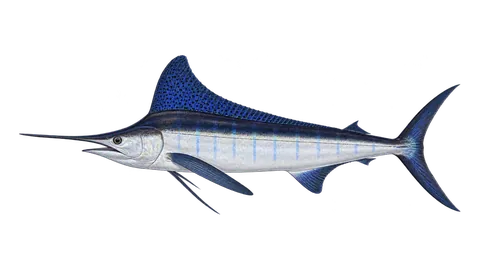
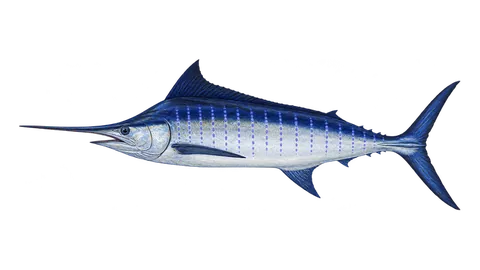
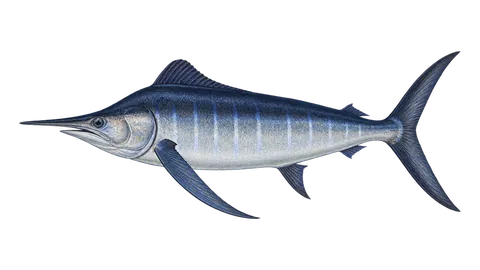
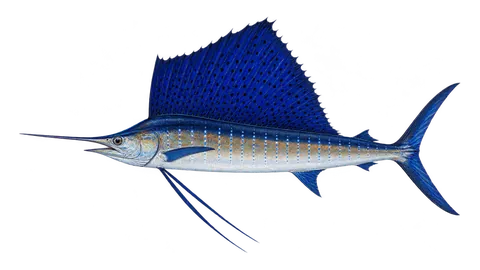
Long, compressed body, medium sturdy bill. The first dorsal fin is tall and pointed, taller than the body depth. Flanks with about 15 to 20 vertical cobalt-blue bars, clearly visible. Flexible pectoral fins that fold against the body. The black marlin has rigid pectoral fins and a low dorsal fin; the blue marlin has a lower dorsal fin and faint stripes.
how striped marlin fishing looks
Loading the next 7 days…
Each card shows the day's index (0 to 100) and, below it, a strip with the index for each hour, from 0h to 23h. from poor to excellent.