

sailfish
Istiophorus platypterus
Brazil's most accessible billfish. In summer it comes close to islands and reefs, jumps a lot, and is the gateway to offshore fishing.
- common size
- 170–240 cm
- maximum
- 315 cm
- common weight
- 15–30 kg
- record/max.
- 64.0 kg
- depth
- 0–50 m
- ideal water
- 24–28 °C
how to recognize it
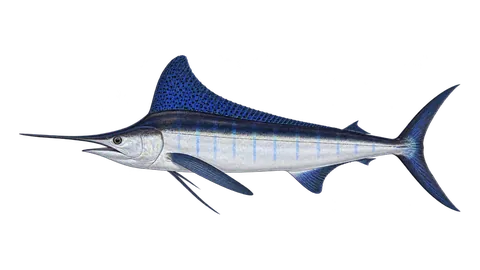
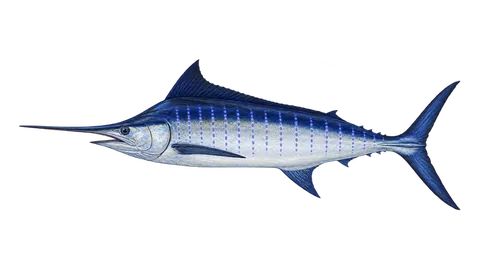
Sail-shaped dorsal fin, blue with black spots, taller than the body and extended over almost the whole back. Very long, thin pelvic fins reaching close to the anus. Slender body with rows of pale blue dots. The white marlin has a rounded dorsal that drops off soon after and short pelvic fins. The blue marlin is much more robust, with a pointed, low dorsal.
Also called: agulhão-bandeira, vela, sailfish
don't confuse with:
where found
open on the large mapWhere to look: Warm, blue waters of the outer shelf and slope, but it comes in near islands and reefs when there are sardine schools. It stays in the 0 to 50 m layer.
From the Northeast to Santa Catarina, most sought after in the Southeast. Ilhabela-SP is the benchmark, with grounds around the Búzios and Vitória islands and the channel reefs. Also Santos/Guarujá and Ubatuba-SP, Cagarras Islands and Cabo Frio-RJ, Guarapari and Vitória-ES. In the Northeast it appears off Natal-RN, Recife-PE, and Salvador-BA.
coast
states
Ceará, Rio Grande do Norte, Paraíba, Pernambuco, Alagoas, Sergipe, Bahia, Espírito Santo, Rio de Janeiro, São Paulo, Paraná, Santa Catarina
when to fish
next 7 days
Loading the next 7 days…
best season
In the Southeast, December to March, peaking in January and February, when the water passes 24 °C near the islands. In the Northeast it is spread more evenly through the year.
best time of day
Daytime. Diurnal. The best strikes usually come in the morning and return in mid-afternoon. With a sardine school at the surface, it strikes at any hour of the day.
what affects the sailfish
cold and cold fronts
Water below 22 °C pushes the sailfish away from shore. An incursion of cold water (upwelling) at Cabo Frio or on the north coast of SP shuts down fishing right away.
atmospheric pressure
After a cold front the sea gets murky and cold; wait for it to settle and the blue water to return.
moon
Small effect. What matters is the presence of sardines.
rain
Light rain doesn't bother. Thunderstorm with lightning: head back.
water level
Not applicable at sea. The equivalent is the color and clarity of the water: look for blue, clean water and current lines.
noise
Near the islands, a loud motor and maneuvering over the school scare off bait and fish. Approach slowly.
wind
Moderate wind helps hide the line. Strong southerly wind churns the sea and cools the water.
tide
Near the islands, tidal current concentrating bait at the points and reefs helps.
depth
Surface down to 50 m. Fish over 20 to 100 m of bottom, at island points, reefs, and the shelf edge.
how to fish
lures
- small silicone squid
- 6 to 8 inch skirts
- lipped trolling plugs
- chain squid teasers
natural baits
- live sardine
- live mackerel or xixarro
- rigged agulhinha
- whole squid
tip from an angler
Slow trolling with live bait at 2-4 knots near islands and sardine patches. When you see the bill strike, open the reel, count to five, and set the drag without a jerk: the circle hook sets in the corner of the mouth.
- rod
- 15 to 30 lb, 6'6" to 7'0", moderate action
- spinning / baitcasting reel
- 20 to 30 lb trolling baitcaster or 6000 to 8000 spinning reel with smooth drag
- line
- 20 to 30 lb monofilament or 30 to 40 lb braided with monofilament topshot
- leader
- fluorocarbon 60 to 80 lb, 2 to 3 m
- hook
- 6/0 to 7/0 circle hook, preferably with the barb crimped
accessories
- balloon or float for live bait
- luvas
- desanzolador
catch and release
Don't take it out of the water. Hold it by the bill with a glove, keep the boat moving slowly, and revive it until it swims off on its own. The sail and pelvic fins are fragile: don't lift the fish by them. Release is the standard practice of operators and tournaments.
kits and guides
rules for the sailfish
Rules change; before keeping or transporting fish, check with the state environmental agency.
Cutting the dorsal and anal fins aboard is prohibited
confirm with the agency details
The first dorsal and first anal fins of billfish, including the sailfish, may not be cut aboard; cutting is only permitted after landing. Text confirmed in a legislation database; confirm it is in force with the MPA.
ICCAT: reducing sailfish mortality
details
ICCAT requires countries to limit sailfish mortality through measures such as releasing live fish, using circle hooks, and minimum sizes. We have not found a federal rule requiring release in recreational fishing; confirm with the Ministry of Fisheries and Aquaculture.
Conservation: No national ban on localized catch. IN SEAP 12/2005 prohibits only the sale of blue and white marlins. IUCN global: VU · vulnerable.
how much it weighs without taking it out of the water
estimated weight
—
how we calculate
Length-weight relationship W = a·Lb (a = 0.000915134, b = 3.14; FishBase (estimativa bayesiana, comprimento total); coeficiente a ajustado ao porte máximo registrado). It's an average: a fat or lean fish can vary by 10% to 20%.
more about the sailfish
The sailfish, or agulhão-bandeira, is the fastest and most coastal of the billfish. It uses its huge dorsal fin to corral schools of sardines and squid and its bill to stun prey. In the Atlantic it rarely exceeds 40 kg, but it fights with repeated jumps and long runs. In summer it approaches the islands and reefs off the São Paulo and Rio coasts, a few miles offshore, which makes it possible to fish it from medium boats with light tackle. Ilhabela is the national benchmark. Fishing is recreational and catch and release: the fish suffers greatly when handled, and the species is considered vulnerable by the IUCN.
Family: Istiophoridae · predator
fun facts
- Hunts in groups: several sailfish surround the school with their sails open and take turns attacking.
- It changes color in seconds: the blue stripes light up while hunting.
- It is among the fastest fish in the sea over short bursts.
in the kitchen
Reddish, firm flesh, good smoked. As the species is vulnerable and release is the rule in sport fishing, let it go.
similar species
sources and references (6)
The season weights (months), the time of day and the sensitivities (cold, pressure, moon, wind, rain, tide, strong light, murky water and noise) are the app's editorial estimates, based on the literature below and on the field experience of anglers and guides. They are not official data nor a measurement made for this species, and they may vary by region and year. Closed seasons and legal rules appear in the rules section, with the norm and a link.
- scientific FishBase — Istiophorus platypterus (ficha da espécie)Names, distribution, biology, length-weight relationship and references. Page checked on October 13, 2026.
- official Portaria GM/MMA nº 1.667, de 27 de abril de 2026 — Lista Nacional Oficial de Espécies da Fauna Ameaçadas de Extinção (peixes e invertebrados aquáticos)Most recent national list. The species is not on it (search by scientific name in the text published in the DOU, checked on October 13, 2026).
- official ICMBio/SALVE — Ficha de Istiophorus platypterus (avaliação nacional do risco de extinção)ICMBio national assessment, published in 2026. DOI checked on Crossref.
- scientific IUCN Red List — Istiophorus platypterus (avaliação global: Vulnerável, VU, 01/05/2021)Global assessment. Link given on the FishBase entry (Red List, version 2025-2).
- scientific Nakamura, I. (1985). FAO species catalogue. Vol. 5. Billfishes of the world. FAO Fisheries Synopsis 125(5). Roma: FAO.
- technical ICCAT Manual, cap. 2.1.8.1 — Sailfish (Istiophorus platypterus). International Commission for the Conservation of Atlantic Tunas.Biology and fishery of the species in the Atlantic.