Skip to content
fishing forecast

yellow sea chub

Kyphosus incisor · Kyphosidae · omnivore

Sea

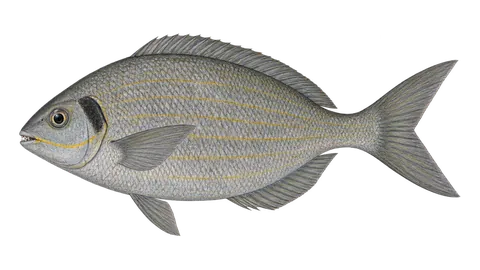
A relative of the pirajica, grey with brass-coloured stripes, of rocky shores and shallow reefs. It eats algae and sargassum, is strong and wary, and calls for light line.

Also called: pijirica, piranjica, salema-preta, salema-do-alto, yellow chub

Scientific illustration of Yellow sea chub
common size
35–55 cm
maximum
90 cm
common weight
0.7–2.9 kg
record/max.
3.9 kg
depth
1–15 m
ideal water
21–27 °C
location

Sample location: choose yours to see the forecast for where you fish.

period

Reading the weather across 3 global models and 31 simulations…

the species

everything about the yellow sea chub

overview

who is the yellow sea chub

The pijirica (yellow chub) is a Kyphosus, a herbivorous fish of rocky shores and shallow Atlantic reefs (the "chopas" of Spanish-speaking countries): in the west, from Cape Cod to Brazil, and also in Argentina; in the east, in Madeira, Cape Verde, Angola and São Tomé. It lives from 1 to 15 m, over reef rocks, and also among drifting sargassum beds. It eats algae, a lot of sargassum. FishBase lists it as a minor commercial and sport fish; the common length is 45 cm and the maximum 90 cm, with a published weight of up to 3.9 kg. The species has not yet been assessed by the IUCN.

fun facts

  • The incisor teeth, shaped like hockey sticks, form a ridged plate for scraping algae.
  • It also appears among drifting sargassum beds, where it eats sargassum.
  • In the eastern Atlantic it appears in Madeira, Cape Verde, São Tomé and Angola.
how to recognize it

identification

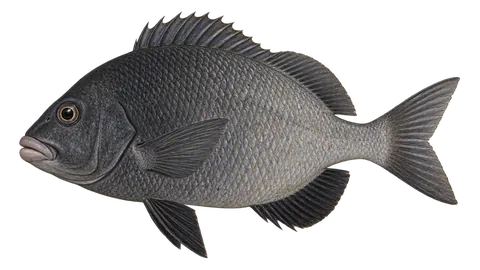
Grey with longitudinal brass-coloured stripes on the body and two horizontal brass-coloured stripes on the head; gill-cover membrane lightly pigmented. Each jaw has a regular row of strong incisor teeth, rounded at the tip and shaped like hockey sticks, which form a ridged plate inside the mouth. Dorsal fin with 11 spines and 13 to 15 soft rays; anal fin with 3 spines and 12 to 13 rays. It is separated from the pirajica (Kyphosus sectatrix) by the brass-coloured stripes and the lightly pigmented gill-cover membrane (the pirajica's is darkened on top); in Brazil it may appear as Kyphosus vaigiensis.

distribution

where found

open on the large map

On rocky shores, shallow reefs and islands, from Maranhão to Rio Grande do Sul, according to collection records, with more specimens from São Paulo, Rio de Janeiro and Santa Catarina. Outside Brazil, from Massachusetts to Argentina and Uruguay in the west, and Madeira, Cape Verde, São Tomé and Angola in the eastern Atlantic.

Habitat: Rocky shores and reef rock bottoms, from 1 to 15 m, and drifting sargassum beds.

coast

North CoastNortheast CoastSoutheast CoastSouth Coastcoastal

states

Maranhão, Bahia, Espírito Santo, Rio de Janeiro, São Paulo, Paraná, Santa Catarina, Rio Grande do Sul

calendar and clock

when to fish

best season

time of yearbest: Dec–Mar
JanFebSeaAprMayJunJulAugSepOctNovDec

Fished year-round on the Northeast coasts; in the Southeast and South it does better in the warm water of summer and autumn.

best time of day

0h6h12h18h sunrise ~6amsunset ~6pm

Daytime. Feeds on algae by day, most active with the flooding tide and choppy water on the rocky shore.

weather, water and behavior

what affects the yellow sea chub
sensitivity The little bars show how much each factor affects this species. Five full: it feels it a lot.

cold and cold fronts

Cold water from a front or upwelling pushes the school away from the shallow rocky shore.

atmospheric pressure

Rough sea after the front stops fishing; when it calms down, the foam helps.

moon

Big-moon tides cover more rock and algae, and the school rises to feed.

rain

Little effect; a storm on the rocky shore is a danger.

water level

Heavy surf makes the rocky shore dangerous.

noise

Very wary: shadow and noise on the rock make the school disappear.

wind

Moderate swell and surf help hide the line.

tide

The flooding tide covers the algae on the rocks and brings the school close.

depth

Usually down to 10 m, in the foam zone and over the rock slabs.

technique, gear and bait

how to fish

rod
shore: 9' to 12', 10 to 25 lb, sensitive tip
spinning / baitcasting reel
spinning reel 3000 to 5000 with a light drag
line
monofilament 0.30 to 0.40 mm or braided 15 to 25 lb
leader
fluorocarbon 0.35 to 0.45 mm, 1 m
hook
small, strong hook, 1 to 2/0

natural baits

  • green algae from the rocky shore itself
  • sargassum
  • shrimp
  • marisco

accessories

  • small float or very light sinker
  • long-handled landing net

tip from an angler

Use the seaweed from the same rocky shore as bait, with a small float in the foam: the pijirica drops the bait if it feels weight.

what the law says

rules for the yellow sea chub

Summary of the regulations we found, with the source for each. Rules change; before keeping or transporting fish, check with the state environmental agency.
Conservation: Species not assessed by the IUCN. Not on the Brazilian national list (Portaria GM/MMA nº 1.667/2026). We found no specific Brazilian federal rule for the species.

Mexico: up to 10 marine fish per angler per day, no more than 5 of the same species

10 marine specimens per angler per day; no more than 5 of the same species

In Mexico's federal waters, sport and recreational fishing for marine species has a limit of 10 specimens per angler per day, with no more than 5 of any one species. Fish over the limit may only be taken if released alive. Sport-caught fish belong to the permit holder and may not be sold; fish may not be landed as fillets (they may only be filleted on board for consumption during the trip). For spearfishing the limit is 5 fish per day. Fishing from a boat requires a permit.
Source: Amendment to NOM-017-PESC-1994 (recreational sport fishing in federal waters of Mexico), signed Oct 14, 2013 and published in the DOF on Nov 25, 2013, items 4.9.1, 4.9.4, 4.9.5, 4.11 and 4.12 (Sagarpa/Conapesca)

catch and release
catch and release Releasing the fish alive, quickly and with a wet hand. During a closed season it isn't always allowed: what the regulation says applies.

Remove the hook quickly and return it to the surf, head first in the water; avoid resting the fish on hot rock.

in the kitchen

Edible, sold fresh on a small scale. Clean it and chill it right after catching.

calculator

how much it weighs without taking it out of the water

Length-weight relationship W = a·Lb (a = 0.01585, b = 3.02; FishBase (relação peso-comprimento bayesiana, estimativa da própria espécie)). It's an average: a fat or lean fish can vary by 10% to 20%.

estimated weight

—

sources and references

The season weights (months), the time of day and the sensitivities (cold, pressure, moon, wind, rain, tide, strong light, murky water and noise) are the app's editorial estimates, based on the literature below and on the field experience of anglers and guides. They are not official data nor a measurement made for this species, and they may vary by region and year. Closed seasons and legal rules appear in the rules section, with the norm and a link.

  1. scientific FishBase: Kyphosus incisor (ficha da espécie)Size, length-weight, depth, habitat, distribution, biology and IUCN status. Page checked on October 13, 2026. The common weight was calculated from the length-weight relationship. FishBase gives the maximum length as 90 cm standard length and the maximum weight as 3.9 kg, values that do not match each other: the entry keeps FishBase's numbers.
  2. scientific FishBase: nomes populares de Kyphosus incisorNames by country and language. FishBase lists 'pijirica', 'piranjica', 'salema-do-alto' and 'salema-preta' as Portuguese names; this entry uses 'pijirica' so as not to repeat the name of the pirajica (Kyphosus sectatrix) entry.
  3. official Portaria GM/MMA nº 1.667, de 27 de abril de 2026: Lista Nacional Oficial de Espécies da Fauna Ameaçadas de Extinção (peixes e invertebrados aquáticos)The species is not on the list. Checked in the DOU of April 28, 2026.
  4. scientific GBIF: registros de Kyphosus incisor no BrasilChecked on October 13, 2026 in the open GBIF database (country = Brazil). The records come from collections and observations and show where the species has been seen, not how abundant it is. There are collection records from Maranhão, Bahia, Espírito Santo, Rio de Janeiro, São Paulo, Paraná, Santa Catarina and Rio Grande do Sul.
  5. scientific Carpenter, K. E. (org.) (2002). The living marine resources of the Western Central Atlantic. Vol. 3: Bony fishes part 2 (Opistognathidae to Molidae). FAO Species Identification Guide for Fishery Purposes. Roma: FAO.Reference identification guide for the western Atlantic (Kyphosidae chapter).
  6. official ICMBio/SALVE: Ficha de Kyphosus vaigiensis (avaliação nacional do risco de extinção)DOI checked in Crossref. ICMBio's Brazilian lists have an entry for K. vaigiensis and we found none for K. incisor, which suggests that in Brazil the golden-striped fish may appear under the name K. vaigiensis; this entry follows FishBase, which uses K. incisor for the Atlantic. The content of the ICMBio entry was not read.
  7. official Modificação da NOM-017-PESC-1994, para regular a pesca deportivo-recreativa nas águas de jurisdição federal do México (DOF, 25/11/2013)Text read in the DOF: items 4.2 to 4.12 (quotas, underwater fishing, sales and fillets).
don't confuse

similar species