Skip to content
fishing forecast

white piranha

Serrasalmus brandtii · Serrasalmidae · predator

Freshwater

Small piranha endemic to the São Francisco, with cutting teeth. It lives in lagoons and reservoirs, eats fish and fin pieces, and steals bait.

Also called: pirambeba, piranha

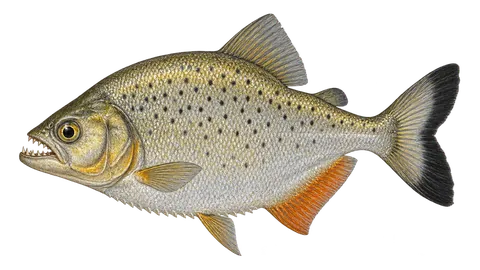
Scientific illustration of White piranha
common size
14–22 cm
maximum
29 cm
common weight
0.1–0.3 kg
record/max.
1.0 kg
depth
0.3–5 m
ideal water
24–30 °C
location

Sample location: choose yours to see the forecast for where you fish.

period

Reading the weather across 3 global models and 31 simulations…

the species

everything about the white piranha

overview

who is the white piranha

Native only to the São Francisco basin, common in marginal lagoons and reservoirs, still-water habitats. Diet changes with size: in the Cajuru reservoir, in Minas Gerais, juveniles ate microcrustaceans and insect larvae, intermediate fish ate insects, fins, scales and pieces of fish flesh, and the largest mostly ate fish. FishBase records up to 29.1 cm and 978 g, and IUCN lists it as Least Concern (2018). It lives in schools and attacks opportunistically. For the angler, it is the bait thief of anyone fishing the bottom. The river's bigger piranha, Pygocentrus piraya, has its own card.

fun facts

  • Diet changes with age: juveniles eat microcrustaceans and large ones eat fish (Oliveira et al., 2004).
  • In the Pantanal and Paraná, pirambeba is the name of another fish (Serrasalmus marginatus); in the São Francisco it is this one.
how to recognize it

identification

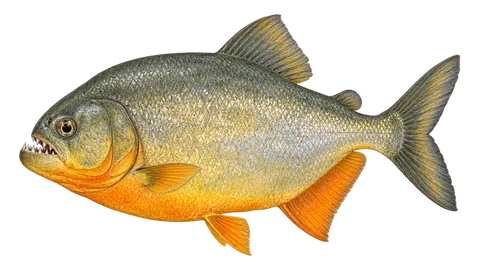
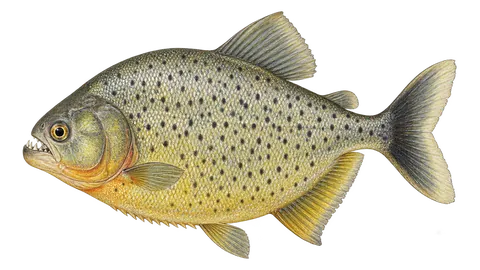
Small piranha with a disc-shaped, flattened, silvery body (hence 'white piranha' in English), pointed snout, projecting lower jaw and triangular cutting teeth, with a serrated keel on the belly. It is smaller and flatter than the São Francisco piranha (Pygocentrus piraya), which has a yellow-orange belly and a short, blunt snout. The pirambeba-do-pantanal (Serrasalmus marginatus) comes from other basins and has a wide dark border on the tail.

distribution

where found

open on the large map

Endemic to the São Francisco basin. There are diet studies in reservoirs such as Cajuru (Pará River, MG) and in marginal lagoons of the São Francisco River.

Habitat: Marginal lagoons, eddies, bays and reservoirs, near vegetation and submerged timber.

native to the basins

São Francisco

states

Minas Gerais, Bahia, Pernambuco, Alagoas, Sergipe

calendar and clock

when to fish

best season

time of yearbest: Oct–Feb
JanFebSeaAprMayJunJulAugSepOctNovDec

Most active in the warm months, from September to March; at the height of cold it becomes slower.

best time of day

0h6h12h18h sunrise ~6amsunset ~6pm

Daytime. Feeds by day, with more attacks early and late in the afternoon (estimate based on the genus's piranhas).

weather, water and behavior

what affects the white piranha
sensitivity The little bars show how much each factor affects this species. Five full: it feels it a lot.

cold and cold fronts

Cold water makes the school sluggish.

atmospheric pressure

Little effect.

moon

Little effect.

rain

Little effect.

water level

Low water concentrates the schools in lagoons and bays.

noise

Not very sensitive.

wind

Little effect.

depth

Mid-water and along the bank, 0.5 to 4 m.

technique, gear and bait

how to fish

rod
cane pole or 5'6" to 6' rod, 8 to 15 lb
spinning / baitcasting reel
spinning reel 1000 to 2500
line
monofilament 0.25 to 0.30 mm
leader
fine steel leader 15 cm or fluorocarbon 30 lb
hook
No. 2 to 1/0, long shank

natural baits

  • piece of fish
  • beef heart
  • minhoca

accessories

  • long-nose pliers
  • cloth to grip

tip from an angler

Long-shank hook and leader: the teeth cut nylon. It nibbles and tears the bait apart; set the hook fast.

what the law says

rules for the white piranha

Summary of the regulations we found, with the source for each. Rules change; before keeping or transporting fish, check with the state environmental agency.
Conservation: Not on the Brazilian national list (Ministerial Ordinance GM/MMA No. 1.667/2026).

We found no species-specific rule beyond the region's general rules.

piracema closures in the basins where the species lives

Closed season in Goiás (state rule)

01/11 to 28/02GO

Allowed: Sport and guided fishing only in reservoirs, catch and release with barbless hooks (no keeping, transporting or eating). Subsistence: up to 5 kg per day, for household consumption only.

Source: IN Semad-GO nº 17/2026, arts. 8º to 11

Spawning closure (piracema) in the São Francisco River basin (rivers and reservoirs)

01/11 to 28/02MGBAPEALSEGODF

Allowed: Recreational fishing from a boat or from shore with handline, rod, spinning or baitcasting reel, up to 5 kg + 1 fish. Prohibited within 1,000 m of dams, waterfalls and rapids, and within 500 m of confluences. Floodplain lakes have a longer closed season (see next item).

Source: Portaria IBAMA nº 50/2007

São Francisco: floodplain lakes

01/11 to 30/04MGBAPEALSEGODF

Allowed: No fishing in the floodplain lakes during the period.

Source: Portaria IBAMA nº 50/2007

catch and release
catch and release Releasing the fish alive, quickly and with a wet hand. During a closed season it isn't always allowed: what the regulation says applies.

Long-nose pliers, and no hands near the mouth. Hold it with a damp cloth and release it quickly.

in the kitchen

Fried or in broth, like other piranhas; the meat has many bones.

calculator

how much it weighs without taking it out of the water

Length-weight relationship W = a·Lb (a = 0.01778, b = 3.16; FishBase (relação peso-comprimento bayesiana, estimativa da própria espécie)). It's an average: a fat or lean fish can vary by 10% to 20%.

estimated weight

—

sources and references

The season weights (months), the time of day and the sensitivities (cold, pressure, moon, wind, rain, tide, strong light, murky water and noise) are the app's editorial estimates, based on the literature below and on the field experience of anglers and guides. They are not official data nor a measurement made for this species, and they may vary by region and year. Closed seasons and legal rules appear in the rules section, with the norm and a link.

  1. scientific FishBase: Serrasalmus brandtii (ficha da espécie)Size, length-weight relationship, depth, habitat, distribution, biology and IUCN status. Page checked on October 13, 2026. The maximum weight of 978 g is the one published in FishBase; the common sizes and weights on this card are editorial estimates, calculated from the length-weight relationship.
  2. scientific FishBase: nomes populares de Serrasalmus brandtiiNames by country and language.
  3. official Portaria GM/MMA nº 1.667, de 27 de abril de 2026: Lista Nacional Oficial de Espécies da Fauna Ameaçadas de Extinção (peixes e invertebrados aquáticos)The species is not on the list. Checked in the DOU of April 28, 2026.
  4. scientific IUCN Red List: Serrasalmus brandtii (avaliação global: Pouco Preocupante, LC, 07/11/2018)Global assessment. Link given on the FishBase entry (Red List, version 2025-2).
  5. scientific Oliveira, E. F.; Alvim, M. C. C.; Peret, A. C.; Alves, C. B. M. (2004). Diet shifts related to body size of the pirambeba Serrasalmus brandtii Lütken, 1875 (Osteichthyes, Serrasalminae) in the Cajuru Reservoir, São Francisco River Basin, Brazil. Brazilian Journal of Biology 64(1): 117-124.Diet change with size (microcrustaceans and larvae, then fins, scales and fish flesh, and finally fish). Abstract checked on Crossref on October 13, 2026.
  6. scientific Pompeu, P. S. (1999). Dieta da pirambeba Serrasalmus brandtii Reinhardt (Teleostei, Characidae) em quatro lagoas marginais do rio São Francisco, Brasil. Revista Brasileira de Zoologia 16 (supl. 2): 19-26.Diet study in marginal lagoons of the São Francisco. Title and reference checked on Crossref; the abstract was not read.
  7. technical Wikipédia (pt): Serrasalmus brandtiiSchooling habit and presence in still-water habitats and reservoirs. Open encyclopedia; page checked on October 13, 2026.
don't confuse

similar species