


the right time
to be on the water
Choose the place and the species. The index, from 0 to 100, combines weather, sun, moon and tide with each fish's habits. Up to 28 days, with each day's confidence.
Loading the forecast…
—
hour by hour
slide your finger or mouse over the chart to see each hoursee hour-by-hour table
why this index at —?
choose the day
the fishing month at a glance
what's the best window for the crew?
Choose how many fishing days. We compare each stretch by its average index, discount days with a warning or closed season, and show the 3 best.
trend for the coming weeks
Line: the middle value of 31 simulations of the American GEFS model. Band: where 8 out of 10 fall. Narrow, firm trend; wide, high uncertainty.
everything about the vampire tetra
how to recognize it
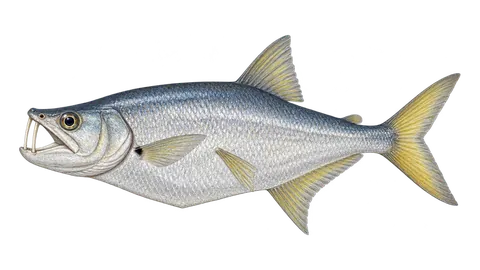
Elongated, compressed, silvery body with a large upturned mouth and two huge fangs on the lower jaw, which fit into holes in the snout when the mouth closes. Told apart from the payara (H. armatus) by its smaller size, the black spot at the base of the inner pectoral rays and a pelvic fin set higher on the flank. The chafalote (cachorra-facão) is much slimmer and longer, and the peixe-cachorro (Acestrorhynchus) lacks the fangs that cross the snout.
Also called: pirandirá, cachorra, peixe-cachorro, saranha-do-rabo-amarelo
don't confuse with:
where found
open on the large mapWhere to look: Channels of large rivers and tributaries, with white and black water, in stretches with current; rocky areas, current breaks and lake mouths. Juveniles stay in smaller tributaries and flooded forest.
Central and upper Amazonia: the Solimões-Amazonas channel and large tributaries such as the Madeira (with Guaporé and Mamoré), Purus and Tapajós, plus rivers of Peru, Bolivia and Ecuador. The Tapajós seems to be the downstream limit in Brazil.
native to the basins
states
Amazonas, Pará, Acre, Rondônia, Mato Grosso
when to fish
best season
Low water and dry season (July to November): low river and fish concentrated in the channel and at lake mouths. In the flood it moves upriver to spawn and spreads out.
best time of day
Daytime, with peaks at dawn and dusk. Hunts by day, most active early and late in the afternoon, when it patrols the current breaks.
what affects the vampire tetra
cold and cold fronts
Cold snaps (friagem) shut down activity for a few days.
atmospheric pressure
Stable weather helps; a storm shuts fishing down for a few hours.
moon
Small effect.
rain
Rain at the start of the flood muddies the water and scatters the fish.
water level
Falling river: the best scenario, with fish on the channel's current breaks.
noise
Moderate: approach rocks and rapids slowly.
wind
Little effect in the channel; strong wind makes casting difficult.
depth
Midwater, 1 to 5 m, along the current line.
how to fish
lures
- spoon, 10 to 20 g
- feather or hair jig, 1/4 oz
- minnow and jerkbait, 7 to 10 cm
- spinner #3 to 4
natural baits
- live lambari
- fish fillet
tip from an angler
Hard mouth: set the hook firmly and keep the line tight during jumps, or the lure will come loose.
- rod
- 6' to 6'6", medium-fast action, 10 to 20 lb
- spinning / baitcasting reel
- spinning reel 2500 to 3000 or low-profile baitcasting reel 100
- line
- braid 20 to 30 lb
- leader
- fluorocarbon 40 to 50 lb or a 20 cm steel leader: the fangs cut thin line
- hook
- small treble hooks 2 to 1/0 on artificials; hook 1/0 to 3/0 for natural bait; the mouth is hard and bony
accessories
- long-nose pliers
- boga-grip
catch and release
Use pliers and a gaff, away from the fangs. Remove the hook quickly, with the fish in or near the water, and release it in the current.
rules for the vampire tetra
Rules change; before keeping or transporting fish, check with the state environmental agency.
MT (Mato Grosso): the payara size can be enforced
60 cm (law cites only Hydrolycus armatus)MTconfirm with the agency details
Annex II of Mato Grosso's fishing law sets 60 cm for the payara in the Amazon and Araguaia-Tocantins basins, but cites only Hydrolycus armatus. The pirandirá rarely exceeds 40 cm and, if enforcement does not separate the species, it would always be below the size. When in doubt, release.
Source: Lei estadual MT nº 9.096/2009, Annex II (as amended by Lei nº 9.895/2013) - Sema-MT
piracema and closed seasons
Each bar is the period when fishing is prohibited or restricted. The green line is today. Tap the name to see what is still allowed.
Spawning closure (piracema) in Mato Grosso (all basins)
Allowed: All fishing modalities are prohibited in rivers, including catch and release (Law 9.096/2009, art. 19-A). Exceptions: subsistence fishing from shore (3 kg or 1 fish, no transport or sale) and scientific fishing. Law 13.159/2025 now allows licensed sport fishing in UHE/PCH hydropower reservoirs, natural lakes and border rivers, subject to a scientific study and a license from the environmental agency. We have not confirmed whether these licenses are already being issued.
Closed season in the rivers of Marajó Island (PA)
Allowed: The same recreational-angler exceptions as in Portaria 48/2007 apply (handline or rod, 5 kg + 1 fish), unless a stricter state rule applies.
Source: Portaria IBAMA nº 48/2007
Closed season in the Amazon basin in Amapá
Allowed: Recreational anglers with handline or rod, line and hook are outside the Annex II prohibitions, with a bag limit of 5 kg + 1 fish, unless a stricter state rule applies.
Source: Portaria IBAMA nº 48/2007
Closed season in Roraima
Border rivers MT/RO and MT/PA
Allowed: See the exceptions in Portaria 48/2007 and the state rules for each bank.
Source: Portaria IBAMA nº 48/2007
Conservation: Not on the national list of threatened species (Portaria GM/MMA nº 1.667/2026).
how much it weighs without taking it out of the water
estimated weight
—
how we calculate
Length-weight relationship W = a·Lb (a = 0.00661, b = 3.2; FishBase). It's an average: a fat or lean fish can vary by 10% to 20%.
more about the vampire tetra
The peixe-cachorro of the family Cynodontidae, a close relative of the payara (Hydrolycus armatus), but much smaller: FishBase and the genus revision indicate fish up to about 40 cm. It lives in central and upper Amazonia, in Brazil, Bolivia, Peru and Ecuador, and in Brazil the Tapajós River seems to mark the downstream limit. Adults prefer the channels of large rivers and tributaries, with white or black water, in stretches with current, where they hunt smaller fish with their long fangs. They spawn between November and April, after moving upriver. It shows up in peacock bass and payara fishing with spoons, jigs and midwater lures, and it fights with jumps. The names payara and pirandirá apply to both species, which confuses size and rule records.
Family: Cynodontidae · predator
fun facts
- The two jaw fangs fit into holes in the snout when the mouth closes.
- FishBase has an IGFA record of 117 cm and 17.8 kg under this scientific name, far above the species' known size; the identification of that fish is doubtful.
in the kitchen
White flesh full of bones, not highly valued in the market.
similar species
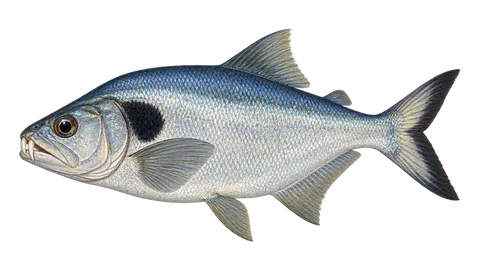
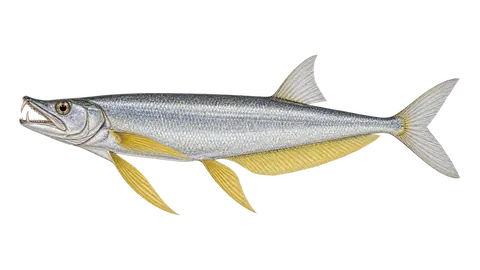
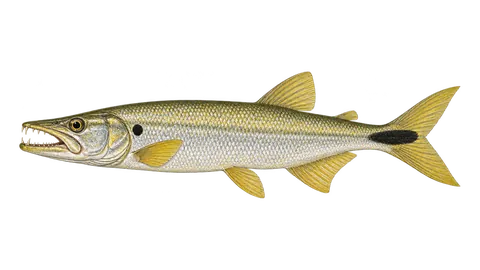
sources and references (5)
The season weights (months), the time of day and the sensitivities (cold, pressure, moon, wind, rain, tide, strong light, murky water and noise) are the app's editorial estimates, based on the literature below and on the field experience of anglers and guides. They are not official data nor a measurement made for this species, and they may vary by region and year. Closed seasons and legal rules appear in the rules section, with the norm and a link.
- scientific FishBase — Hydrolycus scomberoides (ficha da espécie)Names, distribution, biology, length-weight relationship and country list. The entry cites a maximum length of 117 cm and 17.8 kg from the IGFA records base (2001) and, in the biology section, about 40 cm; we adopted the second value. The maximum weight in the app's entry was estimated from the length-weight relationship. The country list marks Colombia as a misidentification and Venezuela as doubtful. Page checked on 13/10/2026.
- scientific IUCN Red List — Hydrolycus scomberoides (avaliação global: Pouco Preocupante, LC, 14/07/2020)Global assessment. Link given on the FishBase entry (Red List, version 2025-2).
- official Portaria GM/MMA nº 1.667, de 27 de abril de 2026 — Lista Nacional Oficial de Espécies da Fauna Ameaçadas de Extinção (peixes e invertebrados aquáticos)The species is not on the list (checked against the text published in the DOU of 28/04/2026, section 1, p. 96).
- technical Seriously Fish — Hydrolycus scomberoidesSummary of distribution, habitat, spawning season and the characters separating the species from other payaras, based on the revision by Toledo-Piza, Menezes and Santos (1999). Page checked on 13/10/2026.
- official Lei estadual MT nº 9.096/2009 (consolidada) — Política da Pesca de Mato Grosso, Anexo IITable of measurements for the Amazon and Araguaia-Tocantins basins. Page checked on 13/10/2026.
how we calculatewhere each number comes from
The weather comes from three independent global models, cross-checked hour by hour: when they agree, confidence goes up; when they diverge, the band between them shows on the chart. Beyond 16 days, we use the GEFS ensemble of 31 simulations: if 20 of the 31 predict rain, the chance of rain is 65%. Sun and moon are calculated astronomically, with no uncertainty.
The index adds up, weighted for each species: time of day (species curve anchored to real sunrise and sunset), moon (transits, rise and set, phase), pressure (3 h trend and 24 h swing), water temperature (in rivers, estimated from air temperature; at sea, estimated by an ocean model), wind, rain, clouds, tide and the month in the species' cycle.
sources for this lookup
how accurate the forecast is
Accuracy measured in the reference project (4 regions, 93 days, forecast vs. observed): maximum temperature is off by 0.6 °C on average the next day and 1.7 °C at 7 days; rain of 5 mm or more is detected 76% of the time the next day and 57% at 7 days. Detection isn't everything: the false alarm rate isn't published here yet, and 93 days in 4 regions is still a small sample. We now also measure every day, at the app's destinations: