Skip to content
fishing forecast

roughtail stingray

Bathytoshia centroura · Dasyatidae · predator

EstuarySeanational list: CR · critically endangered

Large whiptail stingray of the western Atlantic, with a spiny tail. Critically Endangered in Brazil, with catch banned: if you hook one, release it carefully and away from the stinger.

Also called: raia-prego (nome usado na lista oficial divulgada pela Fiperj), raia-de-cauda-áspera, raia-chicote

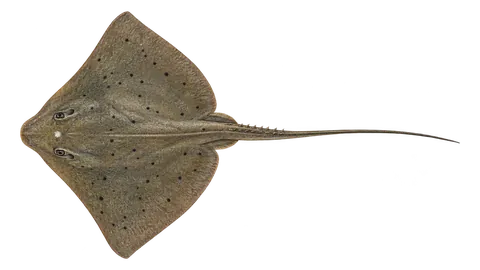
Scientific illustration of Roughtail stingray
common size
—
maximum
300 cm
common weight
—
record/max.
300.0 kg
depth
15–50 m
ideal water
16–24 °C
location

Sample location: choose yours to see the forecast for where you fish.

period

Reading the weather across 3 global models and 31 simulations…

the species

everything about the roughtail stingray

overview

who is the roughtail stingray

The roughtail stingray is one of the largest whiptail rays (family Dasyatidae) in the western Atlantic. It lives on sand and mud bottoms of the shelf, usually between 15 and 50 m, but has been recorded from 3 to 270 m, and visits the coast in the warm season, according to FishBase. It eats bottom invertebrates and fish. It is ovoviviparous: gestation lasts about 4 months and 2 to 4 pups are born. In the southwestern Atlantic it occurs from Brazil to Argentina; the eastern Atlantic populations, formerly treated as the same species, are now Bathytoshia lata. The national list (Portaria GM/MMA 1.667/2026) classifies it as Critically Endangered, a more serious category than the IUCN global assessment (Vulnerable): catch, transport and sale are banned. It turns up by chance in bottom and beach fishing, and its stinger is venomous.

fun facts

  • The scientific name has changed: it was Dasyatis centroura, became Bathytoshia centroura, and the eastern Atlantic form became a different species, B. lata.
  • FishBase describes it as harmful to mollusk beds, which it exploits as food.
  • In Uruguay it is known as chucho, and in Buenos Aires the name "chucho" also covers rays of the genus Myliobatis.
how to recognize it

identification

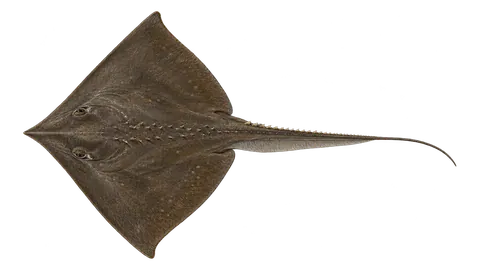
Rhombus-shaped disc, wide, with a short snout, and a long whip-like tail with a stinger. Large adults have "spiny" tails and backs: large, well-spaced tubercles and plates along the middle of the back and at the disc edges; in juveniles these tubercles have not yet formed. According to FishBase, the tail has no skin fold on top (Hypanus say does) and the fold below is much narrower than that of the Caribbean stingray. FishBase gives 300 cm total length as the maximum and 125 cm disc width as the common size: these are different measures, so don't compare them directly.

distribution

where found

open on the large map

In the southwestern Atlantic it ranges from Brazil to Argentina, passing through Uruguay; in Brazil, the most cited records are from the South and Southeast, and distribution along the Brazilian coast is poorly documented in the sources checked. In the northwestern Atlantic it occurs from the northeastern United States to the Gulf of Mexico. The eastern Atlantic populations are Bathytoshia lata.

Habitat: Sand and mud bottoms of the shelf, 3 to 270 m and usually between 15 and 50 m; enters brackish water and comes close to shore in the warm season.

coast

Southeast CoastSouth Coastcoastalshelf
calendar and clock

when to fish

best season

time of yearbest: Dec–Feb
JanFebSeaAprMayJunJulAugSepOctNovDec

Estimate: FishBase describes it as a visitor to the coast in the warm season, so in the South and Southeast the chance of finding it near shore is higher from November to March. Catch is banned at any time; this information is for knowing when it may turn up by chance.

best time of day

0h6h12h18h sunrise ~6amsunset ~6pm

Any time. There is no time-of-day study for this species in the sources checked. Like other whiptail rays, it spends part of its time buried in sand (estimate).

weather, water and behavior

what affects the roughtail stingray
sensitivity The little bars show how much each factor affects this species. Five full: it feels it a lot.

cold and cold fronts

Warm-season visitor: it moves away from the coast when the water is cold.

atmospheric pressure

Little known effect.

moon

Little known effect.

rain

Little known effect.

water level

Not applicable at sea.

noise

Not very sensitive; it tends to stay buried or still on the bottom.

wind

Little direct effect; rough seas make it hard to see the ray in shallow areas.

tide

Enters shallow areas on the rising tide to look for food (estimate).

depth

In most records, 15 to 50 m.

technique, gear and bait

how to fish

rod
Catch banned: not applicable.
spinning / baitcasting reel
not applicable
line
not applicable
leader
not applicable
hook
not applicable

accessories

  • long-nose pliers
  • line cutter
  • thick gloves

tip from an angler

If a large ray hooks up while bottom or beach fishing, don't pull it onto dry sand or into the boat. Keep it in the water, away from the stinger, and cut the line close to the mouth if the hook won't come out easily.

what the law says

rules for the roughtail stingray

Summary of the regulations we found, with the source for each. Rules change; before keeping or transporting fish, check with the state environmental agency.
Conservation: Catch banned throughout Brazil. Already on the previous list (Portaria MMA 148/2022) as CR. Global assessment: Vulnerable (IUCN, Jun 21, 2019). According to FishBase, the eastern Atlantic populations belong to Bathytoshia lata.

Threatened species in Brazil: catch banned

full protection

The national list (Portaria GM/MMA nº 1.667/2026) classifies the species as CR. Under Portaria GM/MMA nº 1.666/2026 (art. 3), VU, EN and CR species have full protection: catch, transport, storage, processing and trade are banned. If you hook one by accident, release it right away, with minimal handling.

Source: Portaria GM/MMA nº 1.666/2026, art. 3º, and Portaria GM/MMA nº 1.667/2026

Buenos Aires (AR): rays in the "with reserve" category, up to 2 killed per day

up to 2 specimens per angler per day may be killed; the surplus goes back into the waterconfirm with the agency

In recreational sea fishing on the Buenos Aires province coast, chuchos (Myliobatis), "rayas en general", pez ángel, pez elefante and corvina negra form the "Mixed Fishing With Reserve" subcategory: up to two specimens per angler per day may be killed, counted within the 40-piece limit of mixed fishing, and all surplus must be released right away. The text says "rayas en general" and does not list species. We did not check whether a more recent provision replaces it; confirm with the province's Ministry of Agrarian Development.

Source: Disposición nº 217/2007 (arts. 4º, 9º and 10), Ministry of Agrarian Affairs of the Province of Buenos Aires

catch and release
catch and release Releasing the fish alive, quickly and with a wet hand. During a closed season it isn't always allowed: what the regulation says applies.

This is not catch and release: it is release of an accidental catch. The tail stinger is serrated and venomous; a sting causes intense pain and a deep cut. Don't step on the ray or hold it by the tail. Keep it in the water, out of reach of the tail, remove the hook with long pliers or cut the line close to the mouth. If you are stung: wash the area, immerse it in very hot water (not so hot that it burns) and seek medical care.

in the kitchen

Catch and trade banned in Brazil. FishBase records wings sold fresh, smoked or salted and dried. Don't buy it.

calculator

how much it weighs without taking it out of the water

Length-weight relationship W = a·Lb (a = 0.00447, b = 3.12; FishBase (relação peso-comprimento bayesiana, estimativa)). It's an average: a fat or lean fish can vary by 10% to 20%.

estimated weight

—

sources and references

The season factors (months), the time of day, and the sensitivities (cold, pressure, moon, wind, rain, tide, strong light, murky water, and noise) are editorial estimates by the app, based on the literature cited below and on field experience of anglers and guides. They are not official data or measurements made for this species and may vary by region and year. Closed seasons and legal rules appear in the rules section, with the standard and link. The months indicate when the species is usually found near the coast or at the fishing spot, not a catch season. The water temperature range is also an editorial estimate, supported by FishBase values where they exist.

  1. scientific FishBase: Bathytoshia centroura (ficha da espécie)Size, length-weight relationship, depth, habitat, distribution, biology and IUCN status. Page checked on Oct 13, 2026. Maximum size (300 cm) is total length; the 125 cm common length from FishBase is disc width.
  2. scientific FishBase: nomes populares de Bathytoshia centrouraNames by country and language.
  3. official Portaria GM/MMA nº 1.667, de 27 de abril de 2026: Lista Nacional Oficial de Espécies da Fauna Ameaçadas de Extinção (peixes e invertebrados aquáticos)The species is on the list. Checked in the DOU of April 28, 2026.
  4. official Portaria GM/MMA nº 1.666, de 27 de abril de 2026: regras de proteção das espécies ameaçadas da lista nacionalArt. 3: VU, EN, and CR species are fully protected (catching, transporting, holding, and trading banned); § 4: an animal caught by chance must be released alive on the spot; art. 12: for species that enter the list for the first time, the bans apply 180 days after publication. Checked in the DOU of Apr 28, 2026.
  5. official Portaria MMA nº 148, de 7 de junho de 2022: anexos da lista de espécies ameaçadas (versão anterior)Previous list, used here only to compare the species' category. Checked in the text published in the DOU.
  6. official Fiperj: Peixes cartilaginosos marinhos ameaçados de extinção (Portarias GM/MMA 1.666 e 1.667/2026), atualizado em 11/05/2026Poster from Rio de Janeiro's fisheries agency with the common names and the categories of the 2026 list. Checked on Oct 13, 2026.
  7. scientific IUCN Red List: Bathytoshia centroura (avaliação global: Vulnerável, VU, 21/06/2019)Global assessment. Link given in the FishBase profile (IUCN Red List, version 2025-2); the assessment page was not opened.
  8. official Província de Buenos Aires: Disposição nº 217/2007 (regulamento da pesca esportiva marítima)Text checked on Oct 13, 2026 (arts. 3, 4, 9, 10 and 14). Later provisions were not checked.
  9. scientific Last, P. R.; White, W. T.; Carvalho, M. R.; Séret, B.; Stehmann, M. F. W.; Naylor, G. J. P. (eds.) (2016). Rays of the world. CSIRO Publishing.Printed work, cited in the FishBase entry to separate the eastern Atlantic populations (Bathytoshia lata). Not consulted directly.
don't confuse

similar species