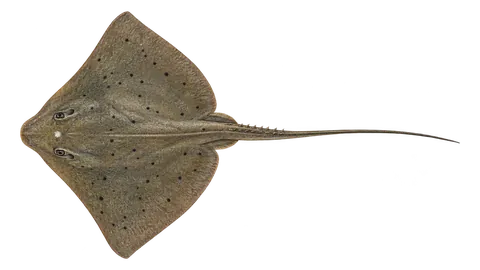
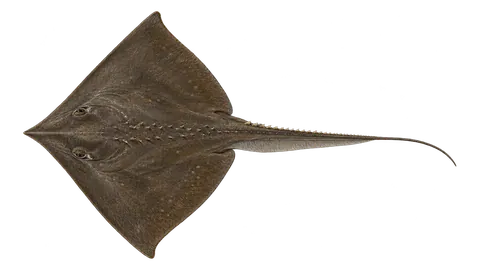
Short-snouted stingray with a rounded disc, yellowish, common in estuaries and the surf zone of the western Atlantic. Near Threatened worldwide; it injures bathers, and the name «manteiga» (butter) gets mixed up with that of protected stingrays.
Also called: arraia-amarela, manteiga, bluntnose stingray, Say's stingray, raya látigo chata
The yellow stingray is a medium-sized stingray, up to 104 cm disc width. It lives in coastal waters near the beach, down to about 10 m deep, and both adults and young frequent estuaries and the surf zone. It forages on the bottom: fish, shellfish, worms, and shrimp. It is ovoviviparous, with 2 to 4 pups per litter and a gestation of 10 to 11 months, which includes a pause in embryo development. FishBase lists it as a sport fish and as a cause of injuries to bathers and people walking in shallow water. The IUCN classifies it as Near Threatened. It is not on Brazil's national list, but similar stingrays are, and the name «manteiga» is also used for protected species.
fun facts
The female can pause embryo development during the 10 to 11-month gestation.
FishBase says it causes several injuries to bathers and people walking in shallow water.
Both juveniles and adults enter estuaries and the surf zone.
how to recognize it
identification
Medium-sized stingray with a short, blunt snout and a rounded disc, with few tubercles and spines along the midline. The tail has a well-developed skin fold on top and bottom. Yellowish or light brown above, white below. Measurements in this profile are disc width. Stingrays of the genus Hypanus look similar, and several are protected in Brazil, such as the raia-prego (H. berthalutzae). When in doubt, release it without handling.
how bluntnose stingray fishing looks
Loading the next 7 days…
Each card shows the day's index (0 to 100) and, below it, a strip with the index for each hour, from 0h to 23h. from poor to excellent.
Western Atlantic: from New Jersey (rare in Massachusetts) and the northern Gulf of Mexico to Argentina, common throughout the Antilles. FishBase includes Brazil in the distribution; since stingrays of the genus Hypanus look alike, check the species before keeping any of them.
Habitat: Shallow coastal waters, down to about 10 m, with estuaries and surf zone; sand and mud bottom.
coast
North CoastNortheast CoastSoutheast CoastSouth Coastcoastal
calendar and clock
when to fish
best season
time of year
JanFebSeaAprMayJunJulAugSepOctNovDec
Estimate: present all year in the tropics and subtropics, closer to the beach in warm months.
best time of day
Night and twilight. No defined time in the sources we checked (estimate): it usually forages in shallow water at dusk and at night, and buries itself in the bottom by day.
weather, water and behavior
what affects the bluntnose stingray
sensitivity The little bars show how much each factor affects this species. Five full: it feels it a lot.
cold and cold fronts
A cold front pushes it away from the shallows and the surf zone.
atmospheric pressure
Little known direct effect.
moon
Little known effect.
rain
Heavy rain lowers estuary salinity and may push it outward.
water level
Not applicable at sea.
noise
In clear, shallow water, it flees from heavy footsteps and motor noise.
wind
Little effect, except for the heavy swell that muddies the surf zone.
tide
It climbs onto the shoals on the rising tide to look for food.
spinning rod 7' to 9', 20 to 40 lb (from the beach, 10' to 12')
spinning / baitcasting reel
spinning reel 5000 to 8000 with a soft drag
line
braid 30 to 50 lb
leader
monofilament 0.60 to 0.90 mm, 1 m
hook
barbless circle hook 5/0 to 8/0
natural baits
shrimp
lula
minhoca-do-mar
mariscos
fish pieces
accessories
long-nose pliers
thick gloves
line cutter
tip from an angler
It fights hugging the bottom and is very heavy: keep steady pressure to pull it off the sand. Never pull the stingray by the tail or bring it into the boat. Anyone wading in shallow water should shuffle their feet to warn it.
what the law says
rules for the bluntnose stingray
Summary of the regulations we found, with the source for each. Rules change; before keeping or transporting fish, check with the state environmental agency. Conservation: Not on Brazil's national list (Portaria GM/MMA nº 1.667/2026). IUCN global assessment: NT (A2bd, Jun 21, 2019). What matters is the protection of the similar stingrays that are on the list.
Watch out for similar protected stingrays
North CoastNortheast CoastSoutheast CoastSouth Coast
Several stingrays of the Brazilian coast are on the national list and have catch banned: raia-prego or raia-manteiga (Hypanus berthalutzae, VU), raia-mariquita (Hypanus marianae, VU, endemic to the Northeast), raia-prego (Bathytoshia centroura, CR), and raia-de-colares (Fontitrygon colarensis, VU), as well as raia-borboleta (Gymnura altavela, CR). The name «manteiga» applies to the protected raia-prego and also to other stingrays. If you are not sure of the species, release it without handling.
Finning banned: sharks and rays only whole, with their fins
fins naturally attached to the body
In Brazil, finning is banned: catching sharks and rays and keeping only the fins, discarding the body (art. 3). Sharks and rays landed must arrive with all fins naturally attached to the body; carrying an animal aboard without fins or with loose fins, and transferring sharks and rays between fishing vessels, is prohibited. This applies to any species that may be retained.
Mexico: rays fall under the general limit of 10 fish per day
10 marine fish per angler per day, no more than 5 of the same species
NOM-017-PESC-1994 gives its own bag limit only to billfish, sharks, and giant croaker (1 fish per day). Rays are not listed separately in the text we checked: the general limit of ten marine fish per angler per day applies, with no more than five of the same species (item 4.9.1 a). Anything over that must be returned alive to the water (item 4.9.5), and recreational catch may not be sold (item 4.11).
Colombia: marine sharks and rays are not fishery resources
commercial or sport extraction not permittedconfirm with the agency
In 2021 Colombia stopped treating marine sharks and rays as fishery resources and began treating them as hydrobiological resources. The recitals of Decree 281/2021 state that they may not be extracted for commercial or sport purposes, and the decree created an environmental protection plan. Later AUNAP rules addressed incidental catch in artisanal fishing; we did not check the consolidated text. When in doubt, release them into the water.
Buenos Aires (AR): rays in general, up to 2 per day, may be killed
up to 2 fish per angler per day; any surplus must be released
In recreational sea fishing in the province of Buenos Aires, rays in general and chuchos (Myliobatis) fall under the subcategory "Pesca Variada con Reserva" (mixed fishing with reserve): only up to 2 fish per angler per day may be killed, counting within the 40-fish limit of mixed fishing, and the rest must be released on the spot (arts. 4 and 10 and Annex 1). Once the quota is reached, fishing may continue with release, keeping the animal out of the water for as little time as possible and without touching the gills (art. 18). Selling the catch is prohibited (art. 24).
catch and release Releasing the fish alive, quickly and with a wet hand. During a closed season it isn't always allowed: what the regulation says applies.
The tail sting is serrated and venomous: the sting causes intense pain and a deep cut, and it can leave fragments in the wound. If stung, wash the area, immerse it in very hot water (not hot enough to burn), and seek medical care. Keep the stingray in the water, away from the tail; remove the hook with long-nose pliers or cut the line close to the mouth.
in the kitchen
FishBase records no commercial use, only lists it as a sport fish. Since it is easily confused with protected stingrays, prefer to release it.
calculator
how much it weighs without taking it out of the water
Length-weight relationship W = a·Lb (a = 0.00447, b = 3.12; FishBase (relação peso-comprimento bayesiana, estimativa)). It's an average: a fat or lean fish can vary by 10% to 20%.
estimated weight
—
sources and references
The season factors (months), the time of day, and the sensitivities (cold, pressure, moon, wind, rain, tide, strong light, murky water, and noise) are editorial estimates by the app, based on the literature cited below and on field experience of anglers and guides. They are not official data or measurements made for this species and may vary by region and year. Closed seasons and legal rules appear in the rules section, with the standard and link. The months indicate when anglers usually find the species near the coast, not a catch season.