A large temperate-water shark, bronze in color, the king of release-based shark fishing in northern Argentine Patagonia. It is not on the threatened list in Brazil, but it is Vulnerable worldwide and resembles protected species.
Also called: tubarão-bronze, bacota, tubarão-cobre, cação
Choose the place and the species. The index, from 0 to 100, combines weather, sun, moon and tide with each fish's habits. Up to 28 days, with each day's confidence.
location
Sample location: choose yours to see the forecast for where you fish.
period
Reading the weather across 3 global models and 31 simulations…
0—
index Score from 0 to 100 for the fishing conditions of each hour. It reads weather, sun, moon, tide and the species' habits. It doesn't promise fish: it tells you when the water is on your side. 0–24 poor · 25–44 fair · 45–64 good · 65–84 very good · 85–100 excellent.
today
—
confidence —
confidence How much you can trust the weather forecast for the day. It drops with distance and when the models disagree. It is not the chance of catching fish.
models and trend Up to 16 days, three global weather models (the European ECMWF, the American GFS and a high-resolution blend) read hour by hour; when they disagree, the light band on the chart widens. Beyond that it's a trend: 31 runs of the American GEFS model. Confirm when it's 1 week out.
window Consecutive hours with the index near the day's peak and no danger alert. It is the time to have the bait in the water.
hour by hour
tap or drag on the chart to read each hour · on a keyboard, arrow keys
see hour-by-hour table
why this index at —?
next 7 days
choose the day
chart: bar height = day's index · line = variation between models · striped = trend · fainter = less confidence
Each card shows the day's index (0 to 100) and, below it, a strip with the index for each hour, from 0h to 23h. from poor to excellent.
4-week calendar
the fishing month at a glance
plan a trip
what's the best window for the crew?
Choose how many fishing days. We compare each stretch by its average index, discount days with a warning or closed season, and show the 3 best.
trend for the coming weeks
Line: the middle value of 31 simulations of the American GEFS model. Band: where 8 out of 10 fall. Narrow, firm trend; wide, high uncertainty.
the species
everything about the copper shark
overview
who is the copper shark
The bronze whaler, the bacota of Argentines and Uruguayans, is the only Carcharhinus that prefers temperate waters. It lives in beaches, bays and on the continental shelf, and makes migrations tied to water temperature. In Argentina it appears from October to late March and enters Anegada Bay, near San Blas, from December, leaving by April; there most are large juveniles and subadults. It grows slowly and only matures beyond 2 m. In Brazil it occurs from the Southeast to the South, and it is not a threatened species on the national list. In Argentina it is the great trophy of beach and boat shark fishing at San Blas, Bahía Creek and San Matías Gulf, always with mandatory release.
fun facts
It is the only Carcharhinus that prefers temperate waters.
Males mature at 2.0 to 2.2 m and females at 2.15 to 2.23 m.
Almost no newborns appear in Anegada Bay: the bay receives mainly large juveniles.
how to recognize it
identification
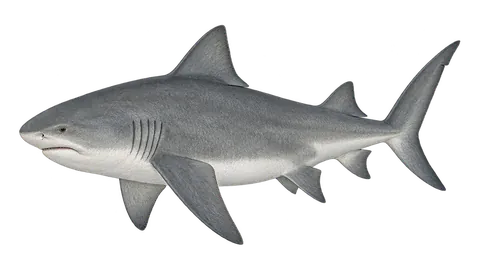
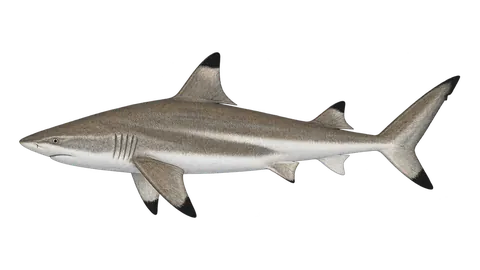
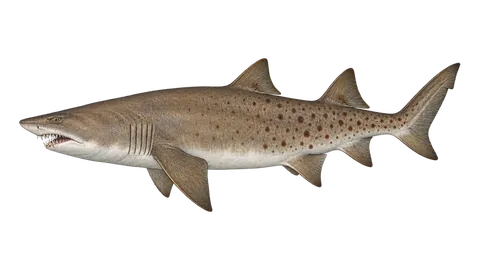
Large, relatively slender body, bronze to olive-gray back with a metallic sheen, white belly and a faint pale band on the flank. Moderately long snout, rounded at the tip. Upper teeth narrow and curved, like hooks. First dorsal fin medium, with no ridge between the dorsals (the dusky shark, fidalgo, C. obscurus, Endangered, has a ridge). Fin tips dark, without distinct black spots. The bull shark has a much shorter snout.
In Brazil, from the Southeast to the South. In the southwestern South Atlantic it ranges from Brazil to Argentina, notably Anegada Bay and San Blas (Buenos Aires) and San Matías Gulf (Río Negro). Also in the Pacific, from California to Peru.
Habitat: Beaches, bays, tidal channels, estuary mouths and the continental shelf.
coast
Southeast CoastSouth Coastcoastalshelf
states
Rio de Janeiro, São Paulo, Paraná, Santa Catarina, Rio Grande do Sul
calendar and clock
when to fish
best season
time of yearbest: Dec–Mar
JanFebSeaAprMayJunJulAugSepOctNovDec
In Argentina, the bacota appears from October to late March and stays in Anegada Bay from December to April, according to a study of the species. In Brazil, there is no defined season for anglers (estimate).
best time of day
Daytime, with peaks at dawn and dusk. Feeds by day in channels with the tide running; from the beach, late afternoon and early evening usually produce more.
weather, water and behavior
what affects the copper shark
sensitivity The little bars show how much each factor affects this species. Five full: it feels it a lot.
cold and cold fronts
Its movements follow water temperature: it arrives with the warm water of summer and leaves in autumn.
atmospheric pressure
Cold fronts lower the temperature of the shallow bays.
moon
Spring tides move the channels.
rain
Not very relevant.
water level
Not applicable at sea.
noise
It is wary of boats with engines running over the shallow channels.
wind
Strong wind and rough seas prevent fishing from the beach.
tide
The tide running through the channels is the bacota's hour.
depth
From the shallows of the beaches to tens of meters out on the shelf.
beach: 13' to 15' for heavy casting; boat: 6' to 7', 50 to 80 lb
spinning / baitcasting reel
large casting spinning reel or 4/0 to 6/0 baitcaster
line
monofilament of at least 0.70 mm (required in Buenos Aires) or 80 lb braided line
leader
1 to 1.5 m wire leader plus 2 to 3 m of heavy monofilament
hook
circle hook 12/0 to 14/0 with the barb flattened; single hook only
natural baits
cut bait or half a fish (mullet, pescadilla, mackerel, anchovy) on the bottom
accessories
stopper float 25 cm above the hook
cutting pliers for steel cable
long hook remover
luvas
tip from an angler
In Argentina release is mandatory; in Brazil, release it too: it is easily confused with the dusky shark and the sandbar shark, which are protected. Don't let it swallow the bait, keep the fight short, and release it in the water.
what the law says
rules for the copper shark
Summary of the regulations we found, with the source for each. Rules change; before keeping or transporting fish, check with the state environmental agency. Conservation: Not on the national list (Ministerial Ordinance GM/MMA 1.667/2026). Global assessment: Vulnerable (IUCN, April 6, 2020). Listed in CITES Appendix II.
Watch out for protected look-alikes
The bronze whaler is not on the national list, but it looks very much like the dusky shark (C. obscurus, Endangered), the sandbar shark (C. plumbeus, Critically Endangered) and the bull shark (C. leucas, Vulnerable from late October 2026), all protected. If you're not sure of the species, release it.
Finning prohibited: shark only whole, with its fins
fins naturally attached to the body
In Brazil, finning is prohibited (cutting off the fins and discarding the body). Every shark or ray landed must arrive with its fins attached to the body; it is prohibited to carry on board an animal without fins or with loose fins, and to transfer sharks between vessels. It applies to any shark that may be kept.
Buenos Aires (AR): mandatory release of large coastal sharks
mandatory release; killing prohibited
On the Buenos Aires Province coast (and in the Plata, Bahía Blanca and Mar Chiquita estuaries), escalandrún, bacota, gatopardo, cazón and hammerheads are "reserved directed fishing": release is mandatory, and killing is prohibited even for incidental catch. Gear rules: one rod per angler on a boat and two from shore; single-hook rigs only (tandem rigs prohibited); circle or biodegradable hook 12/0 to 14/0 with the barb flattened; a stopper float 25 cm above the hook is recommended on bottom lines, along with nylon line of at least 0.70 mm. Gaffs are prohibited. Remove the hook only if there is no risk; otherwise cut the line close to the hook, avoiding lifting the shark out of the water. From Pehuén-Có to the mouth of the Río Negro (including the Bahía Blanca estuary, Anegada Bay and San Blas), a permanent closed season also applies to artisanal and commercial fishing for escalandrún, bacota, gatopardo and cazón (Disposition 55/2008).
Río Negro (AR): mandatory release (Law 5.706/2023)
mandatory release; killing prohibited
In Río Negro Province marine sport fishing (San Matías Gulf, El Cóndor, Bahía Creek), the bacota (Carcharhinus brachyurus) is under a special protection regime: killing during capture is prohibited and release is mandatory. In boat fishing targeting sharks: one hook per line (tandem rigs and tartuna-type galvanized hooks prohibited), a "J" hook with the barb filed or flattened, or a circle hook. A specimen on board only with scientific authorization.
1 specimen per angler per day (counts as 5 against the quota of 10)
In recreational sport fishing in Mexican saltwaters, the limit for sharks is one specimen per angler per day, which counts as five toward the total limit of ten fish. Fish caught in sport fishing may not be sold. Catch and release does not count toward the limit: prefer releasing.
catch and release Releasing the fish alive, quickly and with a wet hand. During a closed season it isn't always allowed: what the regulation says applies.
Leave it in the water or at the shore, head facing the sea, without dragging it across the sand. Remove the hook with a dehooker or cut the line close to the mouth. Revive it until it swims off strongly.
in the kitchen
In Brazil it may be kept under the general rules, but release is best practice: it is Vulnerable worldwide and resembles protected species. In Argentina, killing is prohibited. Sharks accumulate mercury.
calculator
how much it weighs without taking it out of the water
Length-weight relationship W = a·Lb (a = 0.00501, b = 3.07; FishBase (estimativa bayesiana para a espécie e o gênero, comprimento total)). It's an average: a fat or lean fish can vary by 10% to 20%.
estimated weight
—
sources and references
The seasonal weights (months), time of day and sensitivities (cold, pressure, moon, wind, rain, tide, strong light, murky water and noise) are the app's editorial estimates, based on the literature below and on field experience of anglers and guides. The months indicate the time of year when the angler usually finds the species near the coast, not a catch season. They are not official data or measurements made for this species and may vary by region and year. Legal rules appear in the rules section, with the regulation and link.
The weather comes from three independent global models, cross-checked hour by hour: when they agree, confidence goes up; when they diverge, the band between them shows on the chart. Beyond 16 days, we use the GEFS ensemble of 31 simulations: if 20 of the 31 predict rain, the chance of rain is 65%. Sun and moon are calculated astronomically, with no uncertainty.
The index adds up, weighted for each species: time of day (species curve anchored to real sunrise and sunset), moon (transits, rise and set, phase), pressure (3 h trend and 24 h swing), water temperature (in rivers, estimated from air temperature; at sea, estimated by an ocean model), wind, rain, clouds, tide and the month in the species' cycle.
Accuracy measured in the reference project (4 regions, 93 days, forecast vs. observed): maximum temperature is off by 0.6 °C on average the next day and 1.7 °C at 7 days; rain of 5 mm or more is detected 76% of the time the next day and 57% at 7 days. Detection isn't everything: the false alarm rate isn't published here yet, and 93 days in 4 regions is still a small sample. We now also measure every day, at the app's destinations:
where are you going fishing?
Your location is saved only on this device and feeds the forecast, the map and the "today" on the home page.