Skip to content
fishing forecast

ladyfish

Elops saurus · Elopidae · predator

EstuarySea

Silvery, leaping fish of bays, passes and lagoons in the Gulf of Mexico and the Caribbean, a relative of the camurupim. It takes spoon, plug and fly lightly and jumps several times; the meat is little valued.

Also called: ubarana-do-golfo, ubarana, juruma, ladyfish, tenpounder

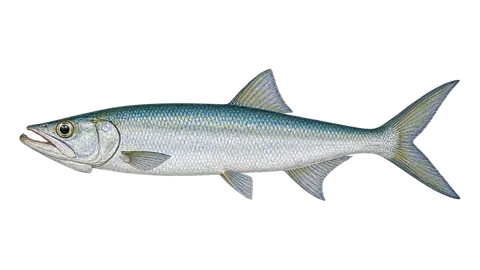
Scientific illustration of Ladyfish
common size
40–70 cm
maximum
100 cm
common weight
0.3–1.7 kg
record/max.
10.1 kg
depth
0–50 m
ideal water
22–30 °C
location

Sample location: choose yours to see the forecast for where you fish.

period

Reading the weather across 3 global models and 31 simulations…

the species

everything about the ladyfish

overview

who is the ladyfish

The ladyfish (Elops saurus, ubarana-do-golfo) is a silvery, slender fish of the tarpon family, with a large mouth and a forked tail. Until 2010 it was the only Elops in the western Atlantic; the description of Elops smithi split the records, and Brazilian ubaranas are now assigned to E. smithi, the species in the ubarana entry. According to the species lists consulted, E. saurus mainly occupies the Gulf of Mexico and the US East Coast, overlapping with the other species in some areas. Adults live in shallow water over mud bottoms and enter estuaries; juveniles are common in hypersaline lagoons and bays. They form large schools near shore and eat crustaceans and small fish. Spawning takes place offshore; the ribbon-shaped larvae return to the coast and develop. It reaches 1 m and 10.1 kg, with a common size around 60 cm. It is famous for leaping out of the water and running along the surface when hooked.

fun facts

  • It is famous for leaping out of the water and running in short jumps near the surface when hooked.
  • The ribbon-shaped larvae undergo major changes in shape and pass through a stage in which they shrink before growing.
  • It was the only Elops in the western Atlantic until 2010, when McBride and colleagues described Elops smithi.
how to recognize it

identification

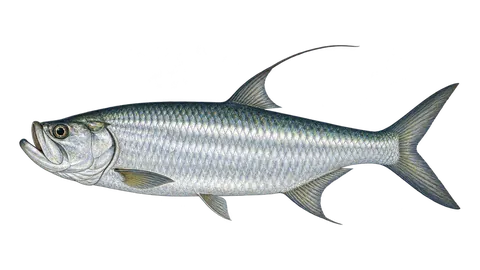
Elongated, rounded body, silver with a bluish back, small scales (more than 100 on the lateral line), large terminal mouth, a narrow bony plate between the jaw branches, and a deeply forked tail. It lacks the filamentous last dorsal ray of the tarpon, and its scales are much smaller. Separating it from Elops smithi is difficult: the 2010 review does so only by counting vertebrae (79 to 87 in saurus, 73 to 80 in smithi), which cannot be seen in the field.

distribution

where found

open on the large map

According to the review that separated Elops smithi, the two species occur in the western Atlantic, mainly in distinct areas, with overlap in some stretches. E. saurus is the species of the Gulf of Mexico and the US East Coast. FishBase still gives it down to southern Brazil, but that text predates the split, and Brazilian ubaranas are attributed to E. smithi.

Habitat: Shallow waters of estuaries, bays, lagoons and mud-bottomed bars, from 0 to about 50 m; juveniles use hypersaline lagoons and bays.

calendar and clock

when to fish

best season

time of yearbest: May–Oct
JanFebSeaAprMayJunJulAugSepOctNovDec

In the Gulf of Mexico it is best from April to October, with warm water; in winter, schools move away from the banks (editorial estimate).

best time of day

0h6h12h18h sunrise ~6amsunset ~6pm

Daytime, with peaks at dawn and dusk. Hunts by day and at dusk, often at the surface, in schools.

weather, water and behavior

what affects the ladyfish
sensitivity The little bars show how much each factor affects this species. Five full: it feels it a lot.

cold and cold fronts

Cold water pushes schools away from the bars and banks.

atmospheric pressure

A cold front shuts down activity.

moon

Big tides move the inlets and help.

rain

Heavy rain and very muddy water get in the way.

water level

Follows salt water into the channels and lagoons.

noise

Moderately sensitive; don't pass over the school with the motor.

wind

Moderate wind doesn't hurt; strong wind makes fly fishing hard.

tide

A running tide at the inlets and channel mouths is the hunting time.

depth

Surface and mid-water, 0 to 5 m for most catches.

technique, gear and bait

how to fish

rod
6'0" to 7'0", 6 to 14 lb; fly #6 to #8
spinning / baitcasting reel
spinning reel 2000 to 3000
line
10 to 15 lb braided line
leader
fluorocarbon 20 to 30 lb (the mouth is rough)
hook
single hook 1 to 2/0 or small treble hooks

lures

  • spoons 7 to 15 g
  • 6 to 9 cm mid-water plugs
  • streamers and clousers

natural baits

  • live shrimp
  • live anchovy or sardine

accessories

  • alicate
  • landing net

tip from an angler

On the hookset it jumps several times: lower the rod tip at each jump so you don't lose it.

what the law says

rules for the ladyfish

Summary of the regulations we found, with the source for each. Rules change; before keeping or transporting fish, check with the state environmental agency.
Conservation: Global assessment of 2011, with the species understood in the broad sense, before the split of Elops smithi. Not on the Brazilian national list (Portaria GM/MMA nº 1.667/2026).

Mexico: up to 5 per species and 10 saltwater fish per day

5 specimens of the species per angler per day, within the limit of 10 saltwater fish

In recreational sport fishing in Mexican federal waters, each angler may keep up to 10 marine fish per day, with at most 5 of the same species. Ladyfish (macabí) has no limit of its own in the rule. Fish over the limit are released alive, and fish kept may not be sold. Anyone fishing from a boat needs a Conapesca permit.

Source: Amendment to NOM-017-PESC-1994 (recreational sport fishing in federal waters of Mexico), DOF Nov 25, 2013, items 4.9.1, 4.9.5 and 4.11 (Sagarpa/Conapesca)

catch and release
catch and release Releasing the fish alive, quickly and with a wet hand. During a closed season it isn't always allowed: what the regulation says applies.

Hold it firmly from below, remove the hook quickly and release it head first into the current; it thrashes a lot.

in the kitchen

Flesh full of fine bones, considered second-grade by FishBase, which lists it as sold fresh, salted and frozen. Ground up, it works for fish cakes and broth, and as bait.

calculator

how much it weighs without taking it out of the water

Length-weight relationship W = a·Lb (a = 0.00631, b = 2.94; FishBase (relação peso-comprimento bayesiana, estimativa da própria espécie)). It's an average: a fat or lean fish can vary by 10% to 20%.

estimated weight

—

sources and references

Seasonal weights (months), timing and sensitivities (cold, pressure, moon, wind, rain, tide, bright light, murky water and noise) are the app's editorial estimates, based on the literature below and on field experience from anglers and guides. They are not official data or measurements made for this species and may vary by region and year. Closed seasons and legal rules appear in the rules section, with the regulation and link. Common sizes and weights are ranges around the common length reported by FishBase, with weight calculated from the length-weight relationship. The seasons shown are those of the Gulf of Mexico and northern Caribbean, where the species is most common, and are also editorial estimates.

  1. scientific FishBase: Elops saurus (ficha da espécie)Size, length-weight relationship, depth, habitat, distribution, biology and IUCN status. Page checked on Oct 13, 2026. FishBase's country list includes Brazil based on records predating the split of Elops smithi; the app removed BR from paises because Brazilian ubaranas are attributed to E. smithi (ubarana entry).
  2. scientific FishBase: nomes populares de Elops saurusNames by country and language. Ubarana and juruma are Brazilian names for the genus; the app uses ubarana-do-golfo, with the Spanish name macabí, to separate this entry from the Brazilian ubarana.
  3. official Portaria GM/MMA nº 1.667, de 27 de abril de 2026: Lista Nacional Oficial de Espécies da Fauna Ameaçadas de Extinção (peixes e invertebrados aquáticos)The species is not on the list. Checked in the DOU of April 28, 2026.
  4. scientific McBride, R. S.; Rocha, C. R.; Ruiz-Carus, R.; Bowen, B. W. (2010). A new species of ladyfish, of the genus Elops (Elopiformes: Elopidae), from the western Atlantic Ocean. Zootaxa 2346: 29-41Describes Elops smithi and designates a lectotype for E. saurus. The two species are separated only by vertebrae (E. saurus 79 to 87, usually 81 to 85; E. smithi 73 to 80) and occur in the western Atlantic mainly in distinct areas, with some overlap. Summary checked on Oct 13, 2026. The exact range limits of each species were not confirmed in a primary source.
  5. scientific FishBase: Elops smithi (ficha da espécie)Distribution in the western Atlantic (coasts of the Americas, Bahamas and Caribbean islands) and note on the split of E. saurus. Checked on Oct 13, 2026.
  6. official DOF: Modificação da NOM-017-PESC-1994, para regular a pesca deportivo-recreativa em águas de jurisdição federal do México (DOF de 25/11/2013)Daily quotas at sea (item 4.9.1), return of the excess (4.9.5), ban on selling the fish (4.11) and ban on fishing in closed zones and seasons (4.10 a). Text checked Oct 13, 2026.
don't confuse

similar species