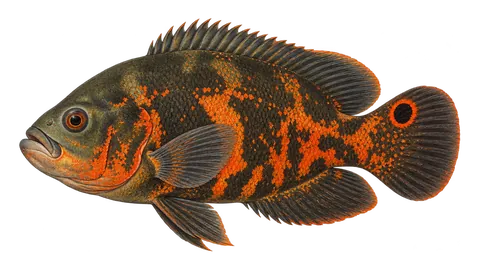
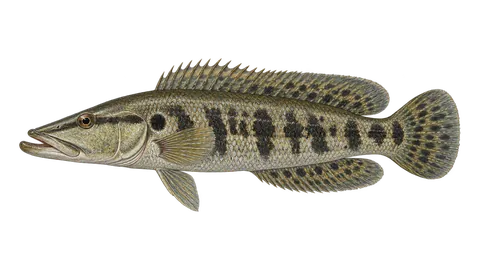
A tall, bright cichlid from the blackwater rivers of the Negro River and the upper Orinoco, with a red chest and red eyes. It is food for Indigenous peoples and an aquarium fish, and FishBase lists it as a sport fish.
Also called: acará-papagaio, acará-paragaio, acará-paragua
The only member of the genus Hoplarchus, it lives in the blackwater rivers of the Negro River basin (including the Preto da Eva and Urubu) and in tributaries of the upper Orinoco in Venezuela. It inhabits rivers, swamps and lakes of acidic, warm water. During the flood it eats aquatic insects and crustaceans, and in the dry season it switches to eating fish. It reaches 32 cm and 0.73 kg (FishBase also cites 35 cm elsewhere). It is a subsistence fish for local Indigenous peoples and appears in the aquarium trade as 'parrot cichlid'. Its biology is little known: in aquariums, the pair digs a deep pit and spawns on firm substrate. Given its size, it suits light tackle and small midwater baits.
fun facts
It is the only member of the genus Hoplarchus.
The name 'papagaio' (parrot) recalls the red chest, which evokes the colors of some Amazonian parrots.
The true 'parrot cichlid' is not the 'blood parrot', an artificial aquarium hybrid.
how to recognize it
identification
A tall, compressed cichlid, greenish to iridescent blue-green, with red chest and belly, red eyes and facial markings. Dominant males are easy to recognize; females are smaller, with a flatter forehead and shorter pelvic fins. Don't confuse it with the hybrid aquarium 'parrot cichlid' (blood parrot), which does not exist in nature.
how parrot cichlid fishing looks
Loading the next 7 days…
Each card shows the day's index (0 to 100) and, below it, a strip with the index for each hour, from 0h to 23h. from poor to excellent.
Blackwater rivers of the Negro River basin, such as the Negro itself, the Preto da Eva and the Urubu, in Amazonas state; outside Brazil, tributaries of the upper Orinoco in Venezuela (the literature also mentions Colombia).
Habitat: Blackwater, acidic rivers (pH 5.5 to 6.0), swamps and lakes, alongside submerged timber, fallen logs and vegetated banks.
native to the basins
Amazon
states
Amazonas
calendar and clock
when to fish
best season
time of yearbest: Aug–Nov
JanFebSeaAprMayJunJulAugSepOctNovDec
Dry season and falling water (September to December in the Negro basin): the fish switches to eating fish and concentrates in pools, beaches and banks, and this is the best season. During the flood it eats insects and crustaceans and spreads through the flooded forest.
best time of day
Daytime. Active by day, most active in the early morning and late afternoon, close to structure.
weather, water and behavior
what affects the parrot cichlid
sensitivity The little bars show how much each factor affects this species. Five full: it feels it a lot.
cold and cold fronts
Cold snaps (friagem) shut down activity for a few days.
atmospheric pressure
Little effect; stable weather is better.
moon
Small effect.
rain
Heavy rain scatters the fish; blackwater is already dark and doesn't bother it.
water level
A falling river and the dry season concentrate fish in pools and along the banks; in the flood it moves into the flooded forest.
noise
Wary: approach by paddle or electric motor and avoid knocking the hull.
No. 6 to 2 hook on natural bait; No. 8 to 6 trebles on small lures
lures
1/16 to 1/8 oz jig
spinner #1 to 2
5 to 7 cm minnow
small streamer fly
natural baits
freshwater shrimp
fish pieces
minhoca
grilo
accessories
landing net
polarized glasses
alicate
tip from an angler
Work the lure slowly alongside submerged timber and logs: the acará follows and strikes at the end of the retrieve. Small hook and a gentle hookset.
what the law says
rules for the parrot cichlid
Summary of the regulations we found, with the source for each. Rules change; before keeping or transporting fish, check with the state environmental agency. Conservation: Not on the Brazilian national list (Ministerial Ordinance GM/MMA No. 1.667/2026).
We found no species-specific rule beyond the region's general rules.
piracema closures in the basins where the species lives
Spawning closure (piracema) in Mato Grosso (all basins)
01/10 to 31/01MT
Allowed: All fishing modalities are prohibited in rivers, including catch and release (Law 9.096/2009, art. 19-A). Exceptions: subsistence fishing from shore (3 kg or 1 fish, no transport or sale) and scientific fishing. Law 13.159/2025 now allows licensed sport fishing in UHE/PCH hydropower reservoirs, natural lakes and border rivers, subject to a scientific study and a license from the environmental agency. We have not confirmed whether these licenses are already being issued.
Allowed: Recreational anglers with handline or rod, line and hook are outside the Annex II prohibitions, with a bag limit of 5 kg + 1 fish, unless a stricter state rule applies.
catch and release Releasing the fish alive, quickly and with a wet hand. During a closed season it isn't always allowed: what the regulation says applies.
Wet your hands, support the body and avoid lifting it out of the water; use a barbless hook or one with the barb flattened and release it right away, head toward the bank.
in the kitchen
According to FishBase, it is food for local Indigenous peoples. Small in size, with bony flesh; it is usually fried whole or used in broths.
calculator
how much it weighs without taking it out of the water
Length-weight relationship W = a·Lb (a = 0.02692, b = 3.03; FishBase (relação peso-comprimento bayesiana, estimativa)). It's an average: a fat or lean fish can vary by 10% to 20%.
estimated weight
—
sources and references
The season weights (months), the time of day and the sensitivities (cold, pressure, moon, wind, rain, tide, strong light, murky water and noise) are the app's editorial estimates, based on the literature below and on the field experience of anglers and guides. They are not official data nor a measurement made for this species, and they may vary by region and year. Closed seasons and legal rules appear in the rules section, with the norm and a link.
scientificFishBase: Hoplarchus psittacus (ficha da espécie)Size, length-weight, depth, habitat, distribution, biology and IUCN status. Page checked on October 13, 2026. The typical size and weight and the depth range are editorial estimates for sport fish; the maximum length of 32 cm and the weight of 730 g are the published values (the FishBase text itself also cites 35 cm). FishBase lists the Negro, Preto da Eva, Urubu and Jamari rivers; on the species page only Amazonas was listed as the state.
marketAquarium Glaser: Hoplarchus psittacusRed chest coloration, sexual differences, omnivorous diet in aquariums, spawning in a dug pit, and the Indigenous name 'acará paragua'. Aquarium-hobby source, used only for description and habits. Page checked on October 13, 2026.
technicalWikipedia: HoplarchusGenus with a single species, about 35 cm in size, blackwater rivers of Brazil, Colombia and Venezuela, and use as food by Indigenous peoples. Page checked on October 13, 2026.