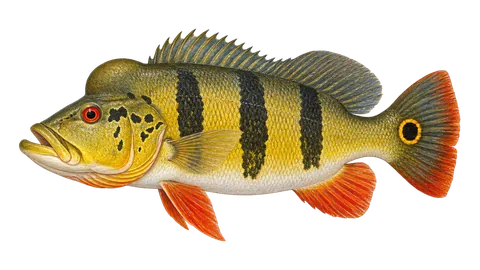
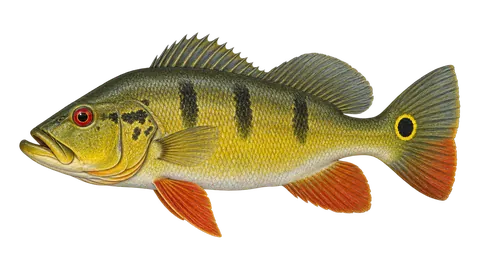
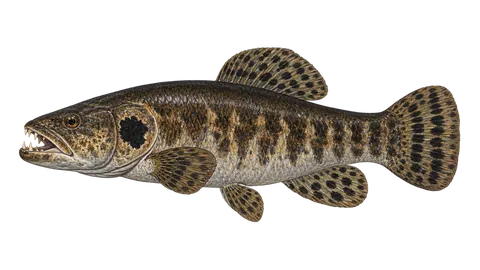
A cichlid with a long body and large mouth, the jacundá ambushes among rocks, logs and snags on the bank. Lugubria lugubris, known until 2023 as Crenicichla lugubris, is one of the largest jacundás in the Amazon and lives in blackwater and clearwater rivers, such as the Negro, the Branco and the Uatumã. For sport anglers it is a frequent catch while peacock bass fishing: it attacks jigs, jerkbaits and mid-water plugs worked tight to the structure. For its size it fights with short, strong head shakes. Like other cichlids, the pair guards the eggs and young.
fun facts
Mariana, one of the common names, is also used for other jacundás.
Until 2023 it was classified in the genus Crenicichla; the ICMBio data sheet and the IUCN assessment still use the old name.
how to recognize it
identification
Elongated, nearly cylindrical body, long head and large mouth, with a more prominent lower jaw. Olive to grey coloration, with irregular dark spots or bars on the flank and a dark spot just behind the head, above the pectoral fin. Long dorsal fin, with spines at the front. Peacock basses have an ocellus on the tail and a taller body.
how jacundá fishing looks
Loading the next 7 days…
Each card shows the day's index (0 to 100) and, below it, a strip with the index for each hour, from 0h to 23h. from poor to excellent.
low-profile baitcasting reel or 2500 spinning reel
line
braid 20 to 30 lb
leader
fluorocarbon 30 to 40 lb
hook
treble hooks #2 to 1/0 or 1/0 jig hook
lures
feathered jig 1/8 to 1/4 oz
jerkbait 7 to 9 cm
spinner
streamer
natural baits
live lambari (where the rule allows)
accessories
long-nose pliers
polarized glasses
tip from an angler
Lure close to the snags, with long pauses: it leaves its lair and strikes on the pause.
what the law says
rules for the jacundá
Summary of the regulations we found, with the source for each. Rules change; before keeping or transporting fish, check with the state environmental agency. Conservation: Not on the national list (Portaria GM/MMA 1.667/2026).
We found no species-specific rule beyond the region's general rules.
piracema closures in the basins where the species lives
Spawning closure (piracema) in Mato Grosso (all basins)
01/10 to 31/01MT
Allowed: All fishing modalities are prohibited in rivers, including catch and release (Law 9.096/2009, art. 19-A). Exceptions: subsistence fishing from shore (3 kg or 1 fish, no transport or sale) and scientific fishing. Law 13.159/2025 now allows licensed sport fishing in UHE/PCH hydropower reservoirs, natural lakes and border rivers, subject to a scientific study and a license from the environmental agency. We have not confirmed whether these licenses are already being issued.
Allowed: Recreational anglers with handline or rod, line and hook are outside the Annex II prohibitions, with a bag limit of 5 kg + 1 fish, unless a stricter state rule applies.
catch and release Releasing the fish alive, quickly and with a wet hand. During a closed season it isn't always allowed: what the regulation says applies.
Hold it by the mouth with pliers or a boga, support the belly, and release it next to the structure it came from.
in the kitchen
White, tasty meat, but the fish is small: fried whole.
calculator
how much it weighs without taking it out of the water
Length-weight relationship W = a·Lb (a = 0.00912, b = 3.1; FishBase). It's an average: a fat or lean fish can vary by 10% to 20%.
estimated weight
—
sources and references
The season weights (months), the time of day and the sensitivities (cold, pressure, moon, wind, rain, tide, strong light, murky water and noise) are the app's editorial estimates, based on the literature below and on the field experience of anglers and guides. They are not official data nor a measurement made for this species, and they may vary by region and year. Closed seasons and legal rules appear in the rules section, with the norm and a link.