

african sharptooth catfish
Clarias gariepinus
Exotic, invasive African catfish. Breathes air, tolerates foul water and eats just about anything. Caught at pay lakes and in rivers where it escaped.
- common size
- 40–80 cm
- maximum
- 170 cm
- common weight
- 1–6 kg
- record/max.
- 60.0 kg
- depth
- 0.3–4 m
- ideal water
- 25–30 °C
how to recognize it
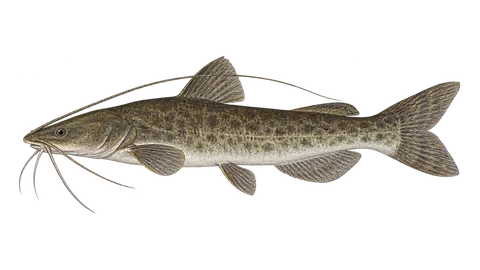
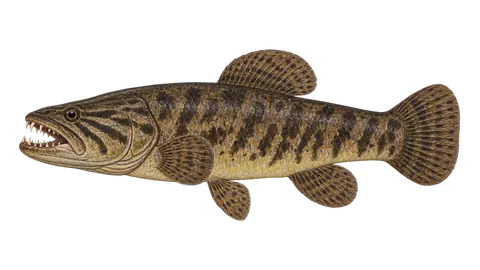
Long, eel-like body, scaleless, grey-olive to marbled. Large, flattened, bony head, like a helmet. Four pairs of barbels. Very long dorsal and anal fins, without spines and without an adipose fin. Rounded tail. The jundiá has an adipose fin, a smaller body and three pairs of barbels. The trahira has scales.
Also called: bagre-africano, clarias
don't confuse with:
where found
open on the large mapWhere to look: Still, warm, low-oxygen water: lagoons, swamps, canals, reservoirs, tanks and muddy slack water.
Exotic, native to Africa. Pay lakes and fish farms; invasive populations in rivers, lagoons and reservoirs of the South, Southeast, Northeast and Center-West.
introduced in
states
São Paulo, Minas Gerais, Paraná, Santa Catarina, Rio Grande do Sul, Bahia, Pernambuco, Mato Grosso do Sul, Goiás
when to fish
next 7 days
Loading the next 7 days…
best season
Warm months. In winter in the South it is not very active.
best time of day
Nighttime. Hunts and feeds mainly at night; in murky water also during the day.
what affects the african sharptooth catfish
cold and cold fronts
Stops feeding in cold water.
atmospheric pressure
Little effect.
moon
Dark nights produce more.
rain
Small effect; rain may make it move between puddles.
water level
Floods spread the catfish into new habitats.
noise
Not very sensitive.
wind
No significant effect.
depth
Shallow bottom, 0.5 to 3 m.
how to fish
natural baits
- beef liver
- heart
- sardinha
- piece of fish
- minhocuçu
- salsicha
tip from an angler
At night, liver or fish bait on the bottom, in still, warm water. Strike firmly: the mouth is hard.
- rod
- 6' to 7', 15 to 30 lb
- spinning / baitcasting reel
- spinning reel 3000 to 4000 or baitcasting reel 200
- line
- monofilament 0.35 to 0.40 mm or braided 30 lb
- leader
- monofilament 50 lb (the plate-like teeth wear down the line)
- hook
- 2/0 to 5/0
accessories
- alicate
- cloth to grip (smooth, slippery skin)
catch and release
Exotic invader: do not return it to natural environments where local rules allow killing it. Never transport it alive.
kits and guides
rules for the african sharptooth catfish
Rules change; before keeping or transporting fish, check with the state environmental agency.
Releasing it into the natural environment without a license is an offense
releasing or introducing fish into rivers, reservoirs and lakes is prohibitedSPMGPRSCRSBAPEMSGOconfirm with the agency details
Introducing an exotic species, or one outside its natural range, without a technical opinion and a license is a federal environmental offense. This includes releasing a fish from a tank, pay lake or aquarium into a river or reservoir. In MG, the IEF states that stocking without a license is prohibited.
Source: Lei federal nº 9.605/1998, art. 31, and Decreto federal nº 6.514/2008, art. 25
MT: introducing an exotic species without a license carries a fine
fine of R$6,000 to R$100,000MT details
Mato Grosso's fishing law penalizes anyone who introduces native, exotic or non-native species without authorization from the environmental agency, with a surcharge per kilogram or per fish.
Source: Lei estadual MT nº 9.096/2009, art. 46 (as amended by Lei nº 12.197/2023) - Sema-MT
MS: African catfish outside the native-fish limit
specimens may be added to the limit, subject to the closed seasonMS details
In MS, African catfish is on the list of exotic, allochthonous and hybrid species whose specimens may be added to the angler's limit (1 native + 5 piranhas), subject to the closed season.
PR: exotics allowed; returning them to the water is restricted
exotics may be caught freely; confirm the release rulePRconfirm with the agency details
In PR, non-native fish may be caught in the interior basins. Portaria IAT 650/2025 sets a rule on releasing non-natives, with an exception for catch-and-release events aimed at them. Confirm with IAT before returning the fish to the water.
Conservation: Considered invasive, with an impact on native fish and amphibians.
how much it weighs without taking it out of the water
estimated weight
—
how we calculate
Length-weight relationship W = a·Lb (a = 0.00776, b = 2.97; FishBase). It's an average: a fat or lean fish can vary by 10% to 20%.
more about the african sharptooth catfish
African catfish brought into fish farming, now invasive in several Brazilian basins. It breathes air through a special organ, survives in water with almost no oxygen, and can even crawl over damp ground between puddles. Eats fish, amphibians, insects, scraps and feed, and preys on native species. That is why it is one of the most problematic exotics: releasing African catfish into a river, lagoon or reservoir without a license is an environmental offense. It grows large and fights hard. Caught at pay lakes and in rivers near fish farms, mostly at night.
Family: Clariidae · predator
fun facts
- Breathes atmospheric air and survives for hours out of water in a damp place.
- It can crawl over wet ground from one puddle to another.
in the kitchen
White, boneless and firm meat; good fried or smoked.
similar species
sources and references (5)
The season weights (months), the time of day and the sensitivities (cold, pressure, moon, wind, rain, tide, strong light, murky water and noise) are the app's editorial estimates, based on the literature below and on the field experience of anglers and guides. They are not official data nor a measurement made for this species, and they may vary by region and year. Closed seasons and legal rules appear in the rules section, with the norm and a link.
- scientific FishBase — Clarias gariepinus (ficha da espécie)Names, distribution, biology, length-weight relationship and references. Page checked on October 13, 2026.
- scientific IUCN Red List — Clarias gariepinus (avaliação global: Pouco Preocupante, LC, 20/06/2018)Global assessment. Link given on the FishBase entry (Red List, version 2025-2).
- technical CABI Compendium — Clarias gariepinus (North African catfish). Chakraborty, S. (2024).Technical sheet for an invasive species (DOI checked in Crossref).
- scientific IUCN SSC Invasive Species Specialist Group — Global Invasive Species Database: Clarias gariepinusPage checked on Oct 13, 2026.
- scientific Ota, R. R.; Deprá, G. C.; Graça, W. J.; Pavanelli, C. S. (2018). Peixes da planície de inundação do alto rio Paraná e áreas adjacentes: revised, annotated and updated. Neotropical Ichthyology 16(2): e170094.Annotated list of species of the upper Paraná River, indicating native and non-native ones. Open access; species name checked in the text.