Minimum size: 30 cm
PRParanáSoutheast Atlantic
Source: Portaria IAT nº 650/2025, Annex I (interior basins of PR, except Iguazu and coastal)
Rhamdia quelen
The leather catfish of the rivers of the South and Southeast. Nocturnal, tolerates cold water and bites well on worms on the bottom.
Also called: jundiá, jundiá-cinza, bagre

Scaleless catfish, small to medium size, common in rivers, streams, lagoons and farm ponds of the South and Southeast. It tolerates cold water better than the Pantanal catfish, which is why it is one of the most-caught fish in RS, SC and PR. Eats just about anything: small fish, insects, worms, crustaceans and scraps. Comes out at night and stays near rocks, logs and cutbanks. Raised in fish farms in the South. Fights little, but bites well on worms on the bottom at night. Has a pectoral spine that wounds the hand: be careful when handling it.
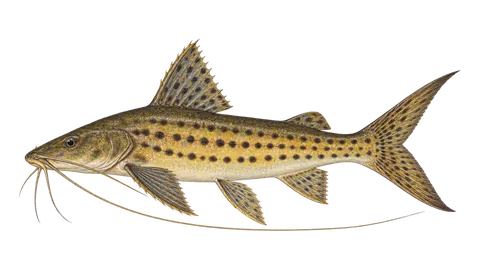
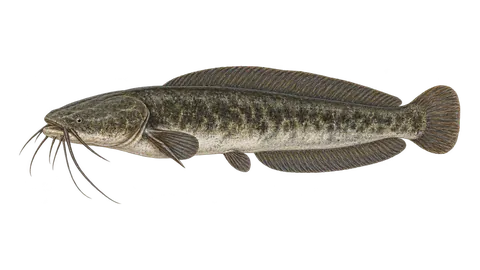
Elongated, scaleless body, grey to olive-brown, sometimes mottled, with a light belly. Three pairs of long barbels; the jaws reach close to the tail. Long adipose fin. The mandi is yellowish with rows of spots and has stronger spines. The African catfish has a broad bony head, four pairs of barbels and no adipose fin.
Loading the next 7 days…
Each card shows the day's index (0 to 100) and, below it, a strip with the index for each hour, from 0h to 23h. from poor to excellent.
Rivers, streams, lagoons and farm ponds of the South and Southeast, the Pantanal and the São Francisco; very common in RS, SC and PR.
Habitat: Bottoms with rocks, logs and holes; slack water, cutbanks and small farm ponds.
native to the basins
states
Rio Grande do Sul, Santa Catarina, Paraná, São Paulo, Minas Gerais, Mato Grosso do Sul, Goiás
Spring and summer are the best, but it keeps biting in autumn and on mild winter days.
Nighttime. Active at night, mostly in the first hours after dusk. Cloudy days and murky water help during the day.
Tolerates the cold, but stops on freezing winter nights.
Little effect.
Dark nights produce more.
Water turning murky after rain often activates the jundiá.
A river rising slowly brings food and gets fish moving.
Not very sensitive.
Almost no effect.
Bottom, 0.5 to 4 m.
natural baits
accessories
At night, bait on the bottom near rocks and snags, with little slack in the line. The jundiá swallows the bait: strike quickly so you don't injure the fish.
For anyone who's never fished and wants a simple kit for a pay lake, lake, reservoir or calm river, with natural bait.
guideWhat to do about a hook stuck in the skin, stingray and catfish stings, piranha bites, line cuts, sunburn, heat exhaustion and drowning. It doesn't replace a first-aid course or medical care.
guideFor anyone who has never fished: license, where to go, a cheap kit that works, how to rig a bobber line, how to bait the hook and what to do when the fish bites.
Summary of the regulations we found, with the source for each. Rules change; before keeping or transporting fish, check with the state environmental agency.
Conservation: Rhamdia quelen is treated as a species complex.
Source: Portaria IAT nº 650/2025, Annex I (interior basins of PR, except Iguazu and coastal)
Source: Portaria Naturatins nº 47/2026, Annex I, as amended by Portaria nº 105/2026
Allowed: Recreational fishing only for non-native species and hybrids (peacock bass, tilapia, black bass, carp, croaker, etc.; piauçu remains prohibited), with handline, simple pole, or rod with spinning or baitcasting reel, up to 10 kg + 1 fish. In rivers, from shore only; in reservoirs, from a boat or from shore. Prohibited: floodplain lakes, aquatic-animal bait, within 1,500 m of dams and waterfalls, and within 500 m of confluences. Tournaments only in reservoirs and only with non-native species.
Source: IN IBAMA nº 25/2009
Allowed: Only exotic or hybrid species, 3 kg + 1 fish per day, with handline, rod, simple pole, or spinning or baitcasting reel. Nets prohibited. Keep the minimum distances from dams and reservoirs.
Source: Portarias IEF nº 154/2011 (São Francisco), 155/2011 (East) and 156/2011 (Grande/Paranaíba)
Allowed: Sport and guided fishing only in reservoirs, catch and release with barbless hooks (no keeping, transporting or eating). Subsistence: up to 5 kg per day, for household consumption only.
Allowed: Subsistence fishing by riverside residents and authorized scientific fishing. Decree 15.166/2019 (art. 11, §5) allows catch and release only in February and only in the channels of the Paraguay and Paraná rivers. For the rest of the period, not even catch and release is allowed. Check the Imasul portaria for each season.
Source: Decreto estadual MS nº 15.166/2019, art. 11; IN IBAMA nº 201/2008
Allowed: All fishing modalities are prohibited in rivers, including catch and release (Law 9.096/2009, art. 19-A). Exceptions: subsistence fishing from shore (3 kg or 1 fish, no transport or sale) and scientific fishing. Law 13.159/2025 now allows licensed sport fishing in UHE/PCH hydropower reservoirs, natural lakes and border rivers, subject to a scientific study and a license from the environmental agency. We have not confirmed whether these licenses are already being issued.
Allowed: Recreational fishing from a boat or from shore with handline, rod, spinning or baitcasting reel, up to 5 kg + 1 fish. Prohibited within 1,000 m of dams, waterfalls and rapids, and within 500 m of confluences. Floodplain lakes have a longer closed season (see next item).
Source: Portaria IBAMA nº 50/2007
Allowed: No fishing in the floodplain lakes during the period.
Source: Portaria IBAMA nº 50/2007
Allowed: Recreational fishing from shore, or from a boat without motor. Only handline or rod, line and hook, one gear per angler, up to 5 kg. Prohibited in floodplain lakes, within 1,500 m of dams, within 500 m of confluences, and in stretches listed in the rule (e.g., Turvo River).
Source: IN IBAMA nº 193/2008
Allowed: Recreational fishing from a boat or from shore, with a single hook, one gear per angler, up to 5 kg.
Source: IN IBAMA nº 197/2008
Allowed: In rivers, shore fishing only; in reservoirs, from a boat or from shore. Only non-native species, hybrids, and giant river prawn (camarão-gigante-da-malásia), up to 10 kg + 1 fish. Prohibited in floodplain lakes and within 1,000 m of dams.
Source: IN IBAMA nº 195/2008
Allowed: Same rules as the Southeast basins: only non-native species and hybrids, up to 10 kg + 1 fish; in rivers, shore fishing only.
Source: IN IBAMA nº 196/2008
Hold it behind the pectoral spines with a damp cloth. If it swallowed the hook, cut the line close to the hook.
White meat with no intramuscular bones, very tasty; fried, stewed or grilled over coals.
Length-weight relationship W = a·Lb (a = 0.00912, b = 3.02; FishBase). It's an average: a fat or lean fish can vary by 10% to 20%.
estimated weight
—
The season weights (months), the time of day and the sensitivities (cold, pressure, moon, wind, rain, tide, strong light, murky water and noise) are the app's editorial estimates, based on the literature below and on the field experience of anglers and guides. They are not official data nor a measurement made for this species, and they may vary by region and year. Closed seasons and legal rules appear in the rules section, with the norm and a link.
Your location is saved only on this device and feeds the forecast, the map and the "today" on the home page.