

- common size
- 35–60 cm
- maximum
- 132 cm
- common weight
- 0.8–4 kg
- record/max.
- 26.3 kg
- depth
- 1–8 m
- ideal water
- 22–29 °C

the right time
to be on the water
Choose the place and the species. The index, from 0 to 100, combines weather, sun, moon and tide with each fish's habits. Up to 28 days, with each day's confidence.
Loading the forecast…
—
Looking for alerts within 30 km…
Looking for what anglers have logged near here…
what you need to fish herelicense, certification and boat documents
fish likely at this spot
Tap a fish to see its forecast.
hour by hour
slide your finger or mouse over the chart to see each hoursee hour-by-hour table
why this index at —?
choose the day
the fishing month at a glance
what's the best window for the crew?
Choose how many fishing days. We compare each stretch by its average index, discount days with a warning or closed season, and show the 3 best.
trend for the coming weeks
Line: the middle value of 31 simulations of the American GEFS model. Band: where 8 out of 10 fall. Narrow, firm trend; wide, high uncertainty.
everything about the channel catfish
how to recognize it
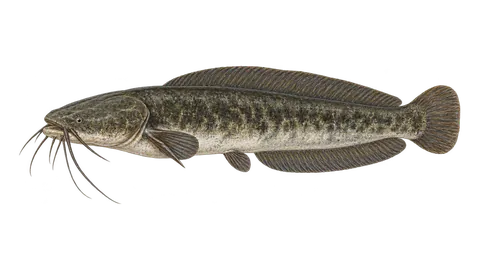
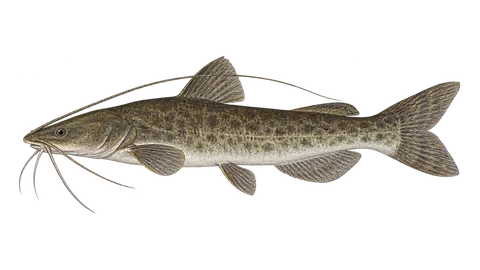
Smooth body without scales, blue-grey to olive on the back and white on the belly, with scattered dark spots on the flank (clearer in juveniles). Four pairs of barbels around the mouth. Deeply forked tail. The African catfish has a rounded tail and a long dorsal fin without a spine.
Also called: bagre-americano, bagre-do-canal, catfish, channel catfish
don't confuse with:
where found
open on the large mapWhere to look: Pay lakes, farm ponds and reservoirs; in rivers, deep pools with sand or stone bottoms.
Exotic, native to North America. Raised in fish farms and pay lakes; recorded in the wild in the upper Paraná (PR) and listed as exotic by the Goiás rules (Paranaíba and Araguaia-Tocantins) and by Minas Gerais.
introduced in
states
Paraná, Goiás, Minas Gerais
when to fish
best season
Warm months, October to March; eats less in winter.
best time of day
Night and twilight. Feeds more at night and at dusk; in a pay lake it also feeds by day.
what affects the channel catfish
cold and cold fronts
Tolerates cold, but feeds little below about 15 °C.
atmospheric pressure
A cold front stops the bites for a day or two.
moon
Dark nights tend to produce more.
rain
Often becomes active when the water starts to cloud.
water level
Little effect in a lake.
noise
Moderately sensitive.
wind
Little effect.
depth
Bottom, 1 to 5 m.
how to fish
natural baits
- piece of fish
- chicken liver
- strong-smelling dough
- minhoca
tip from an angler
Strong-smelling bait on the bottom, late afternoon and at night. Follow the pay lake's rules.
- rod
- 6' to 7', medium action, 15 to 30 lb
- spinning / baitcasting reel
- spinning reel 3000 to 5000 or baitcasting reel
- line
- monofilament 0.35 to 0.40 mm or braided 30 lb
- leader
- monofilament 40 lb
- hook
- #2/0 to 5/0 hook or circle hook
accessories
- olive sinker
- alicate
catch and release
At a pay lake, follow the house rules. In the wild, do not release exotic fish somewhere else.
rules for the channel catfish
Rules change; before keeping or transporting fish, check with the state environmental agency.
GO: free capture and transport (exotic)
no size or bag limitGO details
In Goiás the channel catfish is in Annex II of the state rule: exotic, allochthonous and hybrid species may be collected, killed and transported without size or bag limits, even with the zero transport quota for native fish.
Source: IN Semad-GO nº 17/2026, art. 5º and Annex II (exotic, allochthonous and hybrid species)
Releasing into the wild without a license is an offense
releasing or introducing fish into rivers, reservoirs and lakes is prohibitedconfirm with the agency details
Introducing an exotic species without a technical opinion and license is a federal environmental offense. This includes releasing a fish from a tank, pay lake or aquarium into a river or reservoir.
Source: Lei federal nº 9.605/1998, art. 31, and Decreto federal nº 6.514/2008, art. 25
Conservation: In its native range, the global IUCN assessment is Least Concern (LC, Feb 20, 2012).
how much it weighs without taking it out of the water
estimated weight
—
how we calculate
Length-weight relationship W = a·Lb (a = 0.00525, b = 3.13; FishBase). It's an average: a fat or lean fish can vary by 10% to 20%.
more about the channel catfish
Native to North America, where it is one of the most farmed and fished fish, the channel catfish was brought to Brazil for fish farming and is now common in pay lakes in the South and Southeast. It prefers clean, well-oxygenated water, but lives well in reservoirs and tanks. It eats small fish, crustaceans, mollusks and insects. In the upper Paraná there are already wild records, in the São Francisco Verdadeiro River (PR), and Goiás and Minas rules treat it as exotic. For anglers it is a bottom fish, active at night, that fights with strong runs.
Family: Ictaluridae · predator
fun facts
- It is one of the most farmed fish in aquaculture in the United States.
- There is an albino form, raised as an ornamental fish.
in the kitchen
White, firm flesh with no intermuscular bones; fried as fillets, breaded or smoked.
similar species
sources and references (5)
The season weights (months), the time of day and the sensitivities (cold, pressure, moon, wind, rain, tide, strong light, murky water and noise) are the app's editorial estimates, based on the literature below and on the field experience of anglers and guides. They are not official data nor a measurement made for this species, and they may vary by region and year. Closed seasons and legal rules appear in the rules section, with the norm and a link.
- scientific FishBase — Ictalurus punctatus (ficha da espécie)Names, distribution, biology, length-weight relationship and references. Page checked on October 13, 2026.
- scientific IUCN Red List — Ictalurus punctatus (avaliação global: Pouco Preocupante, LC, 20/02/2012)Global assessment. Link given on the FishBase entry (Red List, version 2025-2).
- technical CABI Compendium — Ictalurus punctatus (channel catfish). Engle, C.; Kumar, G. (2023).Data sheet for an introduced species. DOI checked in Crossref.
- scientific Ota, R. R.; Deprá, G. C.; Graça, W. J.; Pavanelli, C. S. (2018). Peixes da planície de inundação do alto rio Paraná e áreas adjacentes: revised, annotated and updated. Neotropical Ichthyology 16(2): e170094.Annotated list of the species of the upper Paraná, indicating native and non-native species. Open access; species name checked in the text. Records the species as non-native in the São Francisco Verdadeiro River (PR).
- official IN Semad-GO nº 17/2026 — normas de pesca em Goiás (Anexos I e II)Annex II lists exotic, allochthonous and hybrid species with free capture and transport. Text checked on Oct 13, 2026.
how we calculatewhere each number comes from
The weather comes from three independent global models, cross-checked hour by hour: when they agree, confidence goes up; when they diverge, the band between them shows on the chart. Beyond 16 days, we use the GEFS ensemble of 31 simulations: if 20 of the 31 predict rain, the chance of rain is 65%. Sun and moon are calculated astronomically, with no uncertainty.
The index adds up, weighted for each species: time of day (species curve anchored to real sunrise and sunset), moon (transits, rise and set, phase), pressure (3 h trend and 24 h swing), water temperature (in rivers, estimated from air temperature; at sea, estimated by an ocean model), wind, rain, clouds, tide and the month in the species' cycle.
sources for this lookup
how accurate the forecast is
Accuracy measured in the reference project (4 regions, 93 days, forecast vs. observed): maximum temperature is off by 0.6 °C on average the next day and 1.7 °C at 7 days; rain of 5 mm or more is detected 76% of the time the next day and 57% at 7 days. Detection isn't everything: the false alarm rate isn't published here yet, and 93 days in 4 regions is still a small sample. We now also measure every day, at the app's destinations: