overview
who is the flathead catfish
A catfish of the family Ictaluridae, native to North America, from the Mississippi, Ohio and Missouri basins and the Gulf drainages down to Mexico. In Mexico it occurs in the north, in the Rio Bravo basin, and Mexico's inland-waters rule lists it, as pintontle, among the commercial-fishing species of the Venustiano Carranza (Don Martín, in Coahuila) and José López Portillo (Cerro Prieto, in Nuevo León) reservoirs. Adults live in deep pools of rivers from small to large, among logs and debris, and also in lakes and reservoirs. It is an ambush predator, mostly nocturnal: juveniles eat insect larvae and crustaceans, and adults eat fish, crayfish and mollusks. FishBase gives up to 155 cm, 55.8 kg and 25 years. The IGFA world record, 123 lb (about 55.8 kg), came from Elk City Reservoir, Kansas, in 1998. Outside its native range, in the USA, it is a problem as an introduced predator.
fun facts
- The IGFA world record, 123 lb, was caught at Elk City Reservoir, Kansas, in 1998; a 2016 study estimated the fish was at least 22 years old.
- The male guards the nest built under logs or other cover.
- In U.S. rivers where it was introduced, it became a control priority because of its appetite for native fish.
how to recognize it
identification
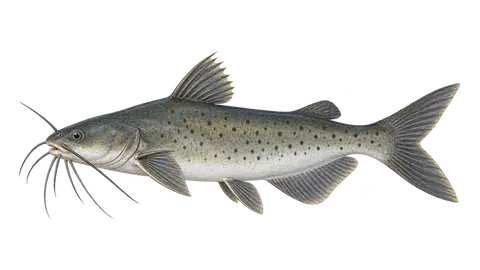
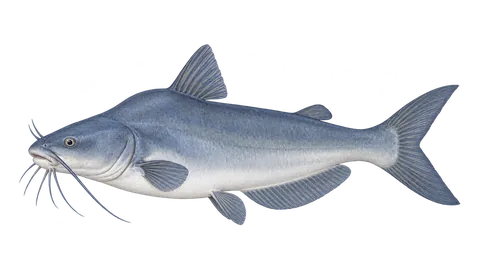
Broad, very flattened head, with the lower jaw projecting beyond the upper and small eyes. Rounded tail, unlike the forked tail of the channel and blue catfish, and an adipose fin with a free rear tip. The body is grayish brown, mottled with dark, and the belly is yellowish white; the chin barbels are pale.
how flathead catfish fishing looks
Loading the next 7 days…
Each card shows the day's index (0 to 100) and, below it, a strip with the index for each hour, from 0h to 23h. from poor to excellent.