Skip to content
catalog Sciaenidae · predator

california kingcroaker

Menticirrhus undulatus

Sea

The betara (California corbina) of the northern Pacific beaches, from California to the Gulf of California. It hunts sand crabs and worms right in the surf, and is a classic target for shore anglers using fine natural bait.

Also called: betara-da-califórnia, california corbina, california kingcroaker, california king-croaker

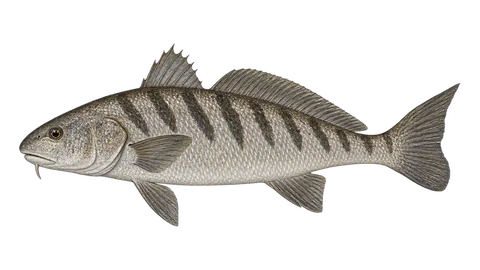
Scientific illustration of California kingcroaker
common size
30–50 cm
maximum
71 cm
common weight
0.3–1.3 kg
record/max.
3.9 kg
depth
1–20 m
ideal water
16–24 °C
overview

who is the california kingcroaker

Northeastern Pacific betara, from southern California (USA) to the Gulf of California. Lives on sandy beaches, bays and open-coast surf, almost always at less than 20 m, in small groups; the largest tend to roam alone. Eats sand crabs, other small crustaceans and worms. Grows to 71 cm and almost 4 kg, with a recorded maximum age of 8 years. Like other betaras, it has no swim bladder, so it does not make the drumming sound of corvinas. Spawning starts in July, with eggs released into the water. It is a prized food fish and common in markets, caught in the surf with fine natural bait and light line.

fun facts

  • It has no swim bladder, so it does not make the drumming sound that gives corvinas their name 'croaker'.
  • FishBase records pelagic spawning from July and a maximum age of 8 years.
how to recognize it

identification

Elongated, rounded body with a straight belly; long, low head with a conical snout that projects past the mouth, which is horizontal and set low. It has a short, thick barbel on the chin and no canine teeth. Gray to metallic blue above, white below, with dark wavy lines on the flanks and black pectorals; juveniles have a dark spot on the flank. The chest scales are much smaller than the body scales, and the third spine of the first dorsal does not reach the second dorsal. The Atlantic betara (M. americanus) is a different species.

how california kingcroaker fishing looks

Loading the next 7 days…

Each card shows the day's index (0 to 100) and, below it, a strip with the index for each hour, from 0h to 23h. from poor to excellent.

distribution

where found

open on the large map

Does not occur in Brazil. Northeastern Pacific, from southern California (USA) to the Gulf of California, including the Pacific coast of the Baja California peninsula. FishBase extends the range to Peru, but STRI records it only as far as the Gulf of California; records farther south need confirmation (Central America and Peru have other betaras, such as M. panamensis).

Habitat: Sandy beaches, bays and open-coast surf, on sandy bottoms, almost always down to about 20 m.

calendar and clock

when to fish

best season

time of yearbest: Jun–Oct
JanFebSeaAprMayJunJulAugSepOctNovDec

Bites best in warm water, from late spring to early autumn, a period that coincides with spawning (from July). In winter it tends to stay deeper and be less active.

best time of day

0h6h12h18h sunrise ~6amsunset ~6pm

Daytime, with peaks at dawn and dusk. It comes into the surf to feed at dawn, at dusk and on the rising tide; at midday, with strong sun and clear water, it is more wary.

weather, water and behavior

what affects the california kingcroaker
sensitivity The little bars show how much each factor affects this species. Five full: it feels it a lot.

cold and cold fronts

Cold upwelling or winter water pushes the fish deeper and drops activity.

atmospheric pressure

Little direct effect; a churned-up sea after a front hinders it more.

moon

Full and new moon tides bring higher water over the sandbars and activate the fish.

rain

Little effect at sea; runoff that muddies the shore scares fish out of the shallows.

water level

Does not apply at sea. What counts is the height of the tide over the sandbars.

noise

Very wary in the shallows: heavy footsteps, shadows and talking near the water scare the fish.

wind

Strong wind raises the surf, muddies the water and hinders beach fishing.

tide

A rising tide near high tide is best; a low, still tide is usually slow.

depth

Shallow (0.5 to 3 m) in the surf; they sit a bit deeper when the sea is rough.

technique, gear and bait

how to fish

rod
9' to 10', medium to fast action, 8 to 15 lb
spinning / baitcasting reel
spinning reel 3000 to 4000
line
monofilament 8 to 12 lb or braid 15 to 20 lb
leader
fluorocarbon 10 to 15 lb, 50 cm to 1 m
hook
short, thin single hook, sizes 2 to 1/0

lures

  • rarely used with artificials; a light jig head with silicone shrimp works now and then

natural baits

  • live sand crab (tatuíra, Emerita)
  • minhoca-de-mar
  • mussel
  • small shrimp

accessories

  • small sliding sinker, 15 to 40 g
  • bucket for bait
  • alicate

tip from an angler

Use live bait and a small hook, and let the bait roll gently with the wave: the betara is wary and rejects heavy line and a heavy sinker.

what the law says

rules for the california kingcroaker

Summary of the regulations we found, with the source for each. Rules change; before keeping or transporting fish, check with the state environmental agency.
Conservation: Insufficient data: the IUCN has no information to say whether it is threatened.

Mexico: up to 5 per species and 10 saltwater fish per day

5 specimens of the species per angler per day, within the limit of 10 saltwater fish

In federal waters of Mexico, recreational sport fishing allows each angler to keep up to 10 marine fish per day, no more than 5 of the same species. The California betara (berrugata californiana) is not among the species reserved for sport fishing (marlins, sailfish, swordfish, tarpon (sábalo), roosterfish and dorado, up to 50 nautical miles from shore, item 0.3 of the standard) and has no quota of its own. Fish over the quota must go back alive, and sport-caught fish may not be sold. From shore you need no permit; from a boat, you do (permits under the Federal Duties Law, item 4.3).
Source: Amendment to NOM-017-PESC-1994 (recreational sport fishing in federal waters of Mexico), published in the DOF on Nov 25, 2013, items 0.3, 4.3, 4.9.1, 4.9.5 and 4.11 (Sagarpa/Conapesca)

catch and release
catch and release Releasing the fish alive, quickly and with a wet hand. During a closed season it isn't always allowed: what the regulation says applies.

Surf fish: don't drag it over dry sand, wet your hands before picking it up, and release it quickly, facing the wave.

in the kitchen

White, delicate flesh; very good fried, grilled or baked. FishBase considers it a good food fish.

calculator

how much it weighs without taking it out of the water

Length-weight relationship W = a·Lb (a = 0.00933, b = 3.02; FishBase (relação peso-comprimento bayesiana, estimativa da própria espécie)). It's an average: a fat or lean fish can vary by 10% to 20%.

estimated weight

—

sources and references

The season weights (months), the time of day and the sensitivities (cold, pressure, moon, wind, rain, tide, strong light, murky water and noise) are the app's editorial estimates, based on the literature below and on the field experience of anglers and guides. They are not official data nor a measurement made for this species, and they may vary by region and year. Closed seasons and legal rules appear in the rules section, with the norm and a link.

  1. scientific FishBase: Menticirrhus undulatus (ficha da espécie)Size, length-weight relationship, depth, habitat, distribution, biology and IUCN status. Page checked Oct 13, 2026. The maximum length of 71 cm and the weight of 3.9 kg are FishBase values.
  2. scientific FishBase: nomes populares de Menticirrhus undulatusNames by country and language.
  3. scientific Robertson, D. R. & Allen, G. R. (2024). Shorefishes of the Eastern Pacific online information system. Smithsonian Tropical Research Institute: Menticirrhus undulatusDescription, colors, depth (1 to 20 m) and distribution (southern California to the Gulf of California). STRI cites up to 83.6 cm, a value we kept out of the entry for lack of an associated weight. Because STRI does not record the species south of the Gulf of California, the entry lists only Mexico among the countries. Page checked Oct 13, 2026.
  4. scientific Eschmeyer, W. N.; Herald, E. S.; Hammann, H. (1983). A field guide to Pacific coast fishes of North America. Boston: Houghton Mifflin.Main FishBase reference for habitat, feeding and spawning.
  5. official DOF: Modificação da NOM-017-PESC-1994, para regular a pesca deportivo-recreativa em águas de jurisdição federal do México (publicada em 25/11/2013)Species reserved for sport fishing (item 0.3), permits (4.3 and 4.14), rod and hooks (4.6), bait (4.7), daily quotas at sea (4.9.1) and in fresh water (4.9.2), catch and release (4.9.5), closed areas and seasons (4.10) and the ban on selling the fish (4.11). Text checked Oct 13, 2026. The text carries the signature date of Oct 14, 2013; the DOF publication date (Nov 25, 2013) is the one the catalog already uses.
don't confuse

similar species