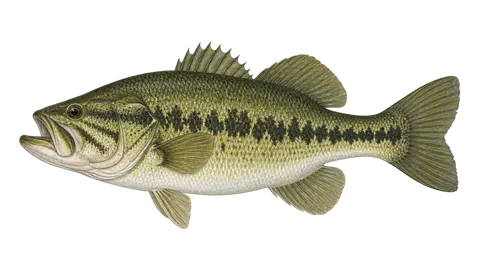
The Florida lineage of black bass, moved to reservoirs in Mexico and Puerto Rico. It is the fish of Mexico's trophy lakes, caught on artificial lures near logs and grass.
Also called: black bass da Flórida, lobina-da-flórida, Florida bass, Florida largemouth bass
Native only to the Florida peninsula (USA); for a long time it was treated as a subspecies of the largemouth bass (Micropterus salmoides) and is now often recognised as its own species. It likes warm water and grows well in tropical and subtropical reservoirs, so it was stocked in lakes in Mexico and Puerto Rico in search of bigger fish. In those reservoirs it crosses with the common largemouth bass, and hybrid populations exist. It is an ambush predator: it stays by logs, submerged timber, vegetation and drop-offs, and eats fish, crayfish and frogs. In Mexico, the reservoirs of the northwest and northeast draw anglers from around the world, always fishing with artificial lures and lots of catch and release.
fun facts
Because it grows larger in warm water, the Florida lineage was moved to reservoirs in other countries in search of trophy fish.
It crosses with the common largemouth bass: genetic studies in northeastern Mexico found pure and hybrid populations, and in Puerto Rico Florida ancestry predominates in the reservoirs.
how to recognize it
identification
Robust body, olive-green on the back, greenish flank with an irregular dark band of blotches from snout to tail, and white belly. The mouth is huge: the maxilla extends past the back edge of the eye. The two dorsal fins are nearly separated by a deep notch. Externally it is nearly identical to the common largemouth bass (M. salmoides); the Florida lineage tends to have more lateral line scales, but only genetics separates them reliably, and there are reservoirs with hybrids.
how florida bass fishing looks
Loading the next 7 days…
Each card shows the day's index (0 to 100) and, below it, a strip with the index for each hour, from 0h to 23h. from poor to excellent.
There is no confirmed record in Brazil, where the introduced black bass is the largemouth bass (M. salmoides). Native to the Florida peninsula (USA). Introduced into reservoirs in Mexico, such as Vicente Guerrero (Tamaulipas), and into reservoirs in Puerto Rico, where the Florida lineage predominates.
Habitat: Warm reservoirs and lakes: submerged logs and timber, vegetation beds, points of land, drop-offs and old river channels within the reservoir.
calendar and clock
when to fish
best season
time of yearbest: Nov–Mar
JanFebSeaAprMayJunJulAugSepOctNovDec
In Mexico's reservoirs the strong season usually runs from November to March, with cooler water and big fish before spawning. In hot summer activity drops during sunny hours. Check the closed seasons for each reservoir.
best time of day
Daytime, with peaks at dawn and dusk. Bites best at dawn and in the late afternoon, when it rises to the shallows. In strong sun it drops into the shade of logs and drop-offs; on cloudy days it feeds all day.
weather, water and behavior
what affects the florida bass
sensitivity The little bars show how much each factor affects this species. Five full: it feels it a lot.
cold and cold fronts
More sensitive to cold than the common largemouth bass: a cold front shuts down activity and drives fish to the bottom for 1 to 3 days.
atmospheric pressure
Stable pressure helps; the drop before a front often gives a short burst of strikes.
moon
Moderate effect; during spawning, the full and new moons coincide with nests in the shallows.
rain
Light rain and overcast skies help; if there is a thunderstorm with lightning, get out of the water.
water level
A rising reservoir floods new vegetation and draws fish into the shallows; a falling reservoir concentrates fish on points and channels.
noise
Sensitive to hull knocks and motor noise near the structure; approach with the electric motor.
wind
A light breeze on the bank breaks up the light and gets fish active; strong wind makes precise casting hard.
depth
Shallow (0.5 to 3 m) at dawn and during spawning; 4 to 10 m on drop-offs and river channels at midday.
6'6" to 7'3", fast action, 12 to 25 lb (heavier for frogs and grass)
spinning / baitcasting reel
low-profile baitcasting reel, 7:1 to 8:1 gear ratio, or spinning reel 2500 to 3000
line
fluorocarbon 12 to 20 lb or braided line 40 to 65 lb in vegetation
leader
fluorocarbon 15 to 20 lb, 1 to 1.5 m, when the main line is braided
hook
offset 3/0 to 5/0 for silicone lures; the original treble hooks of hard lures
lures
10" silicone worm on a Texas rig
jig with trailer
swimbait 12 to 18 cm
mid- and deep-diving crankbait
frog and topwater stickbait at dawn
natural baits
live fish as bait is banned in Mexico's inland waters
accessories
long-nose pliers
polarized glasses
sonar to find drop-offs and river channels
tip from an angler
In Mexican reservoirs, work the silicone worm slowly down the drop-off beside the logs: big fish rarely chase the lure; they grab what passes in front of them.
what the law says
rules for the florida bass
Summary of the regulations we found, with the source for each. Rules change; before keeping or transporting fish, check with the state environmental agency. Conservation: Exotic in Mexico and Puerto Rico; native to the Florida peninsula (USA).
Mexico: up to 5 freshwater fish per day, no live fish as bait
5 fish per angler per day
In Mexico's federal-jurisdiction inland waters, the limit is 5 fish per angler per day, with one rod in use per angler. Using live fish as bait in inland waters is banned, and fish caught in sport fishing may not be sold. Each reservoir's committee may reduce the bag limit and set sizes.
Mexico: largemouth bass at least 35 cm and up to 5 per day
35 cm (total length); up to 5 per angler per day
NOM-060 treats the largemouth bass and the Florida bass together. Outside the reservoirs with their own rules in Annex 1 of the standard, the sport angler may keep up to 5 bass per day, at least 35 cm total length. Once the limit is reached, the rest go back alive, and females visibly carrying eggs must always be released. In boat fishing and tournaments, fishing is only allowed from 6 a.m. to 7 p.m.
El Salto (Sinaloa) and Vicente Guerrero (Tamaulipas) reservoirs: size windows
El Salto: 5 per day from 35 to 45 cm; Vicente Guerrero: 5 from 35 to 39.9 cm and 1 above 61 cm
At the Aurelio Benassini Vizcaíno reservoir (El Salto), the limit is 5 bass per day, 35 to 45 cm; smaller and larger fish go back to the water right away. At Vicente Guerrero reservoir, 5 bass from 35 to 39.9 cm and 1 above 61 cm per day apply; fish under 35 cm and those from 40 to 61 cm must be released, to build trophy fish.
Chihuahua (MX): bass closed season March 10 to June 25
fishing banned March 10 to June 2510/03 to 25/06confirm with the agency
In federal-jurisdiction waters of the state of Chihuahua, fishing for largemouth bass is banned from March 10 to June 25 each year. The agreement uses the name Micropterus salmoides; since the Mexican rule treats the Florida lineage as a subspecies of the bass, consider the closure to apply to it too. It applies only in Chihuahua.
Aguamilpa, El Cajón (Nayarit) and Zimapán: catch and release only during the closed season
bass catch and release only during the closed season01/03 to 30/06
At the Aguamilpa and El Cajón reservoirs (Nayarit), fishing for all fish is closed from March 1 to June 30; at the Zimapán reservoir (between Hidalgo and Querétaro), from March 15 to June 20. During these periods sport fishing for bass remains allowed only as catch and release, with the fish returned alive.
catch and release Releasing the fish alive, quickly and with a wet hand. During a closed season it isn't always allowed: what the regulation says applies.
Hold it by the mouth with your thumb and support the belly on big fish; don't hang a heavy fish by the jaw alone. Release it quickly, preferably near the structure where it was hooked.
in the kitchen
White, lean flesh; fillets fried or baked. In Mexico's trophy reservoirs almost every big fish is released.
calculator
how much it weighs without taking it out of the water
Length-weight relationship W = a·Lb (a = 0.01047, b = 3.08; FishBase (relação da espécie-irmã Micropterus salmoides; a FishBase não traz relação própria confiável para M. floridanus); comprimento máximo estimado por esta relação a partir do peso recorde). It's an average: a fat or lean fish can vary by 10% to 20%.
estimated weight
—
sources and references
The season weights (months), the time of day and the sensitivities (cold, pressure, moon, wind, rain, tide, strong light, murky water and noise) are the app's editorial estimates, based on the literature below and on the field experience of anglers and guides. They are not official data nor a measurement made for this species, and they may vary by region and year. Closed seasons and legal rules appear in the rules section, with the norm and a link.
scientificFishBase — Micropterus floridanus (ficha da espécie)Names, distribution, biology, length-weight relationship, country list and references. Page checked on Oct 13, 2026. The species entry has few data and lists only the USA; the published maximum weight is 7.2 kg.
scientificFishBase — Micropterus salmoides (ficha da espécie)Names, distribution, biology, length-weight relationship, country list and references. Page checked on Oct 13, 2026. Length-weight relationship used in this entry.