

american eel
Anguilla rostrata
An eel that grows in rivers, lagoons and estuaries of Mexico, Central America and the Caribbean, and goes to spawn in the Sargasso Sea. It is Endangered worldwide: if you hook one, release it.
- common size
- 40–70 cm
- maximum
- 152 cm
- common weight
- 0.1–0.7 kg
- record/max.
- 7.3 kg
- depth
- 0–464 m
- ideal water
- 15–23 °C
how to recognize it
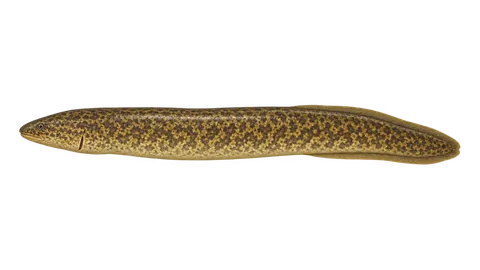
Long, rounded body like a snake's, with no pelvic fins and with the dorsal, caudal and anal fins joined in one continuous fin. Smooth, very slippery skin with tiny embedded scales. Long head, small eyes, thick lips, lower jaw longer than the upper, and well-developed pectoral fins, with the gill opening in front of them. Adults are brown to dark blue on the back and pale below; juveniles have some yellow on the edge of the dorsal and anal fins. Morays have no pectoral fins, and neither does the mussum (Synbranchus).
Also called: enguia-americana, enguia, american eel, freshwater eel
don't confuse with:
where found
open on the large mapWhere to look: Rivers, streams and lagoons with mud or silt bottoms, preferably with steady current, dug-out banks, logs and deep pools where it hides by day. It passes through estuaries and mangroves and goes out to sea, down to about 464 m, to spawn.
Atlantic coast of the Americas, from Greenland to Panama, and much of the Antilles down to Trinidad. In Latin America it occurs in Mexico, Central America, the Caribbean islands and, in northern South America, Colombia and Venezuela. FishBase's country list does not include Brazil.
when to fish
next 7 days
Loading the next 7 days…
best season
Yellow eels (the growth stage) are active all year in warm water. In autumn the adults go down to the sea on dark nights with high water, and in the Antilles young eels (elvers) enter rivers in winter; in the Dominican Republic the 2022-2023 elver season ran from 15/10 to 31/03.
best time of day
Nighttime. Hides by day and goes out at night to hunt; activity is highest in the first hours after sunset.
what affects the american eel
cold and cold fronts
In cold water it stays still and barely feeds; the range reported by FishBase is 4 to 25 °C.
atmospheric pressure
Small effect.
moon
It prefers dark nights: on full-moon nights it goes out less, and the adults' downstream migration to the sea happens on moonless nights.
rain
Rising, muddy water after rain flushes the eel out of its hiding places and triggers the adults' migration.
water level
Low, clear river: only at night. With the water rising, it also becomes active at dusk.
noise
It senses vibration on the bank; step lightly and avoid shining a flashlight in the fish's face.
wind
Little effect.
tide
In estuaries, the ebb tide carries the adults out to sea during migration.
depth
By day it stays on the bottom, hidden; at night it moves up to the shallows and the banks.
how to fish
natural baits
- minhoca
- fish pieces
- shrimp
tip from an angler
Endangered species: if it swallows the hook, cut the leader close to the mouth instead of pulling it out; it survives better.
- rod
- 7', medium action, 10 to 20 lb
- spinning / baitcasting reel
- 3000 reel
- line
- monofilament 12 to 20 lb
- leader
- monofilament 20 to 30 lb, 30 to 40 cm
- hook
- circle 1/0 to 2/0 (hooks in the corner of the mouth and injures less)
accessories
- wet cloth or glove
- long-nose pliers
- red light lantern
catch and release
Always release: the species is Endangered and long-lived, and large eels are very old. Hold it with a wet cloth or glove, horizontally, and release it in deep water with current. If the hook is deep, cut the line close to the mouth.
rules for the american eel
Rules change; before keeping or transporting fish, check with the state environmental agency.
Dominican Republic: eel fishing banned in protected areas
fishing banned, at all stages, in protected areas and buffer zones details
In the Dominican Republic, fishing for eels (Anguilla rostrata) is permanently banned at all stages of development, including elvers, within the units of the National System of Protected Areas and their buffer zones.
Source: Decreto nº 418-21, of Jul 2, 2021, art. 3º (Presidency of the Dominican Republic)
Dominican Republic: eel capture only with registration and a special permit
special CODOPESCA permit to capture, sell and export; season and quota set by resolutionconfirm with the agency details
CODOPESCA Resolution No. 02-22 requires a special permit to exploit, sell and export the American eel, limits capture to fishers registered for the species, and prohibits carrying more than 100 g outside the card zone. For 2022-2023 it opened the elver season from 15/10/2022 to 31/03/2023, closed fishing and trade of all stages from 01/04 to 14/10/2023, and set a maximum quota of 1,500 kg. These dates apply to that period; we did not check a more recent resolution. Check with CODOPESCA before fishing.
Conservation: Endangered in the IUCN global assessment (criterion A2bd, assessed 08/11/2020). As it is outside the Brazilian fauna, it is not on the national list (Portaria GM/MMA nº 1.667/2026). In November 2025 CITES CoP20 rejected the proposal to list eels of the genus Anguilla in Appendix II. IUCN global: EN · endangered.
how much it weighs without taking it out of the water
estimated weight
—
how we calculate
Length-weight relationship W = a·Lb (a = 0.00087, b = 3.19; FishBase (relação peso-comprimento bayesiana, estimativa da própria espécie)). It's an average: a fat or lean fish can vary by 10% to 20%.
more about the american eel
The American eel has one of the strangest lives of any fish caught in Latin America. It is born in the Sargasso Sea, in the middle of the North Atlantic; transparent, leaf-shaped larvae drift to the coast and turn into young eels that swim up rivers, lagoons and swamps. There they spend one to several decades, hiding by day under banks, among logs and in deep pools, and hunting insect larvae, snails, small crustaceans and fish. In autumn the adults go back down the rivers and return to the sea to spawn. It reaches 152 cm, 7.3 kg and 43 years of age, according to FishBase. The IUCN has rated it Endangered since the 2020 assessment.
Family: Anguillidae · predator
fun facts
- Born in the Sargasso Sea; the transparent larvae, the leptocephali, are shaped like willow leaves and drift to the coast before turning into elvers.
- It can exceed 40 years in fresh water before maturing; the oldest age record in FishBase is 43 years.
- In 2025, at CITES CoP20, the proposal to regulate trade in all Anguilla eels (including this one) lost by 100 votes against, 35 in favor and 8 abstentions; countries adopted a resolution on sustainable management.
in the kitchen
Fatty, firm flesh, traditionally smoked or grilled in many cultures. In the Dominican Republic, the trade in elvers (angulas) is regulated by special permit. Because it is Endangered, the recommendation is to release it.
similar species
sources and references (5)
The season weights (months), the time of day and the sensitivities (cold, pressure, moon, wind, rain, tide, strong light, murky water and noise) are the app's editorial estimates, based on the literature below and on the field experience of anglers and guides. They are not official data nor a measurement made for this species, and they may vary by region and year. Closed seasons and legal rules appear in the rules section, with the norm and a link.
- scientific FishBase: Anguilla rostrata (ficha da espécie)Size, length-weight, depth, habitat, distribution, biology and IUCN status. Page checked Oct 13, 2026. The common size range is an editorial estimate around the common length of 50 cm reported by FishBase.
- scientific FishBase: nomes populares de Anguilla rostrataNames by country and language.
- official Decreto nº 418-21, de 02/07/2021 (Presidência da República Dominicana)Art. 3º: permanent ban on eel fishing in protected areas and buffer zones. Text checked on 13/10/2026.
- official Resolução CODOPESCA nº 02-22 (República Dominicana), registro do FAOLEXSeason, closed period, permits and quota for the American eel in 2022-2023. Text checked on 13/10/2026; we found no more recent resolution. Resolution No. 02-19, cited in the FAOLEX record, set a season from 1/11 to 1/04 each year and was not read in full.
- press Mongabay (02/2026): anguilas, extinción y República Dominicana retira protecciones comercialesResult of the CITES CoP20 vote on eels (100 against, 35 in favor, 8 abstentions; two-thirds were required) and the withdrawal, in January 2026, of the Dominican request to list the species in Appendix III.