overview
who is the atlantic moonfish
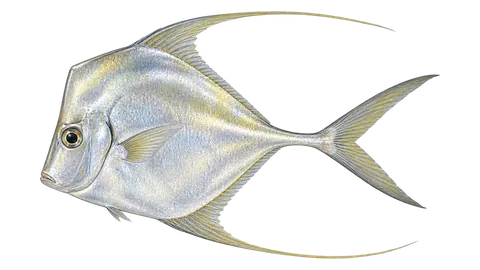
The galo-verdadeiro is a close relative of the lookdown (Selene vomer) and is often sold under the same name. It lives in the western Atlantic, from Nova Scotia (Canada) to Mar del Plata, Argentina, including the Gulf of Mexico and the Caribbean; in the eastern Atlantic it is replaced by Selene dorsalis, and the two may be the same species. Adults stay near the bottom, from shallow water down to at least 54 m, and sometimes rise in schools toward the surface. Juveniles use the mud bottoms of estuaries and coastal waters. They eat small fish and crustaceans. FishBase gives up to 60 cm and 4.6 kg, but markets in Rio de Janeiro show fish of 37 to 46 cm, weighing 0.75 to 1 kg. It is a commercial and subsistence fish, and in recreational fishing it is a bottom supplement, without the reputation of the jacks.
fun facts
- In the eastern Atlantic it is replaced by Selene dorsalis; FishBase says the two may be the same species.
- Specimens bought in markets in Niterói (RJ) in 2012 measured 37 to 46 cm and weighed 0.75 to 1 kg.
- Juveniles live in muddy-bottom estuaries; adults stay near the bottom, on the coast and on the shelf.
how to recognize it
identification
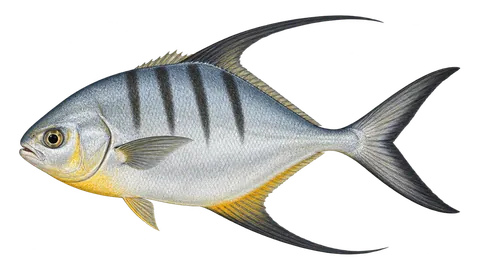
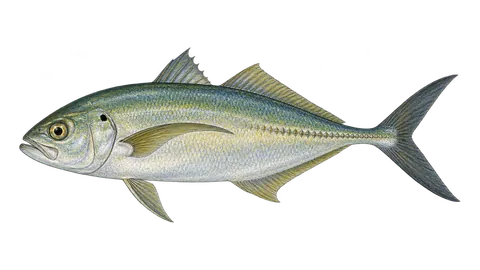
Very high, short and flattened body, silvery, with a bluish back and no stripes or spots. The face profile is almost vertical and concave, the mouth is small, and the pelvic fins are very short. The soft dorsal has 21 rays and the anal fin 17, after 3 spines. The lookdown (Selene vomer) is similar; reliable separation comes from proportions and ray counts, in an identification guide. Jacks (Caranx) are more elongated, and pompanos (Trachinotus) have rounded heads.
how atlantic moonfish fishing looks
Loading the next 7 days…
Each card shows the day's index (0 to 100) and, below it, a strip with the index for each hour, from 0h to 23h. from poor to excellent.