

- common size
- 12–22 cm
- maximum
- 28 cm
- common weight
- 0.1–0.3 kg
- record/max.
- 0.7 kg
- depth
- 0.5–2 m
- ideal water
- 26–30 °C

the right time
to be on the water
Choose the place and the species. The index, from 0 to 100, combines weather, sun, moon and tide with each fish's habits. Up to 28 days, with each day's confidence.
Loading the forecast…
—
Looking for alerts within 30 km…
Looking for what anglers have logged near here…
what you need to fish herelicense, certification and boat documents
fish likely at this spot
Tap a fish to see its forecast.
hour by hour
slide your finger or mouse over the chart to see each hoursee hour-by-hour table
why this index at —?
choose the day
the fishing month at a glance
what's the best window for the crew?
Choose how many fishing days. We compare each stretch by its average index, discount days with a warning or closed season, and show the 3 best.
trend for the coming weeks
Line: the middle value of 31 simulations of the American GEFS model. Band: where 8 out of 10 fall. Narrow, firm trend; wide, high uncertainty.
everything about the yellowjacket cichlid
how to recognize it
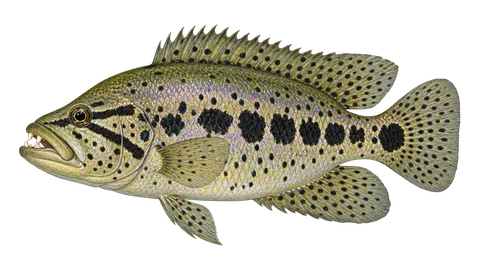
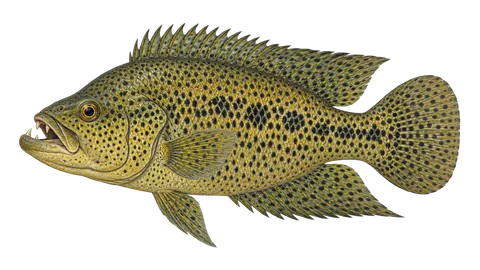
Elongated, robust, strongly compressed body, golden yellow, with broken dark blotches running from the eye to the tail and yellowish fins. The forehead slopes gently, the eyes and mouth are large, and the tail is rounded; the dorsal and anal fins extend backward, and males have stronger colors and more pointed fins. The female of P. motaguensis, also yellowish, can be mistaken for it. The tiger guapote (P. managuensis) has large, well-separated black blotches on its flank.
Also called: guapote-amarelo, yellowjacket cichlid, yellowjacket
where found
open on the large mapWhere to look: Lowland rivers, streams, lakes, ponds, and swamps with weak current, down to about 2 m deep, near logs, vegetation, and roots; enters brackish water.
Not found in Brazil. Atlantic slope of Central America: Mexico (Usumacinta River, in Chiapas and Tabasco), Belize, Guatemala, and Honduras, according to FishBase. The 2023 review of Nicaragua's fish fauna records it in Nicaragua and places the range from eastern Honduras to western Panama, in rivers on both slopes, from 9 to 65 m elevation. The distribution and valid name of the northern populations of that range remain under review.
when to fish
best season
Bites all year round in the tropics. Pairs guard the nest at various times of the year and defend their territory; the dry season, with clearer, lower water, concentrates fish in holes and bank areas with logs.
best time of day
Daytime, with peaks at dawn and dusk. The sources consulted do not give a time. As an ambush predator, it should bite best early and late in the day, along the bank.
what affects the yellowjacket cichlid
cold and cold fronts
Tropical species: cold fronts and water below about 22 °C reduce activity.
atmospheric pressure
No known effect.
moon
Little effect.
rain
Heavy rain muddies rivers and lagoons and scatters the fish.
water level
Low water concentrates fish in holes and banks with logs.
noise
Moderate: an ambush predator, approach quietly.
wind
Little effect in sheltered backwaters.
depth
Shallow, down to about 2 m, next to logs and vegetation.
how to fish
lures
- small minnow 5 to 8 cm
- spinner #2 to 3
- jig 1/16 to 1/8 oz
- small streamer
natural baits
- fish pieces
tip from an angler
Imitate a wounded baitfish and pause near logs and vegetation: it strikes from ambush.
- rod
- 6' to 6'6", medium-fast action, 6 to 10 lb; or fly #5 to #6
- spinning / baitcasting reel
- spinning reel 2000 to 2500
- line
- monofilament 0.23 to 0.28 mm or braided line 8 to 12 lb
- leader
- fluorocarbon 10 to 15 lb
- hook
- size 4 to 1/0
accessories
- alicate
- landing net
- polarized glasses
catch and release
Small fish with a wide mouth: use a barbless hook, pliers, and a soft-mesh landing net, and return it to the water quickly.
rules for the yellowjacket cichlid
Rules change; before keeping or transporting fish, check with the state environmental agency.
Mexico: up to 5 freshwater fish per day, one rod, and no live fish as bait
5 fish per angler per day; one rod in use; no live fish as bait details
In Mexico's federal inland waters, recreational fishing for freshwater species is limited to 5 fish per angler per day (this also applies to the yellow guapote). Each reservoir's committee may lower the bag limit and set sizes. Only one rod per angler may be in use, and using live fish as bait is prohibited. Fish kept may not be sold, and any fish over the limit must be returned alive to the water. No permit is required to fish from the bank; a permit is required from a boat.
Conservation: Assessed on Dec 18, 2019 as Least Concern, with an unknown population trend.
how much it weighs without taking it out of the water
estimated weight
—
how we calculate
Length-weight relationship W = a·Lb (a = 0.02692, b = 3.03; FishBase (relação peso-comprimento bayesiana, estimativa)). It's an average: a fat or lean fish can vary by 10% to 20%.
more about the yellowjacket cichlid
Predatory cichlid of the same genus as the guapotes (Parachromis), but much smaller: FishBase gives a maximum of 28 cm standard length. It lives in rivers and lakes with weak current, lagoons, and lowland swamps, usually down to about 2 m deep, and enters brackish water. It mainly eats other fish, ambushing them. Pairs dig the nest in sand or mud bottoms and guard the young. According to FishBase and Mexican fishing practice, it occurs on the Atlantic slope of Mexico (Usumacinta), Belize, Guatemala, and Honduras. The most recent treatment of Nicaragua's fish fauna places the species from eastern Honduras to western Panama, on both slopes, which shows that the species' limits and identity are under review. FishBase lists it as of sport and aquarium interest and of no interest for commercial fishing, but the Mexican inland waters standard lists it, as mojarra pinta, among the commercial species of the Malpaso reservoir in Chiapas.
Family: Cichlidae · predator
fun facts
- FishBase lists the species as of interest for behavioral research in the laboratory.
- According to a Mexican outreach website, it plays dead to lure prey, which still needs confirmation in scientific work.
- In Mexico, the name castarrica also applies to the Mayan cichlid (Mayaheros urophthalmus), another fish from the same region.
in the kitchen
Small fish, for local consumption; FishBase marks no interest for commercial fishing.
similar species


sources and references (7)
The season factors (months), the time of day, and the sensitivities (cold, pressure, moon, wind, rain, tide, strong light, murky water, and noise) are editorial estimates by the app, based on the literature cited below and on field experience of anglers and guides. They are not official data or measurements made for this species and may vary by region and year. Closed seasons and legal rules appear in the rules section, with the standard and link. The profile's maximum weight was estimated from the length-weight relationship, because FishBase has no maximum weight. Time of day, depth, gear, and baits are editorial recommendations, based on the ambush-predator habit; there is no specific source on recreational fishing for the species.
- scientific FishBase: Parachromis friedrichsthalii (ficha da espécie)Size, length-weight, depth, habitat, distribution, biology, and IUCN status. Page checked on Oct 13, 2026.
- scientific FishBase: nomes populares de Parachromis friedrichsthaliiNames by country and language.
- scientific IUCN Red List: Parachromis friedrichsthalii (avaliação global: Pouco Preocupante, LC, 18/12/2019)Global assessment. Link given on the FishBase entry (Red List, version 2025-2).
- scientific Angulo, A. et al. (2023). Continental fishes of Nicaragua. Zootaxa 5376(1): 1-89 (tratamento de Parachromis friedrichsthalii, via Zenodo/Plazi)It places the species from eastern Honduras to western Panama, on both slopes, with records in Nicaragua (9 to 65 m elevation), and treats P. loisellei as a synonym of P. friedrichsthalii. Because of this, the profile added Nicaragua to the FishBase country list; the northern range (Mexico, Belize, Guatemala) follows FishBase and the Mexican standard, with the review caveat. The page reproduces only the summary of the treatment, without identification characters. Page checked on Oct 13, 2026.
- technical Mexican Fish: Yellowjacket Cichlid (Parachromis friedrichsthalii)Mexican fish outreach website, used only for the body and blotch description, typical depth (up to 2 m), diet, and local names (guapote amarillo, molula, mojarra del San Juan). Information without a reference in the text. Page checked on Oct 13, 2026.
- official DOF: Modificação da NOM-017-PESC-1994, que regula a pesca esportivo-recreativa em águas de jurisdição federal do México (publicada em 25/11/2013)Items 4.3, 4.4, 4.6 b, 4.7 c, 4.9.2, 4.9.5, and 4.11: permit, one rod per angler in inland waters, ban on live fish as bait, limit of 5 freshwater fish per day, release of the fish over the limit, and ban on sale. Text checked on Oct 13, 2026.
- official DOF: NOM-060-SAG/PESC-2014, pesca responsável em corpos de água continentais de jurisdição federal do México (publicada em 27/05/2014)Annex 1: the mojarra pinta (Parachromis friedrichsthalii) is named among the species of commercial fishing in the Netzahualcóyotl (Malpaso) reservoir, in Chiapas. The standard sets no minimum size or limit for it outside the general recreational bag limit. Text checked on Oct 13, 2026.
how we calculatewhere each number comes from
The weather comes from three independent global models, cross-checked hour by hour: when they agree, confidence goes up; when they diverge, the band between them shows on the chart. Beyond 16 days, we use the GEFS ensemble of 31 simulations: if 20 of the 31 predict rain, the chance of rain is 65%. Sun and moon are calculated astronomically, with no uncertainty.
The index adds up, weighted for each species: time of day (species curve anchored to real sunrise and sunset), moon (transits, rise and set, phase), pressure (3 h trend and 24 h swing), water temperature (in rivers, estimated from air temperature; at sea, estimated by an ocean model), wind, rain, clouds, tide and the month in the species' cycle.
sources for this lookup
how accurate the forecast is
Accuracy measured in the reference project (4 regions, 93 days, forecast vs. observed): maximum temperature is off by 0.6 °C on average the next day and 1.7 °C at 7 days; rain of 5 mm or more is detected 76% of the time the next day and 57% at 7 days. Detection isn't everything: the false alarm rate isn't published here yet, and 93 days in 4 regions is still a small sample. We now also measure every day, at the app's destinations: