Skip to content
catalog Erythrinidae · predator

trairão

Hoplias aimara

Freshwater

The trairão, the giant trahira of the clear-water rivers of the Brazilian Shield. Brutal surface strikes and teeth that cut through anything.

Also called: trairão, aimara

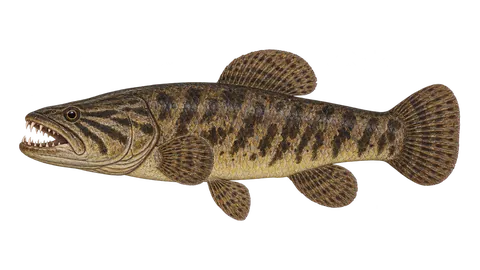
Scientific illustration of Trairão
common size
50–80 cm
maximum
115 cm
common weight
4–12 kg
record/max.
40.0 kg
depth
0.5–4 m
ideal water
25–30 °C
overview

who is the trairão

The trairão is the largest species in the trahira genus and lives in clear-water rivers flowing from the Central Plateau and the Guianas, such as Teles Pires, Juruena, Xingu, Tapajós and Trombetas. It lies in ambush in backwaters, pools, submerged timber and shaded shorelines and makes explosive strikes at fish, frogs and even small mammals. It has strong canine teeth, a powerful jaw and thick skin. In sport fishing it is sought for its violent strike on surface lures and for the strong fight in the first seconds. It often misses strikes, so keep working the same spot. It tolerates low oxygen and stays a long time in the same pool.

fun facts

  • Tolerates low-oxygen water and survives in isolated pools during the dry season.
  • There are reports of attacks on birds and small mammals that fall into the water.
how to recognize it

identification

Cylindrical, thick body, large head and a mouth full of canine teeth. Dark brown to almost black back, lighter flanks with blotches and a large dark spot on the gill cover. Rounded tail with no adipose fin. The common trahira is much smaller and lacks the strong gill-cover spot. Adult trairão easily exceeds 5 kg.

how trairão fishing looks

Loading the next 7 days…

Each card shows the day's index (0 to 100) and, below it, a strip with the index for each hour, from 0h to 23h. from poor to excellent.

distribution

where found

open on the large map

Clear-water rivers of the Brazilian Shield and the Guianas: Teles Pires, Juruena, São Benedito, Xingu, Iriri, Tapajós, Trombetas, Jari and tributaries of the Tocantins.

Habitat: Backwaters, rapids pools, submerged timber, shaded shorelines and side lagoons of clear-water rivers.

native to the basins

AmazonTocantins-Araguaia

states

Mato Grosso, Pará, Amapá, Amazonas, Tocantins, Roraima

calendar and clock

when to fish

best season

time of yearbest: Jun–Oct
JanFebSeaAprMayJunJulAugSepOctNovDec

The dry season, from June to October, is the peak season in the rivers of Mato Grosso and Pará: low water, clear water and fish in the pools.

best time of day

0h6h12h18h sunrise ~6amsunset ~6pm

Dawn and dusk. Most active early in the morning, late in the afternoon and at night. During the day it strikes in the shade of submerged timber and banks.

weather, water and behavior

what affects the trairão
sensitivity The little bars show how much each factor affects this species. Five full: it feels it a lot.

cold and cold fronts

A cold snap (friagem) reduces strikes for a day or two.

atmospheric pressure

Moderate effect.

moon

Clear moonlit nights favor night surface fishing.

rain

Little effect, except when it muddies the water.

water level

Low water concentrates trairão in pools and backwaters.

noise

Moderately sensitive. Approach small pools without a running motor.

wind

Little effect on rivers with riparian forest.

depth

Shallow and in the shade; rarely below 4 m.

technique, gear and bait

how to fish

rod
6'0'' to 6'6'', fast and heavy action, 20 to 40 lb
spinning / baitcasting reel
low- or high-profile baitcasting reel 200 to 300 with strong drag
line
braided line 50 to 65 lb
leader
coated wire leader 60 to 90 lb or fluorocarbon 80 to 100 lb, 40 cm
hook
reinforced treble hooks 4/0 to 6/0; offset hook 6/0 to 8/0 for soft plastics

lures

  • large zara 12 to 15 cm
  • double prop bait
  • frog lure
  • large mid-water lure
  • soft plastic with offset hook

natural baits

  • live or dead fish (piau, cará)
  • fish fillet

accessories

  • long-nose pliers
  • heavy-duty boga-grip
  • luvas

tip from an angler

The trairão misses a lot of strikes. If it attacked and didn't take the lure, cast again to the same spot and work the lure more slowly.

what the law says

rules for the trairão

Summary of the regulations we found, with the source for each. Rules change; before keeping or transporting fish, check with the state environmental agency.
Conservation: Not on the national list (Portaria GM/MMA 1.667/2026).

Mato Grosso: Zero Transport for 12 species

MTParaguay (Pantanal)AmazonTocantins-Araguaia

Transport, storage and sale are fully prohibited for 5 years from Jan 1, 2024 for: cachara, caparari, dorado, jaú, matrinchã (Brycon spp.), pintado/surubim (Pseudoplatystoma spp.), piraíba, piraputanga, pirarara, arapaima (pirarucu), trairão and peacock bass (tucunaré, Cichla spp.). For recreational anglers: catch and release only. These 12 species may not even be eaten on site, since the 2 kg or 1 fish limit excludes the art. 19-B list. The law cites jaú as Zungaro zungaro; we also include the Pantanal jaú (Z. jahu) out of caution. The list may still change: § 2 (exotic and predatory species), § 3 (review through study) and the 3-year assessment planned for 2027. A TJMT news report of Jun 2, 2026 confirms the 12 prohibited species. The STF denied a preliminary injunction in the ADIs against the law in 2024; we found no merits ruling.

Source: Lei estadual MT nº 9.096/2009, arts. 19-A, 19-B and 19-C, as amended by Leis nº 12.197/2023 and 12.434/2024

piracema closures in the basins where the species lives

Closed season in Goiás (state rule)

01/11 to 28/02GO

Allowed: Sport and guided fishing only in reservoirs, catch and release with barbless hooks (no keeping, transporting or eating). Subsistence: up to 5 kg per day, for household consumption only.

Source: IN Semad-GO nº 17/2026, arts. 8º to 11

Spawning closure (piracema) in Mato Grosso (all basins)

01/10 to 31/01MT

Allowed: All fishing modalities are prohibited in rivers, including catch and release (Law 9.096/2009, art. 19-A). Exceptions: subsistence fishing from shore (3 kg or 1 fish, no transport or sale) and scientific fishing. Law 13.159/2025 now allows licensed sport fishing in UHE/PCH hydropower reservoirs, natural lakes and border rivers, subject to a scientific study and a license from the environmental agency. We have not confirmed whether these licenses are already being issued.

Source: IN Interministerial MAPA/MMA nº 10/2017; Resolução Cepesca-MT nº 1/2026; Lei estadual MT nº 9.096/2009, arts. 19-A and 27 (Leis 12.434/2024 and 13.159/2025)

Spawning closure (piracema) in the Araguaia River basin

01/11 to 28/02GOTOPAMT

Allowed: Recreational fishing only in reservoirs, with handline, rod, or spinning or baitcasting reel. Fish may only be eaten on site, not transported. Competitions prohibited. Subsistence: 3 kg + 1 fish. State rules (GO and TO) may be stricter.

Source: IN Interministerial MPA/MMA nº 12/2011

Spawning closure (piracema) in the Tocantins and Gurupi river basins

01/11 to 28/02TOPAMAGO

Allowed: Recreational fishing only in reservoirs, with on-site consumption. Subsistence: 5 kg + 1 fish. State rules may be stricter.

Source: IN Interministerial MPA/MMA nº 13/2011

Closed season in the rivers of Marajó Island (PA)

01/01 to 30/04PA

Allowed: The same recreational-angler exceptions as in Portaria 48/2007 apply (handline or rod, 5 kg + 1 fish), unless a stricter state rule applies.

Source: Portaria IBAMA nº 48/2007

Closed season in the Amazon basin in Amapá

15/11 to 15/03AP

Allowed: Recreational anglers with handline or rod, line and hook are outside the Annex II prohibitions, with a bag limit of 5 kg + 1 fish, unless a stricter state rule applies.

Source: Portaria IBAMA nº 48/2007

Border rivers MT/RO and MT/PA

05/11 to 28/02MTROPA

Allowed: See the exceptions in Portaria 48/2007 and the state rules for each bank.

Source: Portaria IBAMA nº 48/2007

catch and release
catch and release Releasing the fish alive, quickly and with a wet hand. During a closed season it isn't always allowed: what the regulation says applies.

Never put your hand in its mouth. Use a heavy-duty boga-grip and long pliers, support the heavy body and release it in the shade. A tired big fish takes a long time to recover.

in the kitchen

White, firm flesh but with Y-shaped bones like the trahira. Good fried in thin steaks or baked.

calculator

how much it weighs without taking it out of the water

Length-weight relationship W = a·Lb (a = 0.00741, b = 3.13; FishBase (bayesiano, espécie + forma do corpo da família)). It's an average: a fat or lean fish can vary by 10% to 20%.

estimated weight

—

sources and references

The season weights (months), the time of day and the sensitivities (cold, pressure, moon, wind, rain, tide, strong light, murky water and noise) are the app's editorial estimates, based on the literature below and on the field experience of anglers and guides. They are not official data nor a measurement made for this species, and they may vary by region and year. Closed seasons and legal rules appear in the rules section, with the norm and a link.

  1. scientific FishBase — Hoplias aimara (ficha da espécie)Names, distribution, biology, length-weight relationship and references. Page checked on October 13, 2026.
  2. official Portaria GM/MMA nº 1.667, de 27 de abril de 2026 — Lista Nacional Oficial de Espécies da Fauna Ameaçadas de Extinção (peixes e invertebrados aquáticos)Most recent national list. The species is not on it (search by scientific name in the text published in the DOU, checked on October 13, 2026).
  3. official ICMBio/SALVE — Ficha de Hoplias aimara (avaliação nacional do risco de extinção)ICMBio national assessment, published in 2025. DOI checked on Crossref.
  4. scientific IUCN Red List — Hoplias aimara (avaliação global: Pouco Preocupante, LC, 07/08/2020)Global assessment. Link given on the FishBase entry (Red List, version 2025-2).
  5. scientific Mattox, G. M. T.; Toledo-Piza, M.; Oyakawa, O. T. (2006). Taxonomic study of Hoplias aimara (Valenciennes, 1846) and Hoplias macrophthalmus (Pellegrin, 1907) (Ostariophysi, Characiformes, Erythrinidae). Copeia 2006(3): 516–528.
  6. scientific Oyakawa, O. T. (2003). Erythrinidae (trahiras). In: Reis, R. E.; Kullander, S. O.; Ferraris Jr., C. J. (orgs.). Check List of the Freshwater Fishes of South and Central America. Porto Alegre: EDIPUCRS, p. 238–240.Printed book chapter; the URL is the bibliographic record on FishBase, which cites the chapter for the species.
don't confuse

similar species