Skip to content
catalog Sciaenidae · predator

lorna drum

Sciaena deliciosa

Sea

The lorna, a small croaker and the most fished along the Peruvian coast, from sandy beaches and rocky shores. An everyday table fish, it has a minimum size and a closed season in April.

Also called: lorna, cholo, roncacho

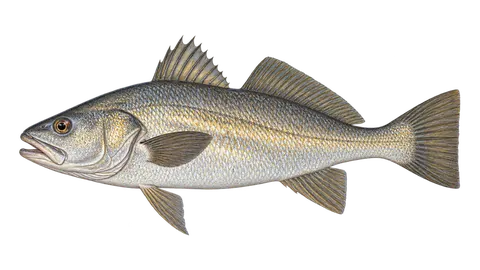
Scientific illustration of Lorna drum
common size
20–30 cm
maximum
46 cm
common weight
0.1–0.4 kg
record/max.
1.0 kg
depth
2–40 m
ideal water
15–21 °C
overview

who is the lorna drum

The lorna is a sciaenid, from the croaker family, in the cold waters of the Humboldt Current, from Ecuador to Chile, where it is called roncacho. It lives near the coast, over sand and mud bottoms and along rocks, roughly between 5 and 50 m, and is one of the species most landed by Peruvian artisanal fishing. It grows past 40 cm, but most catches are 20 to 30 cm. It eats small bottom invertebrates and small fish. For shore and rock anglers on the central Peruvian coast, it is the most common catch. In recent Peruvian rules the scientific name appears as Callaus deliciosa.

fun facts

  • Like other croakers, it makes sounds with its swim bladder.
  • In recent Peruvian rules the scientific name appears as Callaus deliciosa; FishBase keeps Sciaena deliciosa.
how to recognize it

identification

Elongated, moderately deep body, grayish-blue to brown back, silver flanks with a golden sheen and a pale belly. Small mouth, with no chin barbel. Two dorsal fins joined by a deep notch; straight to slightly concave tail. It differs from the Chilean croaker, which grows much larger and has a large, oblique mouth.

how lorna drum fishing looks

Loading the next 7 days…

Each card shows the day's index (0 to 100) and, below it, a strip with the index for each hour, from 0h to 23h. from poor to excellent.

distribution

where found

open on the large map

Does not occur in Brazil. Southeastern Pacific, from Ecuador to Chile, most abundant along the Peruvian coast.

Habitat: Sandy beaches, sand and mud bottoms near the coast, and rocky areas.

calendar and clock

when to fish

best season

time of yearbest: Nov–Feb
JanFebSeaAprMayJunJulAugSepOctNovDec

Caught all year in Peru except April, the closed month. In El Niño years, with warm water, the distribution shifts and the lorna may move away from the coast.

best time of day

0h6h12h18h sunrise ~6amsunset ~6pm

Daytime, with peaks at dawn and dusk. Bites by day from the beach and rocks, with peaks at dawn and late afternoon.

weather, water and behavior

what affects the lorna drum
sensitivity The little bars show how much each factor affects this species. Five full: it feels it a lot.

cold and cold fronts

Adapted to cold water; strong sea warming, as in El Niño, changes availability.

atmospheric pressure

Rough sea from a change in weather hurts beach fishing.

moon

Spring tides at new and full moon stir the bottom more and usually produce on the beach.

rain

It hardly ever rains on the Peruvian coast.

water level

Not applicable at sea.

noise

Not very sensitive in the surf; on shallow rocks, avoid casting shade over the spot.

wind

Moderately choppy sea helps release food; rough sea prevents casting.

tide

Rising tide on beaches and in channels between sandbanks.

depth

1 to 10 m for beach and rock fishing.

technique, gear and bait

how to fish

rod
beach: 3.6 to 4.2 m, 60 to 150 g; rock and dinghy: 2.1 to 2.7 m, 10 to 20 lb
spinning / baitcasting reel
spinning reel 3000 to 6000
line
monofilament 0.28 to 0.35 mm
leader
monofilament 0.35 to 0.45 mm
hook
#2 to 1/0

natural baits

  • muy-muy (Pacific tatuí)
  • shrimp
  • squid strips
  • anchoveta fillet

accessories

  • sinker, 60 to 120 g
  • two-hook leader

tip from an angler

On the beach, look for the channels between sandbanks; fresh muy-muy is the classic lorna bait.

what the law says

rules for the lorna drum

Summary of the regulations we found, with the source for each. Rules change; before keeping or transporting fish, check with the state environmental agency.
Conservation: In Peru there is a minimum size and an annual closed season. We found no specific rule in Ecuador or Chile.

Peru: minimum size 21 cm

21 cm (total length)confirm with the agency

The official minimum size table of Peru's Ministry of Production gives 21 cm total length for the lorna. The previous value, 24 cm, came from Ministerial Resolution nº 209-2001-PE; we did not find the number of the resolution that made the change. It is prohibited to extract, transport and sell below the minimum size.

Source: Peru Ministry of Production (PRODUCE), minimum size table; R.M. nº 209-2001-PE, Annex I (original value)

Peru: lorna closed season in April

extraction prohibited01/04 to 30/04

On the Peruvian coast it is prohibited to extract lorna from April 1 to 30 every year; the fishing season runs from May 1 to March 31. The dates may change if IMARPE detects a change in the maturation pattern.

Source: Resolución Ministerial nº 414-2018-PRODUCE (Peru)

catch and release
catch and release Releasing the fish alive, quickly and with a wet hand. During a closed season it isn't always allowed: what the regulation says applies.

Remove the hook quickly and release right away, without squeezing the belly. In Peru, below 21 cm release is mandatory.

in the kitchen

White, tasty flesh, the base of ceviches, sudados (stews) and fried dishes in Peru.

calculator

how much it weighs without taking it out of the water

Length-weight relationship W = a·Lb (a = 0.01023, b = 3.01; FishBase (estimativa bayesiana com dados da espécie e da subfamília, comprimento total); peso máximo calculado por esta relação). It's an average: a fat or lean fish can vary by 10% to 20%.

estimated weight

—

sources and references

The season weights (months), the time of day and the sensitivities (cold, pressure, moon, wind, rain, tide, strong light, murky water and noise) are the app's editorial estimates, based on the literature below and on the field experience of anglers and guides. They are not official data nor a measurement made for this species, and they may vary by region and year. Closed seasons and legal rules appear in the rules section, with the norm and a link.

  1. scientific FishBase — Sciaena deliciosa (ficha da espécie)Names, distribution, biology, length-weight relationship, country list and references. Page checked on 13/10/2026. FishBase's country list only includes Ecuador and Peru; we included Chile because the species appears as roncacho in identification guides for Chilean fisheries, but we have not confirmed how far it reaches along the Chilean coast.
  2. scientific IUCN Red List — Sciaena deliciosa (avaliação global: Pouco Preocupante, LC, 03/03/2020)Global assessment. Link given on the FishBase entry (Red List, version 2025-2).
  3. official Resolução Ministerial nº 414-2018-PRODUCE (Peru) — temporada de pesca da lorna no litoral peruanoPublished in El Peruano on 28/09/2018. Closed season April 1 to 30, every year.
  4. official Ministério da Produção do Peru (PRODUCE) — Pesca y Consumo Responsable: tallas mínimas de capturaOfficial minimum size table for consumers, checked on 13/10/2026. The page does not indicate the rule behind each value.
  5. official Resolução Ministerial nº 00412-2024-PRODUCE (Peru) — pesca exploratória da lorna (Callaus deliciosa)Published in El Peruano on 20/10/2024. Records the change of scientific name to Callaus deliciosa and cites the minimum size then in force, 24 cm.
  6. official Resolução Ministerial nº 209-2001-PE (Peru) — tamanhos mínimos de captura e tolerância de juvenis dos principais peixes marinhosCopy of the original text in the FAOLEX database, checked on 13/10/2026. Several values in Annex I were later changed by specific resolutions.
don't confuse

similar species