Skip to content
catalog Istiophoridae · predator

white marlin

Kajikia albida

Seanational list: LC · least concern

A smaller, acrobatic marlin, a summer benchmark in São Paulo and Rio. Fights with jumps and requires light tackle and fine technique.

Also called: agulhão-branco, marlim-branco, white marlin

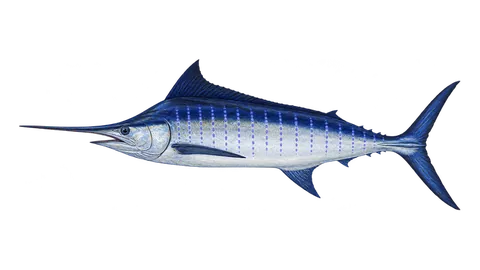
Scientific illustration of White marlin
common size
150–230 cm
maximum
300 cm
common weight
18–35 kg
record/max.
82.0 kg
depth
0–150 m
ideal water
22–27 °C
overview

who is the white marlin

The white marlin is the smallest marlin in the Atlantic and one of the most technical fish in offshore fishing. In Brazil it rarely exceeds 35 kg, but it makes up for it with jumps, runs, and cunning: it often hits the bait several times before taking it. It lives in warm oceanic waters but tolerates somewhat cooler temperatures than the blue marlin, so it appears regularly in the Southeast and South. It follows current edges and schools of squid, sardines, and flying fish. Ilhabela and Santos/Guarujá in São Paulo, and Cabo Frio in Rio, are summer benchmarks. Fishing is catch and release: sale is prohibited and ICCAT maintains a stock recovery plan.

fun facts

  • For a long time it was confused with the roundscale spearfish (Tetrapturus georgii); ICCAT still counts the two species together.
  • It strikes the bait with its bill several times before taking it, which is why the drop-back is decisive.
how to recognize it

identification

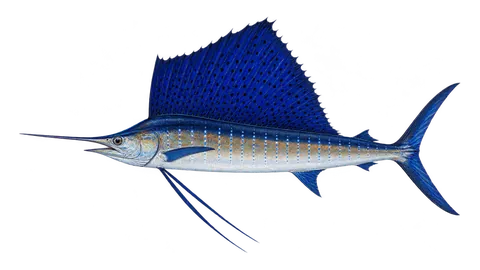
Slender body, much smaller than the blue marlin's. First dorsal and first anal fins with rounded tips; at the front, the dorsal is taller than the body and has black spots. Rounded-tip pectoral fins. Simple, visible lateral line. The blue marlin has a pointed, low dorsal and is much heavier. The sailfish has a sail-shaped dorsal, tall along almost its whole length, and long, thin pelvic fins.

how white marlin fishing looks

Loading the next 7 days…

Each card shows the day's index (0 to 100) and, below it, a strip with the index for each hour, from 0h to 23h. from poor to excellent.

distribution

where found

open on the large map

Open sea from the Northeast to the South, most sought after in the Southeast. Benchmarks: Ilhabela and Santos/Guarujá (SP), on the shelf edge; Cabo Frio, Arraial do Cabo, and Rio de Janeiro (RJ); Vitória (ES), where it shares grounds with the blue marlin. It also occurs off Santa Catarina and the Northeast.

Habitat: Blue oceanic water, in the 0 to 150 m layer, over the shelf edge and the slope. Likes current edges, water-color lines, seamounts, and bait patches.

coast

Northeast CoastSoutheast CoastSouth Coastoceanic

states

Rio Grande do Norte, Paraíba, Pernambuco, Alagoas, Sergipe, Bahia, Espírito Santo, Rio de Janeiro, São Paulo, Paraná, Santa Catarina, Rio Grande do Sul

calendar and clock

when to fish

best season

time of yearbest: Jan–Mar
JanFebSeaAprMayJunJulAugSepOctNovDec

In the Southeast the season runs from December to March, peaking in February, when warm water reaches the shelf edge. Off Espírito Santo and the Northeast it can appear in other months, less regularly.

best time of day

0h6h12h18h sunrise ~6amsunset ~6pm

Daytime. Active by day, with good strikes in the early morning and late afternoon. Usually travels in pairs or trios: if one shows up, leave the other baits in the water.

weather, water and behavior

what affects the white marlin
sensitivity The little bars show how much each factor affects this species. Five full: it feels it a lot.

cold and cold fronts

Water below 21 °C empties the grounds. Thermal breaks and the edge of warm water concentrate the fish.

atmospheric pressure

The cold front cools and muddies the surface; fishing returns 2 to 3 days later, once the sea settles.

moon

Small effect. Some skippers prefer quarter moons, with steadier current.

rain

Light rain doesn't bother. Thunderstorm with lightning in open sea: head back.

water level

Not applicable at sea. The equivalent is the color and clarity of the water: look for blue, clean water and current lines.

noise

Motor and teasers attract. Avoid sharp maneuvers when the fish is behind the baits.

wind

Light swell helps; strong wind breaks up the spread and makes fishing dangerous.

tide

The tide matters little; current and current turns matter more.

depth

Stays in the top 150 m. Fish over bottoms of 100 to 1,500 m, at the shelf edge.

technique, gear and bait

how to fish

rod
20 to 30 lb, 6'0" to 6'6", moderate-fast action
spinning / baitcasting reel
20 to 30 lb trolling baitcaster, or 8000 to 10000 spinning reel for live bait
line
20 to 30 lb monofilament, 400 to 600 m
leader
80 to 100 lb monofilament or fluorocarbon, 3 to 4.5 m
hook
6/0 to 8/0 circle hook on natural bait; 7/0 to 8/0 single on skirts

lures

  • 6 to 9 inch skirts and resin heads
  • silicone squid
  • chain squid teasers and dredges

natural baits

  • agulhinha rigged for trolling
  • whole squid
  • live sardine or mackerel on slow trolling

accessories

  • gloves for the leader
  • long hook remover
  • scientific tagging tags

tip from an angler

Use the bait-and-switch: troll teasers without hooks and, when the marlin appears, offer the natural bait on a circle hook. When you feel the touch, let out line for 3 to 5 seconds (drop-back), and only then set the drag.

what the law says

rules for the white marlin

Summary of the regulations we found, with the source for each. Rules change; before keeping or transporting fish, check with the state environmental agency.
Conservation: It was VU under Portaria MMA 148/2022 and left the list in 2026. Sale remains prohibited (IN SEAP 12/2005), and under the ICCAT recovery plan, which manages the stock together with the roundscale spearfish.

Live marlin goes back to the sea; sale prohibited

confirm with the agency

Blue and white marlins that reach the boat alive must be returned to the sea. Sale in the domestic market and export are prohibited; landed specimens must be donated to scientific or charitable institutions. Cutting the first dorsal and first anal fins aboard is prohibited. Text confirmed in a legislation database; confirm it is in force with the MPA.
Source: Instrução Normativa SEAP/PR nº 12, of Jul 14, 2005 (Special Secretariat of Aquaculture and Fisheries)

ICCAT: rules for recreational marlin fishing

168 cm LJFL (from the tip of the lower jaw to the tail fork)

ICCAT, of which Brazil is a member, requires countries to ensure release with the least possible harm, a minimum retention size of 168 cm LJFL (from the tip of the lower jaw to the tail fork) for white marlin, and a ban on selling marlins caught recreationally. The national rule is stricter: live marlin must be released.

Source: ICCAT Recommendation 19-05, paragraph 11 (International Commission for the Conservation of Atlantic Tunas)

catch and release
catch and release Releasing the fish alive, quickly and with a wet hand. During a closed season it isn't always allowed: what the regulation says applies.

Keep the fish in the water, control it by the bill with a glove, and remove the hook with a hook remover. Revive it with the boat moving slowly. Don't haul it aboard for a photo.

in the kitchen

Not applicable: sale prohibited and release of live fish mandatory.

calculator

how much it weighs without taking it out of the water

Length-weight relationship W = a·Lb (a = 0.00136664, b = 3.14; FishBase (estimativa bayesiana, comprimento total); coeficiente a ajustado ao porte máximo registrado). It's an average: a fat or lean fish can vary by 10% to 20%.

estimated weight

—

sources and references

The season weights (months), the time of day and the sensitivities (cold, pressure, moon, wind, rain, tide, strong light, murky water and noise) are the app's editorial estimates, based on the literature below and on the field experience of anglers and guides. They are not official data nor a measurement made for this species, and they may vary by region and year. Closed seasons and legal rules appear in the rules section, with the norm and a link.

  1. scientific FishBase — Kajikia albida (ficha da espécie)Names, distribution, biology, length-weight relationship and references. Page checked on October 13, 2026.
  2. official Portaria GM/MMA nº 1.667, de 27 de abril de 2026 — Lista Nacional Oficial de Espécies da Fauna Ameaçadas de Extinção (peixes e invertebrados aquáticos)Most recent national list. The species is not on it (search by scientific name in the text published in the DOU, checked on October 13, 2026).
  3. official Portaria MMA nº 148, de 7 de junho de 2022 — atualização da Lista Nacional de Espécies Ameaçadas de ExtinçãoPrevious national list, cited in this species' conservation history.
  4. official ICMBio/SALVE — Ficha de Kajikia albida (avaliação nacional do risco de extinção)ICMBio national assessment, published in 2025. DOI checked on Crossref.
  5. scientific IUCN Red List — Kajikia albida (avaliação global: Pouco Preocupante, LC, 01/05/2021)Global assessment. Link given on the FishBase entry (Red List, version 2025-2).
  6. scientific Nakamura, I. (1985). FAO species catalogue. Vol. 5. Billfishes of the world. FAO Fisheries Synopsis 125(5). Roma: FAO.
  7. technical ICCAT Manual, cap. 2.1.7 — White marlin (Kajikia albida). International Commission for the Conservation of Atlantic Tunas.Biology and fishery of the species in the Atlantic.
  8. scientific Carpenter, K. E. (org.) (2002). The living marine resources of the Western Central Atlantic. Vol. 3: Bony fishes part 2 (Opistognathidae to Molidae). FAO Species Identification Guide for Fishery Purposes. Roma: FAO.Istiophoridae chapter (Nakamura, I.).
don't confuse

similar species