smallscale weakfish
Cynoscion microlepidotus
Large croaker with small scales and canine teeth at the tip of the mouth, from the estuaries of the North and Northeast. It attacks live fish and mid-water lures at river mouths and in channels.
Also called: pescada-bicuda, pescada-dentão, pescada-de-dente, corvina-uçu, pescada-cutinga, dente-de-cão

- common size
- 35–60 cm
- maximum
- 92 cm
- common weight
- 0.5–2 kg
- record/max.
- 3.0 kg
- depth
- 1–25 m
- ideal water
- 25–30 °C
who is the smallscale weakfish
The pescada-bicuda is a large croaker of the genus Cynoscion, the same genus as the acoupa weakfish (pescada-amarela), found from Venezuela to Santos (SP), most common in the North and Northeast. It stays over mud and sand bottoms in estuaries and along the coast down to about 30 m. It grows to 92 cm, but most catches are 35 to 60 cm. A predator of fish and shrimp, it is caught with live bait, shrimp and mid-water lures, at the same spots as the acoupa weakfish. Little biological information has been published, and FishBase estimates low resilience to fishing. It is sold fresh and has good-quality flesh.
fun facts
- The swim bladder has a pair of long, straight, horn-shaped appendages, used to identify the croakers of this genus.
- Microlepidotus means 'small scales'.
identification
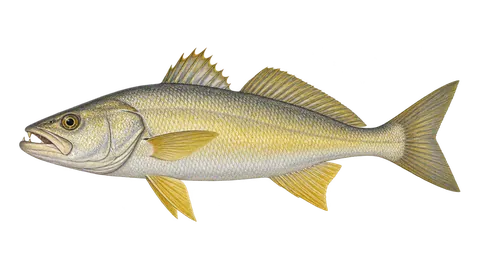
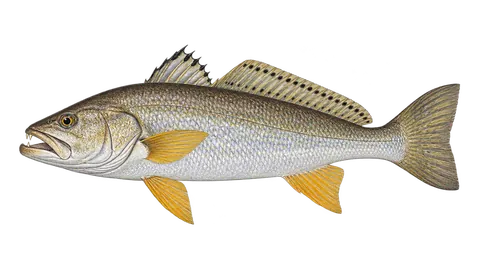
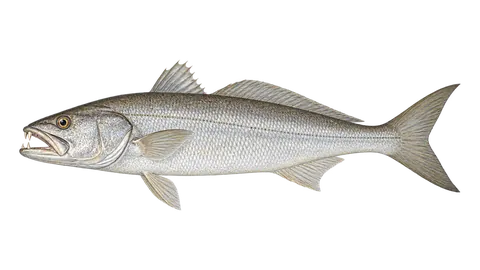
Elongated body, greenish silver to grayish back and whitish belly. Dark tip on the dorsal fin; upper part of the pectorals, front of the anal fin and tail yellowish. Large oblique mouth, with the lower jaw protruding and a pair of large canines at the tip of the upper jaw. The scales are very small and smooth (140 or more rows above the lateral line), which separates it from the acoupa weakfish and the pescada-cambuçu, which have visibly larger scales.
Loading the next 7 days…
Each card shows the day's index (0 to 100) and, below it, a strip with the index for each hour, from 0h to 23h. from poor to excellent.
where found
From Amapá to Santos (SP), most common in the estuaries of the North and Northeast. Outside Brazil, from the Guianas to Venezuela and the southern Caribbean islands.
Habitat: Estuaries, river mouths, channels and bays with mud and sand bottoms, and the shallow coastal strip down to about 30 m.
coast
states
Amapá, Pará, Maranhão, Piauí, Ceará, Rio Grande do Norte, Paraíba, Pernambuco, Alagoas, Sergipe, Bahia, Espírito Santo, Rio de Janeiro, São Paulo
when to fish
best season
Present all year. In the North, the second half of the year, with less rain and saltier water in the estuaries, is usually best in the channels.
best time of day
Night and twilight. Bites best at dawn, late afternoon and at night, during the tide change; by day it stays in the deepest holes of the channels.
what affects the smallscale weakfish
sensitivity The little bars show how much each factor affects this species. Five full: it feels it a lot.
cold and cold fronts
Little effect on the tropical coast; at the southern limit, cold water drives the species away.
atmospheric pressure
Stable weather helps; a weather change with strong wind hurts.
moon
Spring tides at new and full moon, with stronger current, are usually the best.
rain
Heavy rain that sweetens the estuary too much pushes the croaker toward the river mouth.
water level
In the dry season, salt water moves up the estuaries and the croaker follows it.
noise
Sensitive in shallow channels: arrive by oar or electric motor and avoid knocking the hull.
wind
Moderate wind doesn't bother the channels; with strong wind, look for sheltered stretches.
tide
Fish the tide turn and the first hours of the flood and the ebb.
depth
2 to 15 m in the channels and holes of the estuaries.
how to fish
- rod
- 6'0" to 7'0", 12 to 25 lb, medium-fast action
- spinning / baitcasting reel
- spinning reel 3000 to 5000 or low-profile baitcasting reel
- line
- braid 20 to 30 lb
- leader
- fluorocarbon or monofilament 0.50 to 0.60 mm (30 to 40 lb), because of the canines
- hook
- circle or wide gap 2/0 to 5/0; reinforced treble hooks on the lures
lures
- 10 to 15 cm shad on a 10 to 28 g jig head
- mid-water minnow, 9 to 12 cm
- bottom jig for channels
natural baits
- small live fish (mullet, sardine)
- live shrimp
- fish fillet
accessories
- long-nose pliers
- large landing net or boga-grip
tip from an angler
Work the shad close to the bottom of the channels during the tide change, with short twitches: the croaker often strikes when the bait drops.
rules for the smallscale weakfish
Summary of the regulations we found, with the source for each. Rules change; before keeping or transporting fish, check with the state environmental agency.
Conservation: Not on the national list (Portaria GM/MMA 1.667/2026). We found no specific federal size or closed-season rule for the species.
We found no species-specific rule beyond the region's general rules.
catch and release
catch and release Releasing the fish alive, quickly and with a wet hand. During a closed season it isn't always allowed: what the regulation says applies.
Remove the hook quickly with pliers and release the fish facing the current, supporting its belly until it swims away. Don't lift the fish by the mouth vertically: its weight injures the jaw.
in the kitchen
White, firm flesh, prized in fried or baked steaks and in caldeiradas (fish stews).
how much it weighs without taking it out of the water
Length-weight relationship W = a·Lb (a = 0.00741, b = 3.07; FishBase (estimativa bayesiana com dados da espécie e do gênero, comprimento total)). It's an average: a fat or lean fish can vary by 10% to 20%.
estimated weight
—
sources and references
The season weights (months), the time of day and the sensitivities (cold, pressure, moon, wind, rain, tide, strong light, murky water and noise) are the app's editorial estimates, based on the literature below and on the field experience of anglers and guides. They are not official data nor a measurement made for this species, and they may vary by region and year. Closed seasons and legal rules appear in the rules section, with the norm and a link.
- scientific FishBase — Cynoscion microlepidotus (ficha da espécie)Names, distribution, biology, length-weight relationship, country list and references. Page checked on Oct 13, 2026.
- official Portaria GM/MMA nº 1.667, de 27 de abril de 2026 — Lista Nacional Oficial de Espécies da Fauna Ameaçadas de Extinção (peixes e invertebrados aquáticos)Most recent national list. The species is not on it (search by scientific name in the text published in the DOU, checked on October 13, 2026).
- official ICMBio/SALVE — Ficha de Cynoscion microlepidotus (avaliação nacional do risco de extinção)National extinction risk assessment by ICMBio, published in 2025. DOI checked on Crossref.
- scientific IUCN Red List — Cynoscion microlepidotus (avaliação global: Pouco Preocupante, LC, 14/10/2019)Global assessment. Link given on the FishBase entry (Red List, version 2025-2).