

king weakfish
Macrodon ancylodon
The pescadinha dentuça of North and Northeast Brazil. It lives on muddy bottoms near the coast and river mouths; it is the tropical sister of the pescada-foguete of the South.
- common size
- 20–35 cm
- maximum
- 53 cm
- common weight
- 0.1–0.4 kg
- record/max.
- 1.5 kg
- depth
- 1–30 m
- ideal water
- 26–30 °C
how to recognize it
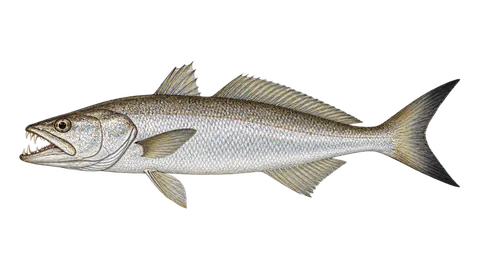
Elongated silvery body, grayish-brown back, large oblique mouth with strong canine teeth in both jaws, and a pointed, spear-shaped tail. Telling it apart from the southern pescada-foguete by appearance is hard: the gó has more pored scales on the lateral line (66 to 78, versus 49 to 63) and proportionally larger canines. In practice, geography settles it: from Amapá to Bahia it is the gó; from Espírito Santo southward, the foguete.
Also called: pescada-gó, gó, pescada-dente-de-cachorro, pescada-dentuça, pescadinha, corvina-gó
don't confuse with:
where found
open on the large mapWhere to look: Mud and muddy sand bottoms near the coast, river mouths, bays and estuary channels; juveniles on tidal flats.
From Amapá to Bahia, most abundant on the north coast (Amapá, Pará and Maranhão), on mud bottoms under the influence of the big rivers. Outside Brazil, from the Guianas to Venezuela and the southern Caribbean islands. Old records from the South and the Río de la Plata are of the pescada-foguete.
coast
states
Amapá, Pará, Maranhão, Piauí, Ceará, Rio Grande do Norte, Paraíba, Pernambuco, Alagoas, Sergipe, Bahia
when to fish
next 7 days
Loading the next 7 days…
best season
Caught all year. On the north coast, the dry season in the second half of the year leaves estuary water saltier and clearer, which concentrates the croakers in the channels.
best time of day
Night and twilight. Comes into the shoreline and the channels late in the afternoon and at night; by day it bites better from a boat, over holes and channels.
what affects the king weakfish
cold and cold fronts
Little effect on the tropical coast.
atmospheric pressure
A change in weather with gales hurts more through the sea than through the fish.
moon
Big spring tides at new and full moon stir the bottom and usually activate the croakers.
rain
A heavy downpour that leaves the water very fresh at the river mouth pushes the croakers out.
water level
On the Amazon coast, river flooding keeps salt water away; in the dry season it comes back in and brings the croakers inside.
noise
Not very sensitive to murky water; in a shallow channel, avoid running the motor over the spot.
wind
Strong wind against the tide raises a short chop and hurts boat fishing.
tide
It depends heavily on the tide: fish the flood and the first hours of the ebb.
depth
1 to 15 m in estuaries and from the shore; a bit deeper from a boat.
how to fish
lures
- small shad on a 7 to 14 g jig head
natural baits
- shrimp
- live shrimp
- small fish strips
tip from an angler
Fish the moving tide in the channels and river bends near the mouth: the pescada-gó follows the salt water that comes in on the flood.
- rod
- 6'0" to 7'0", 8 to 20 lb (boat) or 3.0 to 3.9 m (shore and beach)
- spinning / baitcasting reel
- spinning reel 2500 to 4000
- line
- monofilament 0.25 to 0.30 mm or braid 12 to 20 lb
- leader
- monofilament 0.35 to 0.45 mm (the teeth cut thin line)
- hook
- wide gap or maruseigo 1 to 2/0
accessories
- olive or bottom sinker, 30 to 80 g
- pliers
catch and release
Croakers die easily out of water. If you release a small one, do it quickly and without squeezing the belly, using pliers to remove the hook.
rules for the king weakfish
Rules change; before keeping or transporting fish, check with the state environmental agency.
We found no species-specific rule beyond the region's general rules.
Conservation: Not on the national list (Portaria GM/MMA 1.667/2026). The 25 cm minimum size in IN MMA 53/2005 for 'pescadinha (Macrodon ancylodon)' applies only from Espírito Santo to Rio Grande do Sul, where the species is now the pescada-foguete; for the North and Northeast we found no federal minimum size.
how much it weighs without taking it out of the water
estimated weight
—
how we calculate
Length-weight relationship W = a·Lb (a = 0.00776, b = 3.06; FishBase (estimativa bayesiana, comprimento total); peso máximo calculado por esta relação). It's an average: a fat or lean fish can vary by 10% to 20%.
more about the king weakfish
The pescada-gó is a small, elongated croaker with a large mouth and strong canine teeth, very important in artisanal fishing from Amapá to Maranhão. Until 2010 the name Macrodon ancylodon applied to all croakers of this type, from Venezuela to Argentina. With the revalidation of Macrodon atricauda, it now refers only to the tropical form, which ranges from Venezuela to Bahia; from Espírito Santo southward the species is the pescada-foguete. It lives on mud and muddy sand bottoms, from the shore to about 60 m, and juveniles are abundant in estuaries and tidal flats. It eats shrimp and small fish. It is fished from boats and from estuary shores, using shrimp as bait.
Family: Sciaenidae · predator
fun facts
- Until 2010 the pescada-gó and the southern pescada-foguete were treated as a single species.
- Macrodon comes from Greek and means 'large teeth', because of its canines.
in the kitchen
White, tender flesh with a mild flavor; fried as fillets or whole and widely used in caldeiradas (fish stews) in the North.
similar species
sources and references (6)
The season weights (months), the time of day and the sensitivities (cold, pressure, moon, wind, rain, tide, strong light, murky water and noise) are the app's editorial estimates, based on the literature below and on the field experience of anglers and guides. They are not official data nor a measurement made for this species, and they may vary by region and year. Closed seasons and legal rules appear in the rules section, with the norm and a link.
- scientific FishBase — Macrodon ancylodon (ficha da espécie)Names, distribution, biology, length-weight relationship, country list and references. Page checked on 13/10/2026. FishBase's distribution text still includes the South and Argentina, an area now attributed to M. atricauda, so Uruguay and Argentina were left off the country list. The published maximum weight (109.6 g) is incompatible with the maximum length and was not used.
- official Portaria GM/MMA nº 1.667, de 27 de abril de 2026 — Lista Nacional Oficial de Espécies da Fauna Ameaçadas de Extinção (peixes e invertebrados aquáticos)Most recent national list. The species is not on it (search by scientific name in the text published in the DOU, checked on October 13, 2026).
- official ICMBio/SALVE — Ficha de Macrodon ancylodon (avaliação nacional do risco de extinção)National extinction risk assessment by ICMBio, published in 2025. DOI checked on Crossref.
- scientific IUCN Red List — Macrodon ancylodon (avaliação global: Pouco Preocupante, LC, 30/07/2019)Global assessment. Link given on the FishBase entry (Red List, version 2025-2).
- scientific Carvalho-Filho, A.; Santos, S.; Sampaio, I. (2010). Macrodon atricauda (Günther, 1880) (Perciformes: Sciaenidae), a valid species from the southwestern Atlantic, with comments on its conservation. Zootaxa 2519: 48–58.Revalidation of M. atricauda and the characters that separate the two species (lateral-line scales, rays and canines). Printed work; the URL is the bibliographic record on FishBase.
- official Instrução Normativa MMA nº 53, de 22 de novembro de 2005 — tamanho mínimo de captura de espécies marinhas e estuarinas do litoral Sudeste e SulReproduction of the text published in the Official Gazette (DOU) of 24/11/2005, checked on 13/10/2026. Annexes I and II. Annex II cites 'pescadinha (Macrodon ancylodon)', 25 cm, valid only from ES to RS.