

black curbinata
Plagioscion auratus
A river croaker of the Amazon and Orinoco basins and the rivers of the Guianas, uncommon and important as food. It turns up now and then on the line.
- maximum
- 35 cm
how to recognize it
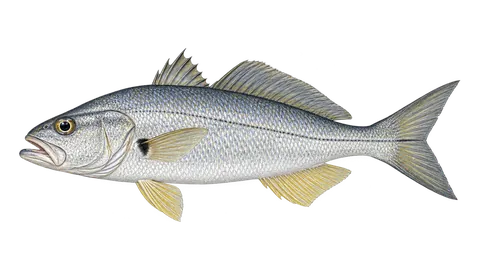
A croaker with an elongated, sturdy body, typical of the family Sciaenidae. It lives in the same habitat as the pescada-do-piauí, which is caught much more often. Because it occurs mostly in estuaries, the capture location is a clue for telling it apart. Its popular name suggests a darker tone than the other river croakers.
Also called: pescada-preta, corvina, pescada, curbinata negra, black curbinata
don't confuse with:
where found
open on the large mapWhere to look: Estuaries and stretches of freshwater river, from the bottom to midwater.
It occurs in the Amazon and Orinoco basins and the rivers of the Guianas, in Brazil, Peru, Venezuela, Guyana, Suriname and French Guiana. In Brazil it also occurs in the Tocantins-Araguaia basin.
native to the basins
how to fish
natural baits
- live lambari
- shrimp
- piece of fish
tip from an angler
Lives mostly in estuaries and eddies. Adults eat fish, so small live bait works; it is easy to catch during the spawning season.
- rod
- 1.8 to 2.1 m, medium action, 8 to 15 lb
- spinning / baitcasting reel
- spinning reel 2000 to 3000
- line
- monofilament 0.30 mm
- leader
- fluorocarbon 0.40 mm, 40 cm
- hook
- #4 to 1
catch and release
It is not dangerous to anglers, but it has spines on the dorsal fin: remove the hook carefully, hold it by the body and return the fish to the water right after capture.
rules for the black curbinata
Rules change; before keeping or transporting fish, check with the state environmental agency.
We found no species-specific rule beyond the region's general rules.
piracema and closed seasons
Each bar is the period when fishing is prohibited or restricted. The green line is today. Tap the name to see what is still allowed.
Closed season in Goiás (state rule)
Allowed: Sport and guided fishing only in reservoirs, catch and release with barbless hooks (no keeping, transporting or eating). Subsistence: up to 5 kg per day, for household consumption only.
Spawning closure (piracema) in Mato Grosso (all basins)
Allowed: All fishing modalities are prohibited in rivers, including catch and release (Law 9.096/2009, art. 19-A). Exceptions: subsistence fishing from shore (3 kg or 1 fish, no transport or sale) and scientific fishing. Law 13.159/2025 now allows licensed sport fishing in UHE/PCH hydropower reservoirs, natural lakes and border rivers, subject to a scientific study and a license from the environmental agency. We have not confirmed whether these licenses are already being issued.
Spawning closure (piracema) in the Araguaia River basin
Allowed: Recreational fishing only in reservoirs, with handline, rod, or spinning or baitcasting reel. Fish may only be eaten on site, not transported. Competitions prohibited. Subsistence: 3 kg + 1 fish. State rules (GO and TO) may be stricter.
Spawning closure (piracema) in the Tocantins and Gurupi river basins
Allowed: Recreational fishing only in reservoirs, with on-site consumption. Subsistence: 5 kg + 1 fish. State rules may be stricter.
Spawning closure (piracema) in Tocantins (state rule)
Allowed: Recreational catch and release with barbless hooks and a recreational fishing card; subsistence fishing by riverside and artisanal fishers from the bank or a rowboat, with a cane pole, handline and hook, with no transport or sale.
Closed season in the Amazon basin in Amazonas
Allowed: Under Portaria 48/2007 (art. 2, II), the recreational angler who fishes with handline or rod, line and hook is outside the Annex II prohibitions, unless a stricter state rule applies. Recreational angler bag limit: 5 kg + 1 fish. Competitions prohibited.
Source: Portaria IBAMA nº 48/2007
Closed season in the Amazon basin in Acre
Allowed: Recreational anglers with handline or rod, line and hook are outside the Annex II prohibitions, with a bag limit of 5 kg + 1 fish, unless a stricter state rule applies. On the Acre River, no fishing of any species during the period.
Source: Portaria IBAMA nº 48/2007; IN IBAMA nº 205/2008 (Acre River)
Closed season in the Acre river
Allowed: IN Ibama 205/2008 prohibits fishing in the Acre river and its tributaries during the closed season, with no exception for recreational anglers: treat it as prohibited.
Source: IN IBAMA nº 205/2008
Closed season in the Amazon basin in Pará
Allowed: Recreational anglers with handline or rod, line and hook are outside the Annex II prohibitions, with a bag limit of 5 kg + 1 fish, unless a stricter state rule applies.
Source: Portaria IBAMA nº 48/2007
Closed season in the rivers of Marajó Island (PA)
Allowed: The same recreational-angler exceptions as in Portaria 48/2007 apply (handline or rod, 5 kg + 1 fish), unless a stricter state rule applies.
Source: Portaria IBAMA nº 48/2007
Amazon basin closed season in Rondônia
Allowed: In the Madeira, Mamoré, Jamari, Abunã, Machado and Roosevelt river basins and in the main channel of the Guaporé, licensed recreational anglers may fish only for non-protected species, using a single simple gear per person (handline, rod with or without a reel, or a simple pole with a single hook). The limit is up to 5 kg or 1 fish per week; if the fish is over 5 kg, you keep only that one. You may not sell, trade or give away the catch. Catch and release is allowed only with non-protected species. Fishing is always banned within 200 m of dams, rapids, waterfalls, fish ladders and river mouths.
Closed season in the Amazon basin in Amapá
Allowed: Recreational anglers with handline or rod, line and hook are outside the Annex II prohibitions, with a bag limit of 5 kg + 1 fish, unless a stricter state rule applies.
Source: Portaria IBAMA nº 48/2007
Closed season in Roraima
Border rivers MT/RO and MT/PA
Allowed: See the exceptions in Portaria 48/2007 and the state rules for each bank.
Source: Portaria IBAMA nº 48/2007
Conservation: Not on the Brazilian national list (Ministerial Ordinance GM/MMA No. 1.667/2026).
how much it weighs without taking it out of the water
estimated weight
—
how we calculate
Length-weight relationship W = a·Lb (a = 0.00575, b = 3.13; FishBase (relação peso-comprimento bayesiana, estimativa)). It's an average: a fat or lean fish can vary by 10% to 20%.
more about the black curbinata
A fish of the family Sciaenidae, the croakers, freshwater with an elongated body. Reaches 34.6 cm. It occurs in the Amazon and Orinoco basins and the rivers of the Guianas, mostly in estuaries, although it is uncommon. It occupies the same habitat as the pescada-do-piauí, but is caught much less. As a juvenile it eats insect larvae and small crustaceans, such as copepods and decapods. Adults eat mostly fish. It is easy to catch during the breeding season. It is an important food fish, used in commercial fishing, aquaculture and aquariums.
Family: Sciaenidae · predator
fun facts
- It is easy to catch during the breeding season.
in the kitchen
It is an important food fish, used in commercial fishing and aquaculture.
similar species

sources and references (4)
Essential profile: size, weight-length, depth, countries and conservation come from FishBase and the cited regulations, and the texts were written from those sources. Technique, baits and hook were estimated from the diet described in FishBase and the size of the species. Season, time of day and sensitivities are not included yet, because we did not find a good source for this species.
- scientific FishBase: Plagioscion auratus (ficha da espécie)Size, length-weight, depth, habitat, distribution, biology, and IUCN status. Page checked on Oct 13, 2026.
- scientific FishBase: nomes populares de Plagioscion auratusNames by country and language.
- official Portaria GM/MMA nº 1.667, de 27 de abril de 2026: Lista Nacional Oficial de Espécies da Fauna Ameaçadas de Extinção (peixes e invertebrados aquáticos)The species is not on the list. Checked in the DOU of April 28, 2026.
- scientific FishBase: Plagioscion auratusBaits and hook estimated from the diet described in FishBase and the size of the species.