Skip to content
catalog Lutjanidae · predator

vermilion snapper

Rhomboplites aurorubens

SeaIUCN global: VU · vulnerable

A small schooling red fish from the gravel and rock bottoms at the edge of the shelf. It takes natural bait and light jigs well and often comes in series.

Also called: realito, vermelho-paramirim, piranga, vermelho-olho-mole, vermilion snapper

Scientific illustration of Vermilion snapper
common size
20–35 cm
maximum
60 cm
common weight
0.2–0.8 kg
record/max.
3.2 kg
depth
25–300 m
ideal water
20–26 °C
overview

who is the vermilion snapper

The realito (vermilion snapper) is a lutjanid of the western Atlantic, from Bermuda and North Carolina to São Paulo, including the Antilles, the Gulf of Mexico and the Caribbean. It lives over rock, gravel and sand bottoms near the shelf edge and islands, usually from 40 to 100 m, in large schools; juveniles stay in shallower water, also in schools. It eats fish, shrimp, crabs, worms, squid and plankton. It lives up to 13 years and matures at about 19 cm. In bottom boat fishing it comes in series, on a multi-hook leader baited with squid or sardine, and it also takes small jigs. The IUCN rates it Vulnerable because of fishing.

fun facts

  • Forms large schools near the shelf edge.
  • In Brazil it has also been called cioba and siobinha, names that apply to other reds.
how to recognize it

identification

Elongated body, back and upper flank bright red, fading to pinkish silver below, with thin yellow lines below the lateral line. Small mouth, short snout and slightly protruding lower jaw; large eye. Dorsal and tail yellowish; anal and pelvic fins whitish. The red snapper (pargo) has a larger mouth and canines; the rabirrubia (guaiúba) has a wide yellow band in the middle of the flank and a yellow tail.

how vermilion snapper fishing looks

Loading the next 7 days…

Each card shows the day's index (0 to 100) and, below it, a strip with the index for each hour, from 0h to 23h. from poor to excellent.

distribution

where found

open on the large map

In Brazil, from the north to São Paulo, on gravel and rock bottoms of the outer shelf.

Habitat: Rock, gravel and sand bottoms near the shelf break; juveniles in shallower water.

coast

North CoastNortheast CoastSoutheast Coastshelf

states

Amapá, Pará, Maranhão, Piauí, Ceará, Rio Grande do Norte, Paraíba, Pernambuco, Alagoas, Sergipe, Bahia, Espírito Santo, Rio de Janeiro, São Paulo

calendar and clock

when to fish

best season

time of year
JanFebSeaAprMayJunJulAugSepOctNovDec

Found year-round. Spawning takes up much of the year, peaking in spring and summer in the Northern Hemisphere, where it was studied.

best time of day

0h6h12h18h sunrise ~6amsunset ~6pm

Daytime. On bottoms 40 to 100 m deep it bites by day; current matters more than the time.

weather, water and behavior

what affects the vermilion snapper
sensitivity The little bars show how much each factor affects this species. Five full: it feels it a lot.

cold and cold fronts

Lives in deep, more stable water.

atmospheric pressure

A cold front brings rough seas and prevents holding position over the spot.

moon

Small effect.

rain

No effect at depth.

water level

Does not depend on water level.

noise

Not very sensitive at depth.

wind

Strong wind speeds up the drift and pulls the line away from the school.

tide

Moderate current is best; very strong current requires heavy sinkers.

depth

Adults from 40 to 100 m for most catches.

technique, gear and bait

how to fish

rod
6' to 7', 15 to 30 lb
spinning / baitcasting reel
baitcasting reel 200 to 300 or spinning reel 4000
line
braided line 20 to 40 lb
leader
leader of 2 or 3 hooks on 30 to 50 lb monofilament
hook
circle 1/0 to 3/0

lures

  • jig 60 to 150 g (light slow pitch)
  • large sabiki

natural baits

  • squid strips
  • sardine pieces

accessories

  • sinker 150 to 400 g
  • descender (fish descender)

tip from an angler

When you find the school, mark the spot and drop again in exactly the same place: the realito usually comes in series.

what the law says

rules for the vermilion snapper

Summary of the regulations we found, with the source for each. Rules change; before keeping or transporting fish, check with the state environmental agency.
Conservation: Vulnerable in the IUCN global assessment, which has no legal effect in Brazil. We found no specific federal rule for the species.

Puerto Rico (federal waters): closed Oct 1 to Dec 31

fishing and possession prohibited Oct 1 to Dec 3101/10 to 31/12

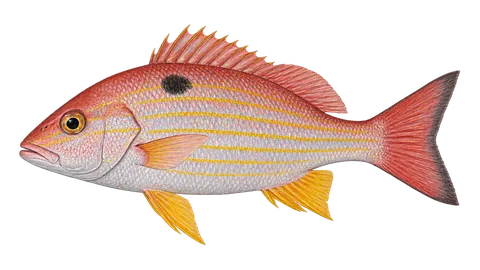
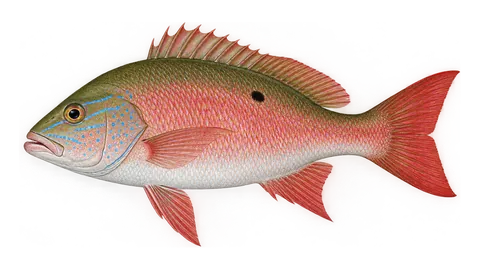
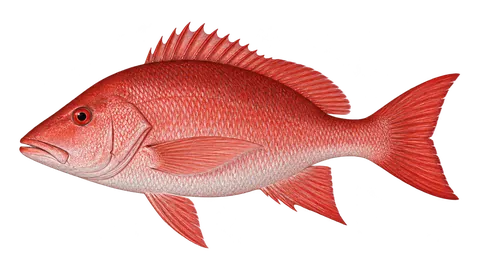
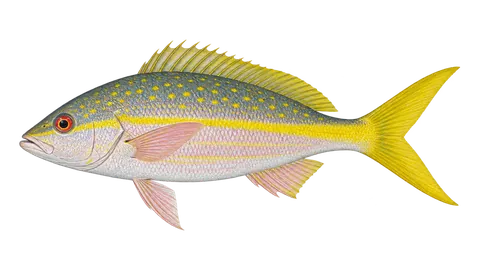
In federal waters around Puerto Rico, beyond 9 miles from the coast, it is prohibited to fish for or have on board vermilion snapper (realito) and black, blackfin and silk snappers from October 1 to December 31 of each year.
Source: 50 CFR 622.439(b)(3) (NOAA Fisheries, US)

Puerto Rico (federal waters): up to 5 per person per day

5 per person per day; 15 per boat with 3 or more people

In federal waters around Puerto Rico, beyond 9 miles from the coast, the recreational angler may keep a maximum of 5 fish per day from groupers, snappers and parrotfish combined (up to 15 per boat when there are 3 or more people aboard). The limit does not apply to anyone with a commercial license from Puerto Rico or the U.S. Virgin Islands.

Source: 50 CFR 622.444(a)(1) (NOAA Fisheries, US)

catch and release
catch and release Releasing the fish alive, quickly and with a wet hand. During a closed season it isn't always allowed: what the regulation says applies.

If it comes from 40 m or deeper, it rises with barotrauma: if you are going to release it, use a descender.

in the kitchen

White, tasty flesh; good fried, baked or in moqueca.

calculator

how much it weighs without taking it out of the water

Length-weight relationship W = a·Lb (a = 0.01514, b = 2.95; FishBase (estimativa bayesiana, comprimento total)). It's an average: a fat or lean fish can vary by 10% to 20%.

estimated weight

—

sources and references

The season weights (months), the time of day and the sensitivities (cold, pressure, moon, wind, rain, tide, strong light, murky water and noise) are the app's editorial estimates, based on the literature below and on the field experience of anglers and guides. They are not official data nor a measurement made for this species, and they may vary by region and year. Closed seasons and legal rules appear in the rules section, with the norm and a link.

  1. scientific FishBase — Rhomboplites aurorubens (ficha da espécie)Names, distribution, biology, length-weight relationship, country list and references. Page checked on Oct 13, 2026.
  2. official Portaria GM/MMA nº 1.667, de 27 de abril de 2026 — Lista Nacional Oficial de Espécies da Fauna Ameaçadas de Extinção (peixes e invertebrados aquáticos)Most recent national list. The species is not on it (search by scientific name in the text published in the DOU, checked on October 13, 2026).
  3. official ICMBio/SALVE — Ficha de Rhomboplites aurorubens (avaliação nacional do risco de extinção)ICMBio national assessment, published in 2025. DOI checked on Crossref.
  4. scientific IUCN Red List — Rhomboplites aurorubens (avaliação global: Vulnerável, VU, 10/10/2015)Global assessment. Link given on the FishBase entry (Red List, version 2025-2).
  5. official Code of Federal Regulations, 50 CFR Part 622, Subpart S — Regulations specific to the Puerto Rico Management Area (NOAA Fisheries, EUA)Consolidated text in the eCFR, checked October 13, 2026: §622.438 (prohibited species), §622.439 (area and time closures) and §622.444 (quotas). It applies in federal waters, beyond 9 miles from the coast.
  6. scientific Allen, G. R. (1985). FAO species catalogue. Vol. 6. Snappers of the world: an annotated and illustrated catalogue of lutjanid species known to date. FAO Fisheries Synopsis 125(6). Roma: FAO.
  7. scientific Carpenter, K. E. (org.) (2002). The living marine resources of the Western Central Atlantic. Vol. 3: Bony fishes part 2 (Opistognathidae to Molidae). FAO Species Identification Guide for Fishery Purposes. Roma: FAO.Chapter Lutjanidae (Anderson Jr., W. D.).
don't confuse

similar species