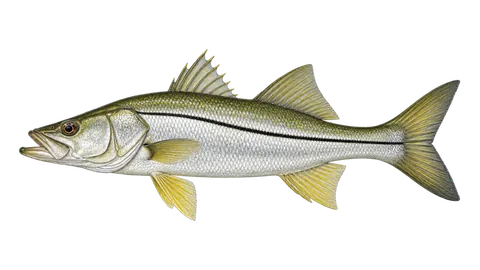
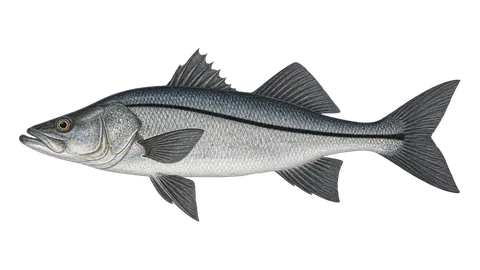
Small Pacific snook, deep-bodied, with a marked hump on the nape of adults and a yellowish head. Lives in bays, estuaries and low rivers, from El Salvador to Peru; in Costa Rica it has a legal minimum catch size.
Also called: robalo-corcunda, róbalo serrano, gualajo, gualaje mano de piedra, Humpback snook, Union snook
Eastern Pacific snook, from El Salvador to Peru according to FishBase; STRI places it from the southeast of the Gulf of California to Peru. Lives in bays, estuaries and the lower reaches of coastal rivers, from 0 to 25 m, near the bottom. It reaches 46 cm and 1.1 kg, with a common length of about 25 cm, and STRI records at least 36.6 cm. The hump on the nape of adults gives the English name humpback snook. It has commercial importance in the region, and FishBase classifies it as a sport fish. In Costa Rica, where it is called gualaje mano de piedra, there is a legal minimum catch size of 28 cm, a general rule that prohibits selling and transporting smaller fish.
fun facts
In Costa Rica the official name in Incopesca's tables is gualaje mano de piedra.
The same species has many names in the region: gualajo, gualazo, róbalo serrano, robalo chato and róbalo ojito.
how to recognize it
identification
Elongated, relatively deep body, with a clearly concave head profile and a marked hump on the nape of adults. Silvery, with a yellowish head, a pale lateral line and yellowish pectoral and anal fins; the tip of the first dorsal fin has a black spot. The second anal spine is much thicker than the third and, bent back, reaches halfway along the caudal peduncle; the anal fin has 6 rays (rarely 5), and the pectoral and pelvic fins are nearly the same length.
how union snook fishing looks
Loading the next 7 days…
Each card shows the day's index (0 to 100) and, below it, a strip with the index for each hour, from 0h to 23h. from poor to excellent.
Not found in Brazil. Eastern Pacific, from El Salvador to Peru, according to FishBase; STRI extends the range to the southeast of the Gulf of California (Mexico). FishBase lists El Salvador, Honduras, Nicaragua, Costa Rica, Panama, Colombia, Ecuador and Peru.
Habitat: Bays, estuaries and lower stretches of coastal rivers, near the bottom.
calendar and clock
when to fish
best season
time of yearbest: Jun–Oct
JanFebSeaAprMayJunJulAugSepOctNovDec
No seasonal study for this species. The app gives more weight to warmer water and to rivers with higher flow, from June to October, when fresh water reaches the river mouths.
best time of day
Dawn and dusk. No dedicated study. The app's estimate follows the snooks: more activity at dawn, dusk and at night, during tide changes.
weather, water and behavior
what affects the union snook
sensitivity The little bars show how much each factor affects this species. Five full: it feels it a lot.
cold and cold fronts
Cold winter water reduces activity in the bays and at river mouths.
atmospheric pressure
Stable pressure helps; a front with strong wind shuts down fishing.
moon
Full-moon and new-moon tides move water at the mouths and in the channels.
rain
A rising, muddy river scatters the fish; clearing water afterwards is good.
water level
Falling river concentrates snook at mouths and channels.
noise
Sensitive to noise and to shadow on the water; arrive by oar or electric motor.
wind
Strong wind makes precise casting near roots and logs difficult.
tide
Ebb tide at river and lagoon mouths is usually the best.
depth
From 0.5 to 5 m, near logs, roots and current breaks.
single hook no. 2 to 1/0; circle hook 1/0 to 2/0 on live bait
lures
mid-water jerkbait, 7 to 10 cm
silicone shad on a light jig head
small stickbait at dawn
streamer for fly fishing
natural baits
live shrimp
small live or dead baitfish
accessories
alicate
small boga-grip
polarized glasses
tip from an angler
Cast tight to the roots and along the edge of the channel and retrieve with pauses: the snook hits the bait that comes out of the shade carried by the current.
what the law says
rules for the union snook
Summary of the regulations we found, with the source for each. Rules change; before keeping or transporting fish, check with the state environmental agency. Conservation: Of least concern globally, but the IUCN assessment is old (2007).
Costa Rica: gualaje mano de piedra (humpback snook), minimum 28 cm
28 cm total length (10% tolerance)confirm with the agency
Incopesca set 28 cm as the legal first-catch size for gualaje mano de piedra (Centropomus unionensis), whose first maturity is at 29 cm, with a 10% tolerance in biomass and number of fish. The rule applies to everyone who fishes and prohibits selling, transporting, processing or handling fish below the size. Article 7, letter B, provided for requiring the first-maturity size (29 cm) after two years; we did not confirm whether this was regulated, so use 29 cm to be safe.
Personal Incopesca license, for people over 16confirm with the agency
In the regulation of the Fisheries and Aquaculture Law (Decree 36782, of May 24, 2011), art. 69, sport fishing is authorized only for natural persons over 16, with a license issued by Incopesca; tourists, whether national or foreign, also need the license. Art. 68 limits the landing of large pelagics to 5 per trip, and art. 66 promotes catch and release, but the rule sets no quota for this species. The decree was later amended (Decree 39458), so confirm the current rule with Incopesca.
Panama: new sport fishing decree in force from Dec 10, 2026
Executive Decree No. 9 (Jun 10, 2026), in force from Dec 10, 2026confirm with the agency
ARAP published Executive Decrees No. 9 and No. 10, of Jun 10, 2026, in the Official Gazette. The first regulates sport fishing throughout the territory; the second protects billfish (sailfish and marlins). Both take effect on Dec 10, 2026, after six months of adaptation. We did not verify the text: the press report gives no catch limits, sizes or license requirements. Before fishing in Panama, check with ARAP.
Colombia: AUNAP license and catch-and-release in sport fishing
Individual AUNAP license; catch-and-release guidanceconfirm with the agency
AUNAP Resolution 0549 of 2022 sets the guidelines for sport fishing for recreational purposes in Colombia. Anyone fishing needs a permit: for a natural person, Colombian or foreign, it is a personal, non-transferable license (art. 6). The rule uses "capture and release" as guidance. We did not verify the daily limit or the minimum sizes by species: check with AUNAP before keeping any fish.
catch and release Releasing the fish alive, quickly and with a wet hand. During a closed season it isn't always allowed: what the regulation says applies.
Hold it by the mouth with a wet hand, support the belly, and watch the sharp edge of the gill cover and the anal spines. Release it facing the current, only once it swims on its own.
in the kitchen
White flesh; sold fresh locally. Because it is small, it yields little fillet.
calculator
how much it weighs without taking it out of the water
Length-weight relationship W = a·Lb (a = 0.00759, b = 3.09; FishBase (relação peso-comprimento bayesiana, estimativa da própria espécie)). It's an average: a fat or lean fish can vary by 10% to 20%.
estimated weight
—
sources and references
The season weights (months), time of day and sensitivities (cold, pressure, moon, wind, rain, tide, strong light, murky water and noise) are the app's editorial estimates, based on the literature below and on field experience of anglers and guides. They are not official data or measurements made for this species, and may vary by region and year. Closed seasons and legal rules appear in the rules section, with the standard and a link. The common size starts from FishBase's common length (25 cm), and the common weight is calculated from the length-weight relationship.