

cabinza grunt
Isacia conceptionis
Grunt of rocky and sandy bottoms in the South American Pacific, from Peru to Chile, commercially fished.
- maximum
- 60 cm
- depth
- 0–50 m
how to recognize it
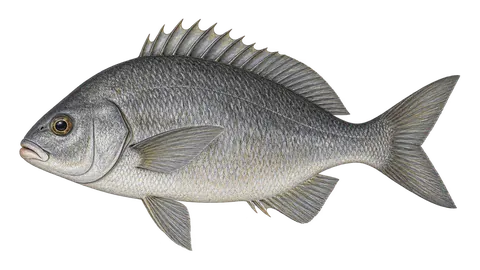
A fish with the typical shape of grunts, family Haemulidae. It lives over rocky and sandy bottoms, from the shore down to 50 m, in South American Pacific waters. It can be confused with the chita, which lives on the same coast and also occupies hard bottoms and rocky reefs.
Also called: roncador-cabinza, cabinza, cabinza grunt
don't confuse with:
where found
open on the large mapWhere to look: Rocky and sandy bottoms, from the shore to 50 m.
Found in the South American Pacific, from Peru to Chile, with records also in Nicaragua.
how to fish
natural baits
- shrimp in tiny pieces
- minhoca-de-mar
- mussel
tip from an angler
Lives over rock and sand, in shallow water (up to 50 m). Eats small crustaceans (isopods and amphipods), polychaetes and algae: very small bait on the bottom. FishBase assumes 60 cm from the family, but the largest published weight is 183 g: it is a small fish.
- rod
- rod 1.8 to 2.4 m, light action
- spinning / baitcasting reel
- spinning reel 2000
- line
- monofilament 0.20 to 0.25 mm
- leader
- fluorocarbon 0.25 mm, 40 to 60 cm
- hook
- size 8 to 4
catch and release
No danger to anglers. If released, return it to the water carefully.
rules for the cabinza grunt
Rules change; before keeping or transporting fish, check with the state environmental agency.
We found no species-specific rule beyond the region's general rules.
how much it weighs without taking it out of the water
estimated weight
—
how we calculate
Length-weight relationship W = a·Lb (a = 0.01202, b = 2.97; FishBase (relação peso-comprimento bayesiana, estimativa da própria espécie)). It's an average: a fat or lean fish can vary by 10% to 20%.
more about the cabinza grunt
The cabinza grunt belongs to the family Haemulidae, the grunts. It reaches 60 cm. It lives in the South American Pacific, from Peru to Chile, over rocky and sandy bottoms, from the shore down to 50 m. Its diet mixes small crustaceans, such as isopods and amphipods, with polychaetes and algae. Commercial fishing takes it, and it has little prominence in sport fishing. There are also records of the species in Nicaragua.
Family: Haemulidae · omnivore
similar species
sources and references (3)
Essential profile: size, weight-length, depth, countries and conservation come from FishBase and the cited regulations, and the texts were written from those sources. Technique, baits and hook were estimated from the diet described in FishBase and the size of the species. Season, time of day and sensitivities are not included yet, because we did not find a good source for this species.
- scientific FishBase: Isacia conceptionis (ficha da espécie)Size, length-weight, depth, habitat, distribution, biology, and IUCN status. Page checked on Oct 13, 2026.
- scientific FishBase: nomes populares de Isacia conceptionisNames by country and language.
- scientific FishBase: Isacia conceptionisHabitat and diet (small crustaceans, polychaetes and algae) per FishBase; baits and hook estimated from real size (largest published weight, 183 g; the 60 cm maximum is assumed from the family); no hook-fishing source found.