Peru: minimum size 24 cm
In Peru it is prohibited to extract, receive, transport, store, process and sell chita under 24 cm total length, with the incidental juvenile catch tolerance set by the rule. Below the size, release.
Anisotremus scapularis
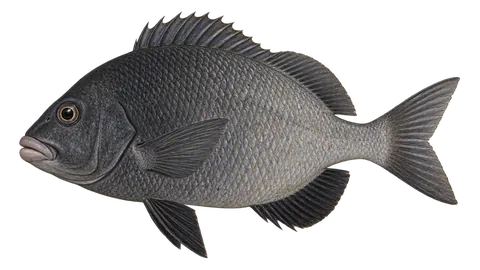
The "sargo" of the rocks of Peru and northern Chile: deep, dark silver and small-mouthed. A rocky-shore and spearfishing species, it has a minimum size and a December closed season in Peru.
Also called: chita
The chita is a grunt, from the family of pigfish and salemas, in the southeastern Pacific, from Manta in Ecuador to Antofagasta in Chile, including the Galápagos. It forms schools in open water over stone reefs, boulder slopes and hard bottoms with good water movement, from 3 to 30 m, mostly between 3 and 12 m. It eats bottom invertebrates and drifting organic matter. It reaches almost 60 cm, but the usual size is 25 to 40 cm. Highly prized in Peruvian cooking, it is sought in rock fishing with natural bait and in spearfishing. IMARPE considers the resource heavily exploited, and Peru has adopted a minimum size of 24 cm and a December spawning closure.
Deep, oval, compressed body with a rounded head profile and a small mouth with thick lips. Gray-silver to dark color, paler on the belly. Continuous dorsal fin with strong spines, anal fin with 3 spines and slightly forked tail. It is related to the Atlantic sargos and salemas (genus Anisotremus); the lorna, which shares the same beaches, is more elongated and has two dorsal fins separated by a notch.
Loading the next 7 days…
Each card shows the day's index (0 to 100) and, below it, a strip with the index for each hour, from 0h to 23h. from poor to excellent.
Does not occur in Brazil. Southeastern Pacific, from Manta (Ecuador) to Antofagasta (Chile), including the Galápagos Islands.
Habitat: Stone reefs, boulder slopes and hard bottoms with good water movement.
In Peru it is caught all year except December (spawning closure). Spawning is concentrated in spring and summer.
Daytime. Active by day over the rocks, in schools; the first hours of the morning usually produce more.
Strong cold upwelling water reduces activity; El Niño changes the distribution.
Rough sea prevents rock fishing.
Little effect.
It hardly ever rains on the Peruvian coast.
Not applicable at sea.
Sensitive on shallow rock: approach without shade and without noise.
Moderately choppy sea with foam helps; surge makes the rock dangerous.
The rising tide covers the rocks and brings food.
2 to 12 m, close to the rocks.
natural baits
accessories
Fish close to the rocks on the rising tide and bring the fish in quickly: the chita runs for its hole once hooked.
Summary of the regulations we found, with the source for each. Rules change; before keeping or transporting fish, check with the state environmental agency.
Conservation: Old global assessment. In Peru, IMARPE considers the resource heavily exploited; there is a minimum size and an annual closed season. We found no specific rule in Ecuador or Chile.
In Peru it is prohibited to extract, receive, transport, store, process and sell chita under 24 cm total length, with the incidental juvenile catch tolerance set by the rule. Below the size, release.
On the Peruvian coast the chita has a spawning closure from December 1 to 31 every year. The dates may change if IMARPE detects a change in the maturation pattern.
Hold it with a cloth, watch the dorsal spines, and release quickly next to the rock. In Peru, below 24 cm release is mandatory and in December extraction is prohibited.
White, firm flesh, highly valued in Peru: classically fried whole, grilled and in sudado.
Length-weight relationship W = a·Lb (a = 0.01202, b = 3.02; FishBase (estimativa bayesiana com dados da espécie e da subfamília, comprimento total); peso máximo calculado por esta relação (o peso máximo publicado, 896 g, é anterior ao registro de 58 cm)). It's an average: a fat or lean fish can vary by 10% to 20%.
estimated weight
—
The season weights (months), the time of day and the sensitivities (cold, pressure, moon, wind, rain, tide, strong light, murky water and noise) are the app's editorial estimates, based on the literature below and on the field experience of anglers and guides. They are not official data nor a measurement made for this species, and they may vary by region and year. Closed seasons and legal rules appear in the rules section, with the norm and a link.
Your location is saved only on this device and feeds the forecast, the map and the "today" on the home page.