overview
who is the coho salmon
Native to the North Pacific, from the Anadyr River (Russia) to Hokkaido (Japan) and from Alaska to Baja California, where Chamalu Bay marks the southern limit. Young fish live one to two years in fresh water, go to sea, grow for about a year and a half, and return to the river where they hatched to spawn in autumn, dying afterward. It was taken to Chile and Argentina through aquaculture and stocking programs; Chile farms coho on a large scale, and escapes from farms feed fishing in the rivers, lakes and estuaries of the south. Unlike chinook, coho did not form large wild populations in the region. It is a fast, jumping sport fish, caught with spoons, spinners and streamers.
fun facts
- Like all Pacific salmon, it dies after spawning.
- The southern limit of the native range is in Mexico, at Chamalu Bay in Baja California.
how to recognize it
identification
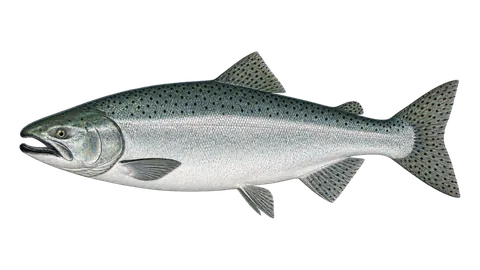
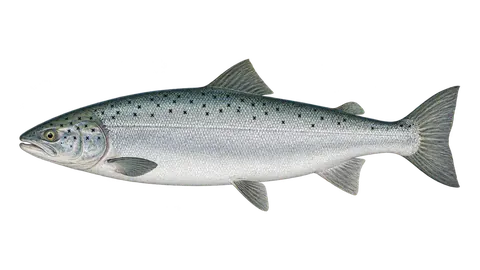
Silvery, with a blue-metallic or greenish back and small black spots on the back and only on the upper lobe of the tail. The gum of the lower jaw is pale, without the black stripe of chinook, which also has spots on both tail lobes. During spawning the head and back turn dark green, the flanks red, and the male grows a hooked snout. Atlantic salmon has a short anal fin, with fewer than 12 rays.
how coho salmon fishing looks
Loading the next 7 days…
Each card shows the day's index (0 to 100) and, below it, a strip with the index for each hour, from 0h to 23h. from poor to excellent.