

atlantic salmon
Salmo salar
The Atlantic salmon of the North Atlantic, present in Patagonia as a landlocked fish in Argentine lakes and as an escapee from farms in southern Chile. In Argentina, release is mandatory.
- common size
- 40–75 cm
- maximum
- 150 cm
- common weight
- 0.7–5 kg
- record/max.
- 46.8 kg
- depth
- 0.5–20 m
- ideal water
- 6–14 °C
how to recognize it
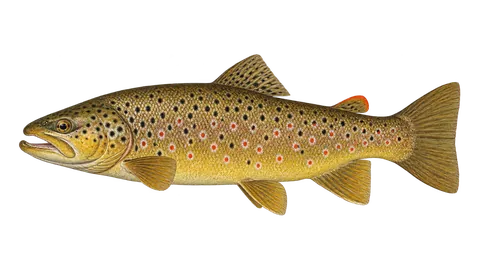
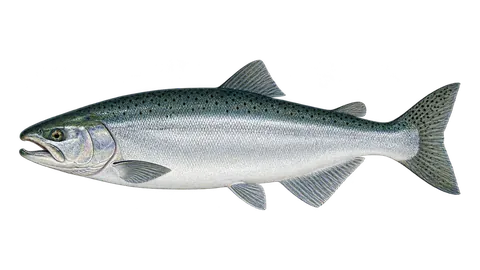
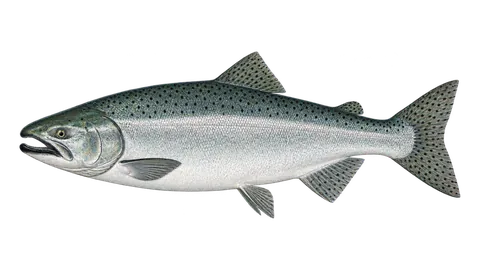
Slender body, thin caudal peduncle and slightly forked tail. Silvery, blue-green back and few black spots, none below the lateral line; tail almost without spots. The mouth reaches only to the back edge of the eye. The brown trout has a larger mouth, red spots with a pale halo, an orange adipose fin and a straight tail. Pacific salmon (coho and chinook) have a longer anal fin, with 12 rays or more.
Also called: salmão-do-atlântico, salmão, salmão encerrado, Atlantic salmon
don't confuse with:
where found
open on the large mapWhere to look: Cold, deep lakes, outflows of lakes and clean-water rivers with rapids and pools; in Chile, also estuaries and fjords near the farms.
Not found in Brazil (FishBase records an introduction without establishment). Exotic, native to the North Atlantic. Landlocked populations in lakes of Argentine Patagonia, such as Traful (Neuquén), and fish escaped from farms in rivers, lakes and fjords of southern Chile.
when to fish
next 7 days
Loading the next 7 days…
best season
Fishing follows the Patagonian seasons, from November to April or May, depending on the region. In autumn the landlocked fish run up the tributaries to spawn.
best time of day
Daytime, with peaks at dawn and dusk. More active at dawn, dusk and on overcast days; in strong sun it goes deeper in the lakes.
what affects the atlantic salmon
cold and cold fronts
Cold-water fish; summer heat drives it to the bottom of the lakes.
atmospheric pressure
Little direct effect; overcast and stable weather is usually good.
moon
Little effect.
rain
Rain that raises the flow encourages the run up the tributaries in autumn.
water level
Rising flow in the tributaries attracts fish; very low river leaves them wary in the pools.
noise
Wary fish in clear water; approach carefully and without shade over the water.
wind
A light chop on the lakes helps; strong wind hinders fly casting.
depth
In lakes, from 2 to 15 m depending on temperature; in rivers, pools and currents from 1 to 3 m.
how to fish
lures
- streamers and salmon flies
- spoon 7 to 15 g
- spinner No. 2 to 4
natural baits
- natural bait is usually banned for salmonids; check the regulations
tip from an angler
In Argentina, a single barbless simple hook was already in use: every Atlantic salmon goes back into the water.
- rod
- fly #6 to #8; spinning 7' to 8', 6 to 15 lb
- spinning / baitcasting reel
- fly reel with a good drag; spinning reel 2500 to 3000
- line
- floating and sinking fly; monofilament 8 to 12 lb or braided line 15 to 20 lb
- leader
- fluorocarbon 8 to 14 lb
- hook
- barbless single hook in release areas
accessories
- rubber-mesh passaguá
- waders with a belt
- alicate
catch and release
Keep the fish in the water, remove the barbless hook with pliers and hold it by the tail base and belly, facing the current, until it swims off on its own.
rules for the atlantic salmon
Rules change; before keeping or transporting fish, check with the state environmental agency.
Argentina (Patagonia): Atlantic salmon, release only
mandatory release in all environments details
The Patagonian General Regulation of Continental Sport Fishing, adopted by Neuquén, Río Negro, Chubut and the National Parks Administration, requires mandatory release of Atlantic salmon in all environments. It requires a fishing permit, an artificial lure with a single hook and, in release areas, a barbless simple hook. The 2025/2026 season ran from Nov 1 to May 1.
Source: Resolución APN nº 417/2025 (Boletín Oficial, Dec 9, 2025), Annex I, items 7º, 11º and 13º
Chile: license and limit of 3 fish or 15 kg per day
3 fish or 15 kg per day (whichever comes first)confirm with the agency details
In recreational salmonid fishing in Chile's inland waters, including Atlantic salmon, the general rule published by Sernapesca is a maximum of 3 fish or 15 kg per angler per day, with a valid recreational fishing license and one rod per person. The season is set by region (in Magallanes, 2025-2026: Oct 16 to Apr 14), and some rivers and lakes are release-only. In some regions it is prohibited to use live or organic bait for salmonids.
Conservation: Exotic in southern South America. In its native range, the IUCN moved the species from Least Concern to Near Threatened in 2023. IUCN global: NT · near threatened.
how much it weighs without taking it out of the water
estimated weight
—
how we calculate
Length-weight relationship W = a·Lb (a = 0.01023, b = 3.03; FishBase). It's an average: a fat or lean fish can vary by 10% to 20%.
more about the atlantic salmon
Native to the North Atlantic, where it hatches in rivers, grows at sea and returns to spawn. It was released in Argentine Patagonia more than a century ago, along with trout, and in some lakes, such as Traful (Neuquén), it formed landlocked populations that spend their whole lives in fresh water and spawn in tributaries in autumn: this is the landlocked salmon (salmón encerrado). In southern Chile, one of the world's largest farmed-salmon producers, most of the fish that appear in rivers, lakes and fjords escaped from net-pen farms, and these fish rarely form populations that sustain themselves. In sport fishing it is a fly and spinning fish in cold lakes and rivers. In Argentina, the Patagonian regulation requires releasing all of them.
Family: Salmonidae · predator
fun facts
- In 2023 the IUCN reclassified Atlantic salmon as Near Threatened, due to a 23% decline in the global population between 2006 and 2020.
- Escapes from farms in southern Chile are studied for their effects on native fauna and for conflicts with local fishing.
in the kitchen
Pink, fatty flesh. In Chile, escaped fish may be kept within the quota; in Argentina, release is mandatory.
similar species
sources and references (7)
The season weights (months), the time of day and the sensitivities (cold, pressure, moon, wind, rain, tide, strong light, murky water and noise) are the app's editorial estimates, based on the literature below and on the field experience of anglers and guides. They are not official data nor a measurement made for this species, and they may vary by region and year. Closed seasons and legal rules appear in the rules section, with the norm and a link.
- scientific FishBase — Salmo salar (ficha da espécie)Names, distribution, biology, length-weight relationship, list of countries and references. Page checked 13/10/2026. FishBase records the species as introduced in Chile and southern Argentina.
- scientific IUCN Red List — Salmo salar (avaliação global: Quase Ameaçada, NT, 2023)Global assessment indicated on the FishBase entry (Red List, version 2025-2).
- official IUCN — Freshwater fish highlight escalating climate impacts on species: IUCN Red List (11/12/2023)Notice of the Red List update that moved Atlantic salmon to Near Threatened (global decline of 23% between 2006 and 2020).
- scientific Pascual, M. A.; Ciancio, J. E. (2007). Introduced anadromous salmonids in Patagonia: risks, uses, and a conservation paradox. In: Ecology of Fish Introductions. Dordrecht: Springer, p. 333-353.DOI checked in Crossref.
- scientific Soto, D.; Jara, F.; Moreno, C. (2001). Escaped salmon in the inner seas, southern Chile: facing ecological and social conflicts. Ecological Applications 11(6): 1750-1762.DOI checked in Crossref.
- official Argentina — Resolución APN nº 417/2025 (Administración de Parques Nacionales): aprova o Reglamento General de Pesca Deportiva Continental Patagónico, temporada 2025/2026Published in the Official Gazette on Dec 9, 2025. Annex I (general regulation) checked: items 8 to 11 (species), 13 (baits) and 17 and 18 (release and daily limit).
- official Sernapesca (Chile) — Comenzó la temporada de pesca recreativa en la región de Magallanes (16/10/2025)Official notice with the 2025-2026 season in Magallanes, mandatory license, a limit of 3 fish or 15 kg per day, and habitats with mandatory release.