

surubim-do-magdalena
Pseudoplatystoma magdaleniatum
The large bagre rayado of the Magdalena basin in Colombia, a relative of the surubim and cachara. Critically Endangered in the country: it has a minimum size and a closed season, and the best option for the species is to release it.
- common size
- 50–90 cm
- maximum
- 150 cm
- common weight
- 2–10 kg
- record/max.
- 70.0 kg
- depth
- 2–15 m
- ideal water
- 26–30 °C
how to recognize it
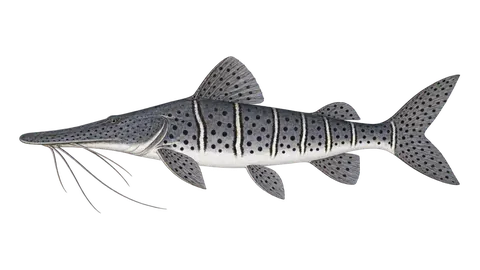
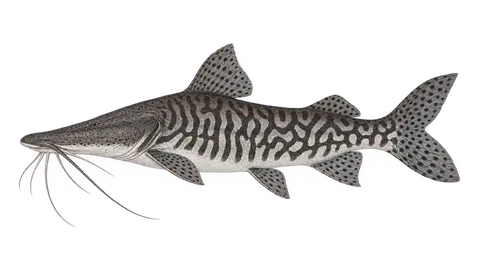
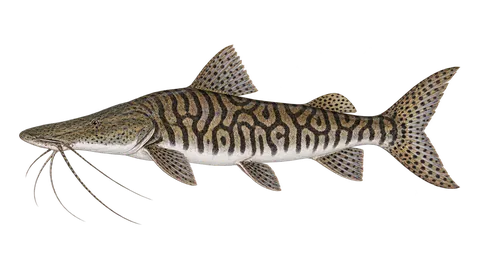
Elongated body, large flattened head, long barbels. Dark grey back, white belly and broad, straight, vertical dark bands on the flank, without the loops and net pattern on the nape of other surubim. Pale pectoral fins without spots, dorsal with few or no spots and adipose fin with 6 or 7 large spots. It is the only surubim of the Magdalena basin.
Also called: surubim-do-magdalena, bagre rayado, pintadillo
don't confuse with:
where found
open on the large mapWhere to look: Channels of large rivers and floodplains; the juveniles spend high water in the ciénagas of the middle and lower Magdalena.
Does not occur in Brazil. Endemic to the Magdalena basin in Colombia: Magdalena, Cauca and San Jorge rivers and their ciénagas.
when to fish
next 7 days
Loading the next 7 days…
best season
It makes two migrations a year, in low-water periods, when fish concentrate in the channel. Spawning peaks in high water, from April to June and in September-October, when the closed season applies.
best time of day
Night and twilight. Hunts more at night and at dusk; by day it stays on the channel bottom.
what affects the surubim-do-magdalena
cold and cold fronts
Little relevance in the Magdalena.
atmospheric pressure
Little effect on the bottom.
moon
Effect not measured.
rain
A rising river triggers spawning.
water level
Low water concentrates fish in the channel.
noise
Not very sensitive.
wind
Little effect.
depth
Channel bottom, 3 to 12 m.
how to fish
natural baits
- live fish or cut pieces (bocachico, nicuro)
tip from an angler
Barbless circle hook and a short fight. Don't take a big fish out of the water: photo with it in the water and release it facing the current.
- rod
- 6'6" to 7', heavy action, 30 to 60 lb
- spinning / baitcasting reel
- baitcasting reel 300 or spinning reel 6000 to 8000
- line
- braided line 50 to 65 lb
- leader
- monofilament 80 to 100 lb, 1 m
- hook
- circle hook 7/0 to 9/0, barbless
accessories
- olive sinker 50 to 120 g
- long-handled pliers
- luvas
catch and release
Release it: the species is critically endangered in Colombia. Use a barbless circle hook, don't hang it by the mouth, support the body in the water and revive it facing the current until it swims off on its own.
rules for the surubim-do-magdalena
Rules change; before keeping or transporting fish, check with the state environmental agency.
Colombia: minimum size of 80 cm
80 cm standard length (60 cm without head) details
In the Magdalena, Cauca and San Jorge basin, bagre rayado may only be kept at 80 cm standard length with head (60 cm without head). Studies cited in the Libro Rojo show that most fish caught today fall below this size.
Source: Resolución INDERENA nº 430/1982 (AUNAP minimum size table in force)
Colombia: May closed season
fishing, storage, sale and transport banned01/05 to 30/05 details
Closed season for bagre rayado in the Magdalena basin (Magdalena, Cauca and San Jorge rivers), with bans on fishing, storage of any kind, sale and transport.
Colombia: September-October closed season
fishing, storage, sale and transport banned15/09 to 15/10 details
Second closed season for bagre rayado in the Magdalena, Cauca and San Jorge basin. There are also local closures, such as the 'candeleo closure' (light fishing) in the Santander stretch of the Middle Magdalena (Resolución AUNAP nº 2367/2019).
Conservation: In Colombia, the Libro Rojo de peces dulceacuícolas (2012) classifies it as Critically Endangered (CR): catches fell more than 90% in 30 years and average size dropped from 92 cm (1973) to 42 cm (2010) in Mompox. Release it. IUCN global: EN · endangered.
how much it weighs without taking it out of the water
estimated weight
—
how we calculate
Length-weight relationship W = a·Lb (a = 0.00407, b = 3.14; FishBase). It's an average: a fat or lean fish can vary by 10% to 20%.
more about the surubim-do-magdalena
An iconic catfish of the Magdalena River and the largest fish in the basin, with records of up to 1.5 m and 70 kg. Until 2007 it was treated as Pseudoplatystoma fasciatum, a name once used for surubim across South America; the revision of the genus showed that the Magdalena fish is a species of its own, endemic to Colombia, in the Magdalena, Cauca and San Jorge rivers and the floodplain swamps (ciénagas). In the 1970s it made up more than half of the subienda catch (migratory run); since then catches have dropped more than 90% and average size has plunged, due to overfishing and habitat degradation. The Colombian Libro Rojo classifies it as Critically Endangered, and the IUCN as Endangered. Fishing is legal with a minimum size and outside the closed season, but for sport anglers the recommendation is to release.
Family: Pimelodidae · predator
fun facts
- Until the 1960s it was the staple of fish consumption in the Magdalena basin; as catches fell, consumption shifted to bocachico.
- Males mature at about 65 cm and females at 89 cm standard length, above the average size caught today.
in the kitchen
It was the most prized fish of the Magdalena. Given the species' condition, in sport fishing it is better to release it.
similar species
sources and references (6)
The season weights (months), the time of day and the sensitivities (cold, pressure, moon, wind, rain, tide, strong light, murky water and noise) are the app's editorial estimates, based on the literature below and on the field experience of anglers and guides. They are not official data nor a measurement made for this species, and they may vary by region and year. Closed seasons and legal rules appear in the rules section, with the norm and a link.
- scientific FishBase — Pseudoplatystoma magdaleniatum (ficha da espécie)Diagnosis (straight bands, adipose fin with 6 to 7 spots), distribution, length-weight relationship and country list. Page checked on Oct 13, 2026.
- scientific IUCN Red List — Pseudoplatystoma magdaleniatum (avaliação global: Em Perigo, EN, 10/10/2014)Global assessment. Link given on the FishBase entry (Red List, version 2025-2).
- scientific Buitrago-Suárez, U. A.; Burr, B. M. (2007). Taxonomy of the catfish genus Pseudoplatystoma Bleeker (Siluriformes: Pimelodidae) with recognition of eight species. Zootaxa 1512: 1-38.Description of the species, formerly treated as P. fasciatum. DOI checked on Crossref.
- official Mojica, J. I.; Usma, J. S.; Álvarez-León, R.; Lasso, C. A. (eds.) (2012). Libro rojo de peces dulceacuícolas de Colombia 2012. Instituto Humboldt, Universidad Nacional de Colombia, WWF Colombia e Universidad de Manizales.Species profile of P. magdaleniatum: national category CR (A1d), size up to 1.5 m and 70 kg, drop in catches, maturity, spawning peaks and management measures. Page checked on Oct 13, 2026.
- official AUNAP — Normatividad tallas mínimas vigentesBagre rayado of the Magdalena: 80 cm with head (60 cm without head), Resolución INDERENA 430/1982. Page checked on Oct 13, 2026.
- official AUNAP — Vedas vigentes (Colômbia)Closed season May 1 to 30 and September 15 to October 15 in the Magdalena basin (Acuerdo 009/1996 and Resolución 0242/1996). The table is from 2021; confirm it is still in force with AUNAP before the trip. Page checked on Oct 13, 2026.