MG: minimum 35 cm
35 cmMG
Minimum catch size for tabarana in MG waters.
Source: Portaria IEF-MG nº 111/2003 (minimum catch sizes in MG) - IEF/Semad-MG
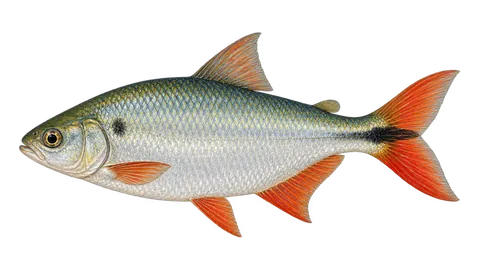
Salminus hilarii
The silver cousin of the golden dorado. Smaller, but just as aggressive in clear, fast-flowing rivers. Excellent on light tackle and fly.
Also called: tabarana, tubarana, dourado-branco

A predator of smaller rivers with cleaner water than the golden dorado, common in headwaters and tributaries of the upper Paraná and São Francisco. It lives in small schools in rapids and pools below waterfalls, hunting lambaris and insects. It strikes small lures fast and jumps like the golden dorado. It rarely exceeds 2 kg, so it calls for light tackle. It suffers from dams, bank deforestation and pollution; in several rivers of the interior of São Paulo and Minas it has become rare. It is a catch-and-release fish.
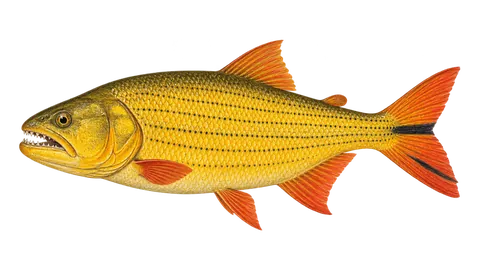
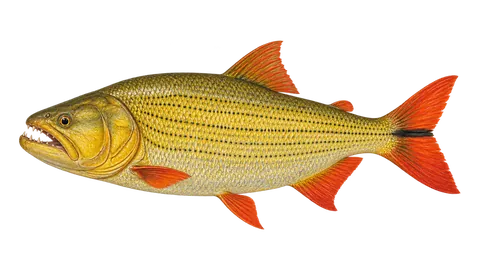
Shaped like a golden dorado, but slimmer and smaller. Silver body with olive back and faint golden sheen. Reddish tail with a central black band. The dorado is a vivid gold-yellow and much deeper-bodied. The piraputanga has a small mouth and a black spot on the caudal peduncle, with no visible conical teeth.
Loading the next 7 days…
Each card shows the day's index (0 to 100) and, below it, a strip with the index for each hour, from 0h to 23h. from poor to excellent.
Tributaries of the upper Paraná (Grande, Pardo, Mogi-Guaçu, Piracicaba, Paranapanema, Paranaíba) and of the São Francisco in MG. Most common in rapids stretches still free of dams.
Habitat: Rapids and pools of medium and small rivers, clear water, rock and gravel, intact riparian forest.
native to the basins
states
São Paulo, Minas Gerais, Goiás, Paraná
Low, clear water from autumn to spring. September and October, before the piracema (spawning closure), tend to be the best.
Daytime, with peaks at dawn and dusk. Active by day, with peaks early and late in the afternoon.
Water below 18 °C makes the tabarana sluggish.
Stable weather is better.
Small effect.
Small rivers muddy quickly with rain; wait for them to clear.
Low, clear water concentrates fish in the rapids.
Very wary in clear water. Walk slowly along the bank and avoid casting shadows over the pool.
Little effect on small rivers.
Shallow, 0.3 to 2 m in the rapids; pool in the heat.
lures
natural baits
accessories
Cast upstream and retrieve a little faster than the current. A silver spinner is the most consistent lure.
Summary of the regulations we found, with the source for each. Rules change; before keeping or transporting fish, check with the state environmental agency.
Conservation: Rare in many rivers of the interior of São Paulo and Minas due to dams and riparian forest degradation.
Minimum catch size for tabarana in MG waters.
Source: Portaria IEF-MG nº 111/2003 (minimum catch sizes in MG) - IEF/Semad-MG
Source: IN Semad-GO nº 17/2026, Annex I, Araguaia-Tocantins basin (on-site consumption only; zero transport)
Source: IN Semad-GO nº 17/2026, Annex I, Paranaíba basin (on-site consumption only; zero transport)
Source: Portaria Naturatins nº 47/2026, Annex I, as amended by Portaria nº 105/2026
Allowed: Recreational fishing only for non-native species and hybrids (peacock bass, tilapia, black bass, carp, croaker, etc.; piauçu remains prohibited), with handline, simple pole, or rod with spinning or baitcasting reel, up to 10 kg + 1 fish. In rivers, from shore only; in reservoirs, from a boat or from shore. Prohibited: floodplain lakes, aquatic-animal bait, within 1,500 m of dams and waterfalls, and within 500 m of confluences. Tournaments only in reservoirs and only with non-native species.
Source: IN IBAMA nº 25/2009
Allowed: Only exotic or hybrid species, 3 kg + 1 fish per day, with handline, rod, simple pole, or spinning or baitcasting reel. Nets prohibited. Keep the minimum distances from dams and reservoirs.
Source: Portarias IEF nº 154/2011 (São Francisco), 155/2011 (East) and 156/2011 (Grande/Paranaíba)
Allowed: Sport and guided fishing only in reservoirs, catch and release with barbless hooks (no keeping, transporting or eating). Subsistence: up to 5 kg per day, for household consumption only.
Allowed: Recreational fishing from a boat or from shore with handline, rod, spinning or baitcasting reel, up to 5 kg + 1 fish. Prohibited within 1,000 m of dams, waterfalls and rapids, and within 500 m of confluences. Floodplain lakes have a longer closed season (see next item).
Source: Portaria IBAMA nº 50/2007
Allowed: No fishing in the floodplain lakes during the period.
Source: Portaria IBAMA nº 50/2007
A delicate fish. Use a rubber-mesh passaguá, remove the hook in the water and release it straight away.
Good meat, but small and rare fish; better to release.
Length-weight relationship W = a·Lb (a = 0.00813, b = 3.12; FishBase). It's an average: a fat or lean fish can vary by 10% to 20%.
estimated weight
—
The season weights (months), the time of day and the sensitivities (cold, pressure, moon, wind, rain, tide, strong light, murky water and noise) are the app's editorial estimates, based on the literature below and on the field experience of anglers and guides. They are not official data nor a measurement made for this species, and they may vary by region and year. Closed seasons and legal rules appear in the rules section, with the norm and a link.
Your location is saved only on this device and feeds the forecast, the map and the "today" on the home page.