

dourado-do-são-francisco
Salminus franciscanus
The Velho Chico (São Francisco River) golden dorado. Same temperament as the Pantanal golden dorado, in rocky stretches and rapids such as Pirapora and downstream of Três Marias.
- common size
- 45–75 cm
- maximum
- 93 cm
- common weight
- 2–6 kg
- record/max.
- 20.0 kg
- depth
- 0.5–6 m
- ideal water
- 23–29 °C
how to recognize it
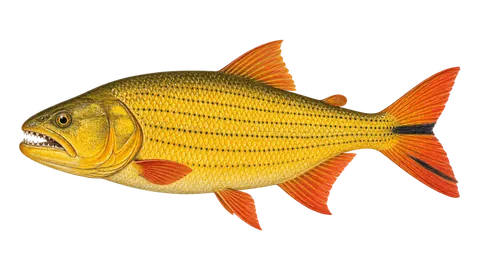
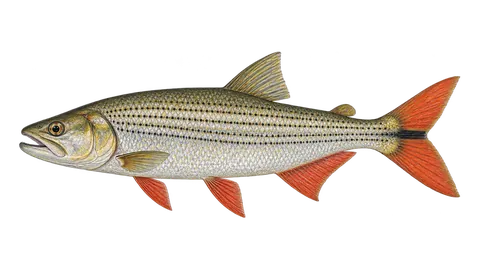
Golden body with lines of dark specks on the scales, reddish fins and a black band in the middle of the tail. It looks almost identical to the Plata golden dorado; the practical difference is the basin: in the São Francisco, it is this species. The tabarana is smaller, slimmer and silvery.
Also called: dourado, dourado-do-velho-chico, dourado-do-são-francisco
don't confuse with:
where found
open on the large mapWhere to look: Rocky stretches, rapids, side-lagoon outlets and backwaters behind islands. Running, oxygenated water.
São Francisco main channel and tributaries. In MG: Pirapora, the stretch downstream of Três Marias, and the Paracatu, Urucuia, das Velhas, Abaeté and Pandeiros rivers. In BA: middle São Francisco and left-bank tributaries.
native to the basins
states
Minas Gerais, Bahia
when to fish
next 7 days
Loading the next 7 days…
best season
Dry season from May to October, with low, clear water. August to October is the peak at Pirapora and below Três Marias.
best time of day
Daytime, with peaks at dawn and dusk. Best from dawn to mid-morning and late afternoon. In strong sun it drops to the pool.
what affects the dourado-do-são-francisco
cold and cold fronts
Cold July mornings delay the strikes; fishing improves after 9 a.m.
atmospheric pressure
Settled weather helps. Sudden change leaves the fish wary.
moon
Small effect.
rain
The first rains muddy the river and scatter the fish.
water level
Stable flow and clean water. Sudden changes in Três Marias releases alter their behavior.
noise
Approach the rapids from below, without the motor running over the rocky stretch.
wind
Little effect in running water.
depth
Shallow in the rapids; pool just below during the hot hours.
how to fish
lures
- mid-water lure 9 to 12 cm
- spoon 15 to 20 g
- hair jig
- surface stickbait
natural baits
- lambari
- tuvira
- small piau
tip from an angler
Work the lure from upstream to downstream through the rapids, close to the rocks. Once hooked, keep the rod tip low to reduce the jumps.
- rod
- 5'6" to 6'6", fast action, 15 to 30 lb
- spinning / baitcasting reel
- low-profile baitcasting reel 100 to 200 or spinning reel 3000 to 4000
- line
- braid 30 to 50 lb
- leader
- fluorocarbon 50 to 60 lb or coated wire leader 30 to 45 lb
- hook
- reinforced treble hooks 1/0 to 3/0, preferably barbless
accessories
- alicate
- boga-grip
- polarized glasses
catch and release
Pliers and a boga-grip. Release it quickly into the current, holding the fish facing the water until it flicks its tail and swims off.
kits and guides
rules for the dourado-do-são-francisco
Rules change; before keeping or transporting fish, check with the state environmental agency.
MG: minimum 60 cm
60 cmMG details
Minimum catch size for Salminus franciscanus in MG waters. In BA and the other basin states, confirm with the state agency whether a specific rule applies.
Source: Portaria IEF-MG nº 111/2003 (minimum catch sizes in MG) - IEF/Semad-MG
other rules that mention the dourado-do-são-francisco (1)
Minimum size: 60 cm
MG details
piracema and closed seasons
Each bar is the period when fishing is prohibited or restricted. The green line is today. Tap the name to see what is still allowed.
Spawning closure (piracema) in Minas Gerais (state rule)
Allowed: Only exotic or hybrid species, 3 kg plus one fish per day or outing, with handline, rod or pole with spinning or baitcasting reel (at most 5 per angler). Nets prohibited. Respect the minimum distances from dams, waterfalls and rapids and the marginal lagoons.
Source: Portarias IEF nº 154/2011 (São Francisco), 155/2011 (East) and 156/2011 (Grande/Paranaíba)
Closed season in Goiás (state rule)
Allowed: Sport and guided fishing only in reservoirs, catch and release with barbless hooks (no keeping, transporting or eating). Subsistence: up to 5 kg per day, for household consumption only.
Spawning closure (piracema) in the São Francisco River basin (rivers and reservoirs)
Allowed: Recreational fishing from a boat or from shore with handline, rod, spinning or baitcasting reel, up to 5 kg + 1 fish. Prohibited within 1,000 m of dams, waterfalls and rapids, and within 500 m of confluences. Floodplain lakes have a longer closed season (see next item).
Source: Portaria IBAMA nº 50/2007
São Francisco: floodplain lakes
Allowed: No fishing in the floodplain lakes during the period.
Source: Portaria IBAMA nº 50/2007
Conservation: Populations reduced in the upper and mid-lower São Francisco by dams.
how much it weighs without taking it out of the water
estimated weight
—
how we calculate
Length-weight relationship W = a·Lb (a = 0.00832, b = 3.12; FishBase). It's an average: a fat or lean fish can vary by 10% to 20%.
more about the dourado-do-são-francisco
A species native to the São Francisco basin, separated from the Plata golden dorado in 2007. In the water it is practically the same fish: a rapids predator, migrant and fighter, that leaps and shakes its head to escape the hook. It hunts curimatãs, piaus, lambaris and mandis in rocky stretches and rapid outlets. The classic spots are in Minas Gerais: Pirapora, the stretch below Três Marias and tributaries such as the Paracatu, Urucuia and das Velhas. Dams and silting have reduced populations in the upper and mid-lower river. Catch-and-release sport fishing is the most sensible way to enjoy the fish.
Family: Bryconidae · predator
fun facts
- It was described as a species separate from the Plata golden dorado only in 2007.
- It is endemic to the São Francisco: it does not naturally occur in any other basin.
in the kitchen
White flesh with Y-shaped bones; baked or in steaks. Respect the minimum size and prefer to release large fish.
similar species
sources and references (5)
The season weights (months), the time of day and the sensitivities (cold, pressure, moon, wind, rain, tide, strong light, murky water and noise) are the app's editorial estimates, based on the literature below and on the field experience of anglers and guides. They are not official data nor a measurement made for this species, and they may vary by region and year. Closed seasons and legal rules appear in the rules section, with the norm and a link.
- scientific FishBase — Salminus franciscanus (ficha da espécie)Names, distribution, biology, length-weight relationship and references. Page checked on October 13, 2026.
- official Portaria GM/MMA nº 1.667, de 27 de abril de 2026 — Lista Nacional Oficial de Espécies da Fauna Ameaçadas de Extinção (peixes e invertebrados aquáticos)Most recent national list. The species is not on it (search by scientific name in the text published in the DOU, checked on October 13, 2026).
- official ICMBio/SALVE — Ficha de Salminus franciscanus (avaliação nacional do risco de extinção)National assessment by ICMBio, published in 2024. DOI verified on Crossref.
- scientific IUCN Red List — Salminus franciscanus (avaliação global: Pouco Preocupante, LC, 07/11/2018)Global assessment. Link given on the FishBase entry (Red List, version 2025-2).
- scientific Lima, F. C. T.; Britski, H. A. (2007). Salminus franciscanus, a new species from the rio São Francisco basin, Brazil (Ostariophysi: Characiformes: Characidae). Neotropical Ichthyology 5(3): 237–244.Describes the São Francisco golden dorado and compares it with S. brasiliensis and S. hilarii (checked in the text).