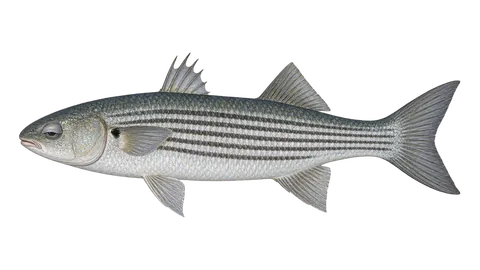
Cosmopolitan mullet with a thick adipose eyelid, living in estuaries, lagoons and mangroves and running up rivers. It grazes mud and algae in schools, nibbles dough and bread, and jumps when hooked.
Also called: tainha-olhalvo, lisa, tainha, flathead grey mullet, striped mullet
The flathead grey mullet (tainha-olhalvo), called lisa in Spanish-speaking countries, is one of the most widely distributed mullets on Earth: it occurs in coastal tropical, subtropical and temperate waters of all seas. It lives in schools over sand and mud bottoms, almost always between 0 and 10 m, and enters estuaries, lagoons, mangroves and even rivers, sometimes far from the mouth. It feeds by day on detritus, microalgae and small bottom organisms. Adults migrate to sea to spawn, and each female releases 0.8 to 2.6 million eggs. It matures at 3 or 4 years and reaches close to 1 m. In Brazil the species is recorded along the coast, but many mullets caught here are Mugil liza, covered in the tainha entry.
fun facts
It is one of the most widespread mullets in the world, in coastal waters of all tropical, subtropical and temperate seas.
Each female releases 0.8 to 2.6 million eggs at sea, and the larvae return to the coast to grow in sheltered waters.
It has no required freshwater stage, but it runs up rivers and enters very salty lagoons.
how to recognize it
identification
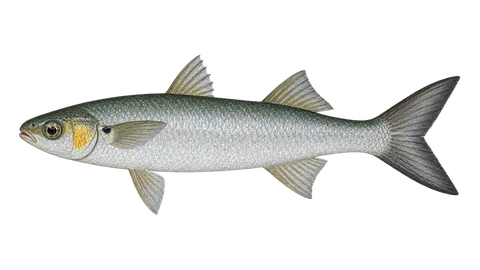
Robust, rounded body, broad head flattened on top, small mouth without visible teeth and a thick adipose eyelid covering much of the eye. Two well-separated dorsal fins, the first closer to the snout than to the tail; scales at the base of the second dorsal and anal fins and an elongated scale in the pectoral axilla. Back grayish-blue to olive, silvery flanks with dark lines along the body and a pale belly. It is told apart from the parati (Mugil curema) by its larger size and the lack of a golden spot on the gill cover. It can only be separated from the tainha (M. liza) by counting scales: if in doubt, follow the tainha rules.
how flathead grey mullet fishing looks
Loading the next 7 days…
Each card shows the day's index (0 to 100) and, below it, a strip with the index for each hour, from 0h to 23h. from poor to excellent.
Cosmopolitan in coastal waters. In the western Atlantic it ranges from Nova Scotia to Brazil, but is absent from the Bahamas and most of the Antilles; in the eastern Pacific, from California to Chile. In Latin America it occurs in Mexico, Central America, Colombia, Ecuador, Peru, Chile, Trinidad and Tobago and French Guiana. In Brazil it is recorded along the coast, in estuaries and lagoons, and separating it from the tainha (Mugil liza) is difficult.
Habitat: Estuaries, coastal lagoons, bays, mangroves and tidal channels with sand or mud bottoms; it enters fresh water and very salty lagoons. At sea, it stays close to the coast.
coast
North CoastNortheast CoastSoutheast CoastSouth Coastcoastal
calendar and clock
when to fish
best season
time of yearbest: May–Aug
JanFebSeaAprMayJunJulAugSepOctNovDec
Present all year in estuaries and lagoons. Peak comes with the cold, when schools gather to spawn at sea (for the southern tainha, May to July; in the Gulf of Mexico, the Mexican lisa standard places the spawning run mainly in autumn and winter).
best time of day
Daytime. Feeds mainly by day, in schools that graze the bottom and surface; early morning and mid-afternoon, with moving water, are usually the best times.
weather, water and behavior
what affects the flathead grey mullet
sensitivity The little bars show how much each factor affects this species. Five full: it feels it a lot.
cold and cold fronts
Prefers water between about 18 and 26 °C. A sharp drop in temperature stops the nibbling, but autumn and winter cold also gathers schools for spawning.
atmospheric pressure
A cold front with gale-force wind muddies the water and scatters the school; once it settles, fishing picks up again.
moon
Small effect. Spring tides stir the school and the current it follows.
rain
Light rain doesn't hurt; runoff that lowers salinity and muddies the estuary scatters the school.
water level
Doesn't apply at sea. In estuaries and lagoons, the tide and the opening of the bar decide where the school enters and leaves.
noise
Wary: footsteps on the pier, shadow and oar noise make the school vanish. Light chumming and silence.
wind
Strong wind raises chop and muddies the bank; light wind, which only ripples the water, hides the angler.
tide
Enters channels and lagoons on the rising tide and leaves on the falling tide; fish mouths and channels while the water is moving.
depth
Shallow: 0 to 3 m most of the time, grazing the bottom and surface.
2.1 to 3.0 m, light and sensitive; bamboo pole on a pier
spinning / baitcasting reel
spinning reel 2000 to 3000
line
monofilament 0.25 to 0.30 mm
leader
monofilament 0.22 to 0.28 mm, 50 cm
hook
small hook no. 8 to 12, chinu or maruseigo style
lures
small fly imitating algae or bread crumb (fly)
natural baits
bread dough with fish meal
bread crumb
filamentous algae (limo)
chopped shrimp
accessories
chum (groundbait) of bread and bran
sensitive float
landing net
tip from an angler
Chum lightly and always in the current, and use a very sensitive float. The mouth is small and soft: short hookset and gentle drag.
what the law says
rules for the flathead grey mullet
Summary of the regulations we found, with the source for each. Rules change; before keeping or transporting fish, check with the state environmental agency. Conservation: Not on the Brazilian national list (Ministerial Ordinance GM/MMA No. 1.667/2026).
Reference minimum size for tainha (35 cm) in the Southeast and South
35 cm (TL)ESRJSPPRSCRSSoutheast CoastSouth Coastconfirm with the agency
IN MMA 53/2005 (Annex II) prohibits fishing for, keeping on board and landing tainha under 35 cm total length on the coast from Espírito Santo to Rio Grande do Sul. The annex names the tainha as Mugil platanus or M. liza and does not name M. cephalus; as the two are easily confused in the field, use 35 cm as the reference and release smaller fish. The rule does not apply to trawl fishing.
Mexico: up to 5 per species and 10 saltwater fish per day
5 specimens of the species per angler per day, within the limit of 10 saltwater fish
In recreational sport fishing in Mexican federal waters, each angler may keep up to 10 marine fish per day, with at most 5 of the same species. Lisa is not among the species with their own limit (billfish, sharks, giant pescada, sábalo, dorado, roosterfish and baya). Fish over the limit are released alive, and sport-caught fish may not be sold. Fishing from a boat requires a permit, and sport fishing is prohibited in closed zones and seasons.
Mexico: minimum size for lisa (30 cm) in the commercial fishing rule
30 cm (total length)confirm with the agency
NOM-016-SAG/PESC-2014 sets 30 cm total length for lisa (Mugil cephalus) in the Gulf of Mexico and Caribbean, and also in the Pacific and the Gulf of California. The rule binds commercial fishing permit and concession holders; NOM-017, for sport fishing, refers minimum sizes to the Secretariat's agreements. As a reference for sport anglers, release lisa under 30 cm.
Mexico: closed season for lisa and liseta in the Gulf of Mexico (Tamaulipas and northern Veracruz)
Dec 1 to 31 and Feb 1 to 28; in Laguna Madre, also Sep 1 to Nov 10confirm with the agency
The 1994 closed-season notice, as worded in the 2015 agreement, prohibits fishing for lisa (Mugil cephalus) and liseta or lebrancha (M. curema) from Dec 1 to 31 and Feb 1 to 28 on the coast of Tamaulipas and northern Veracruz, from the Tuxpan River to the Pánuco River. In Laguna Madre, Tamaulipas, the period of Sep 1 to Nov 10 also applies. NOM-017 prohibits sport fishing in closed zones and seasons. The periods have been adjusted over time (a 2024 news report cites a capture window of Nov 11 to 30 in Laguna Madre): confirm with Conapesca.
Ministerial Resolution 361-2019-PRODUCE set 32 cm total length as the minimum catch size for lisa (Mugil cephalus), with a maximum tolerance of 15% of specimens below it (previously 37 cm and 10%). RM 209-2001-PE prohibits extracting, receiving, transporting, processing and marketing marine fish below the sizes in its annex. For sport anglers, it is best to release anything under 32 cm.
Colombia: minimum size for lisa of 25 cm (Magdalena, Cauca and San Jorge basins)
25 cm (standard length)confirm with the agency
The AUNAP table of minimum sizes in force for the Magdalena, Cauca and San Jorge basin lists lisa (Mugil liza, M. incilis and M. cephalus) at 25 cm standard length. The table dates from 2018, gathers older Inderena rules and does not cover marine waters. Confirm with AUNAP before keeping small fish.
catch and release Releasing the fish alive, quickly and with a wet hand. During a closed season it isn't always allowed: what the regulation says applies.
The slime coat is fragile and scales come off easily: wet your hands, hold the fish briefly and release it quickly. A small barbless hook makes release easier.
in the kitchen
Light, flavorful meat, fattier in the cold; good over charcoal, fried or in stew. The roe is sold fresh or smoked, and the species is farmed in freshwater and brackish ponds.
calculator
how much it weighs without taking it out of the water
Length-weight relationship W = a·Lb (a = 0.01202, b = 2.94; FishBase (relação peso-comprimento bayesiana, estimativa da própria espécie)). It's an average: a fat or lean fish can vary by 10% to 20%.
estimated weight
—
sources and references
The season weights (months), the time of day and the sensitivities (cold, pressure, moon, wind, rain, tide, strong light, murky water and noise) are the app's editorial estimates, based on the literature below and on field experience from anglers and guides. They are not official data or measurements made for this species and may vary by region and year. Closed seasons and legal rules appear in the rules section, with the rule and link. The fishing depth range, the common size and the ideal water temperature range, when FishBase does not give a value, are editorial estimates based on the species' biology.
scientificFishBase: nomes populares de Mugil cephalusNames by country and language. The name tainha-olhalvo was adopted in this entry to separate the species from the tainha (Mugil liza).
officialAUNAP (Colômbia): tallas mínimas vigentesAugust 2018 table. Lisa (Mugil liza, M. incilis, M. cephalus) appears in the Magdalena, Cauca and San Jorge basin at 25 cm standard length.