Skip to content
catalog Carcharhinidae · predator

silky shark

Carcharhinus falciformis

Seanational list: CR · critically endangered

Large, fast open-sea shark, almost always found with tuna schools. Critically Endangered in Brazil: capture banned and, if hooked, release it right away.

Also called: tubarão-lombo-preto, cação-lombo-preto, lombo-preto, silky shark, tiburón sedoso

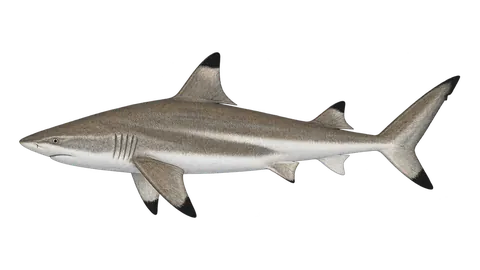
Scientific illustration of Silky shark
common size
219–250 cm
maximum
350 cm
common weight
—
record/max.
346.0 kg
depth
0–500 m
ideal water
24–29 °C
overview

who is the silky shark

The silky shark (lombo-preto) is a large, slender shark over 3 m and 300 kg, common in all tropical seas. It lives at the edge of continental and island shelves and in open sea, from 18 to 500 m most of the time, and sometimes comes close to the coast. It is fast and aggressive, usually travels alone or with tuna schools, and eats fish, squid, argonauts and pelagic crabs. The female has 2 to 15 pups per gestation, with no fixed season. It is heavily fished by industry: the meat is used fresh or salted and dried, the skin becomes leather, and the fins go into soup. In Brazil it is on the national list as Critically Endangered, and, according to the ICMBio text, fishing for it was already banned by IN Interministerial 8/2014.

fun facts

  • It often travels with tuna schools, which is why it shows up in tuna fishing and longline fishing.
  • The female can give birth every year, with no fixed season, to 2 to 15 pups of 55 to 87 cm.
  • FishBase records the species at St. Paul's Rocks, the São Pedro e São Paulo archipelago, in the middle of the Atlantic.
how to recognize it

identification

Slender body, grey or blue-grey on the back and white below, with no strong marks on the fins. Moderately long, flat and rounded snout, large eyes, small jaws and serrated teeth. The second dorsal fin is low, with a very elongated rear tip. It is the only Carcharhinus with a ridge between the dorsal fins and with the first dorsal starting behind the free tip of the pectorals. The name "lombo-preto" is also used for the blacknose shark (cação-corta-garoupa, C. acronotus). When in doubt, release it.

how silky shark fishing looks

Loading the next 7 days…

Each card shows the day's index (0 to 100) and, below it, a strip with the index for each hour, from 0h to 23h. from poor to excellent.

distribution

where found

open on the large map

Circumtropical. In the western Atlantic, from Massachusetts (USA) to southern Brazil, including the Gulf of Mexico and the Caribbean down to Uruguay; in the eastern Atlantic, from Spain and Madeira to northern Angola, with records in Cape Verde and at St. Paul's Rocks. Also in the Indo-Pacific and, in the eastern Pacific, from southern Baja California to northern Chile. A highly migratory species, more common in open sea than near the beach.

Habitat: Edge of shelves and islands, deep-water reefs and open sea, near the surface or bottom, from 18 to 500 m; sometimes comes close to the coast.

coast

North CoastNortheast CoastSoutheast CoastSouth Coastshelfoceanic
calendar and clock

when to fish

best season

time of year
JanFebSeaAprMayJunJulAugSepOctNovDec

Estimate: present year-round in open sea and on the shelf edge, closer to the coast when the water is warm. The female gives birth throughout the year, with no fixed season.

best time of day

0h6h12h18h sunrise ~6amsunset ~6pm

Any time. No defined schedule in the sources we checked; lives in open sea and hunts by day and by night (estimate).

weather, water and behavior

what affects the silky shark
sensitivity The little bars show how much each factor affects this species. Five full: it feels it a lot.

cold and cold fronts

Water below about 20 °C keeps the shark away from the shelf edge.

atmospheric pressure

Little known direct effect.

moon

Little known effect.

rain

Little effect in open sea.

water level

Not applicable at sea.

noise

Not very sensitive to noise in open sea.

wind

Rough seas make it hard to see the tuna schools it accompanies.

tide

Little effect in open sea.

depth

Usually 18 to 500 m, near the surface or the bottom.

technique, gear and bait

how to fish

rod
No recommended gear: capture is banned in Brazil.
spinning / baitcasting reel
Not applicable.
line
Not applicable.
leader
Not applicable.
hook
When fishing for tuna and bottom fish in open sea, prefer a circle hook without barb: it makes it easier to release what cannot be kept.

accessories

  • cutting pliers for steel cable
  • long hook remover
  • luvas

tip from an angler

Anglers fishing for tuna and dolphinfish in open sea may hook it by accident: keep wire cutters and gloves on hand and release it in the water, without pulling it toward the boat. FishBase considers it dangerous to people.

what the law says

rules for the silky shark

Summary of the regulations we found, with the source for each. Rules change; before keeping or transporting fish, check with the state environmental agency.
Conservation: New species on the 2026 national list, as CR: the bans apply from the end of October 2026. IUCN global assessment: VU (A2bd, 26/09/2017). Appendix II of CITES.

Threatened species (CR): capture banned in Brazil from the end of October 2026

full protection: capture, transport, storage, keeping and trade banned (from the end of October 2026)

The national list (Portaria GM/MMA nº 1.667/2026) classifies the silky shark (lombo-preto, Carcharhinus falciformis) as CR, and the species was added to the list only in 2026. Under Portaria GM/MMA nº 1.666/2026 (art. 3), species listed as VU, EN and CR have full protection: capture, transport, storage, keeping, processing and sale are banned. As it was not on the previous list, the deadline in art. 12 applies: the bans take effect 180 days after publication (28/04/2026), that is, around 25/10/2026 (Fiperj, the fisheries agency of Rio de Janeiro, gives 27/10/2026). Incidental capture with immediate release of the live animal is outside the ban (art. 3, § 4). The rule does not authorize targeted fishing, not even with release: in Brazil, do not seek out this species. If you hook one by accident, release it right away, with minimal handling.

Source: Portaria GM/MMA nº 1.667/2026 (list) and Portaria GM/MMA nº 1.666/2026, arts. 3º and 12 (Ministry of Environment and Climate Change)

Silky shark (lombo-preto): fishing already banned since 2014 (IN Interministerial 8/2014)

targeted fishing, retention, landing, transport and trade bannedconfirm with the agency

Interministerial Normative Instruction MPA/MMA nº 8, of 6/11/2014, bans targeted fishing, retention on board, transshipment, landing, storage, transport and sale of the silky shark (Carcharhinus falciformis) in Brazilian waters. In incidental capture the animal must be returned whole to the sea. The ICMBio text links the rule to surface horizontal longline fisheries; we did not check whether it was changed later. For anglers, the full protection of the 2026 ordinances applies in any case.

Source: Instrução Normativa Interministerial MPA/MMA nº 8, of Nov 6, 2014, art. 1º (Ministry of Fisheries and Aquaculture and Ministry of Environment)

Finning banned: sharks and rays only whole, with their fins

fins naturally attached to the body

In Brazil, finning is banned: catching sharks and rays and keeping only the fins, discarding the body (art. 3). Sharks and rays landed must arrive with all fins naturally attached to the body; carrying an animal aboard without fins or with loose fins, and transferring sharks and rays between fishing vessels, is prohibited. This applies to any species that may be retained.

Source: Instrução Normativa Interministerial MPA/MMA nº 14, of Nov 26, 2012, arts. 2º and 3º (Ministry of Fisheries and Aquaculture and Ministry of Environment)

Mexico: no more than 1 shark per angler per day

1 specimen per angler per day (counts as 5 against the quota of 10)

In recreational sport fishing in Mexican marine waters, the limit for sharks is one fish per angler per day, which counts as five toward the total limit of ten fish (item 4.9.1 b). Fish over the limit must be returned alive to the water (item 4.9.5), and recreational catch may not be sold (item 4.11). Fish that are released do not count toward the limit: prefer to release it.

Source: NOM-017-PESC-1994 (recreational sport fishing), amendment published in the DOF, items 4.9.1 b, 4.9.5 and 4.11 (Sagarpa/Conapesca)

Colombia: marine sharks and rays are not fishery resources

commercial or sport extraction not permittedconfirm with the agency

In 2021 Colombia stopped treating marine sharks and rays as fishery resources and began treating them as hydrobiological resources. The recitals of Decree 281/2021 state that they may not be extracted for commercial or sport purposes, and the decree created an environmental protection plan. Later AUNAP rules addressed incidental catch in artisanal fishing; we did not check the consolidated text. When in doubt, release them into the water.

Source: Decreto nº 281, of Mar 18, 2021 (Ministry of Environment and Sustainable Development), which adds Section 27 to Decree 1076/2015; Resolución AUNAP nº 0380/2021

Panama: sharks and rays may not be caught in recreational fishing

catch, retention, and landing banned (from about Dec 10, 2026)

Executive Decree 9/2026 (art. 19) bans, throughout the national territory and in sport, recreational, or tourism fishing, the catch, retention, handling for recreational purposes, use, and landing of sharks and rays (subclass Elasmobranchii). If one is hooked by accident, it must be released immediately, without taking it fully out of the water and without unnecessary handling. It is also prohibited to promote them as targets in tournaments (art. 19) and to sell the catch (art. 20). The decree takes effect six months after its promulgation on June 10, 2026 (art. 40), around Dec 10, 2026, and repeals Resuelto ADM/ARAP 002/2012 (art. 39). Confirm the date with ARAP.

Source: Decreto Ejecutivo nº 9, of Jun 10, 2026, arts. 19, 20, 39 and 40 (Ministry of Agricultural Development / Panama Aquatic Resources Authority, Gaceta Oficial nº 30543-E)

Bahamas: sharks protected since 2011, release them all

shark fishing not permitted; a shark hooked must be released unharmedconfirm with the agency

The official fishing guide of the Bahamas states that shark fishing is not allowed, that sharks have been protected since a 2011 amendment, that they may only be taken under special permits for very specific purposes, and that a shark hooked in any fishing must be released unharmed. The page does not cite the number of the rule.

Source: Ministry of Tourism, Investments & Aviation of the Bahamas, Fishing Regulations & FAQ (reference to the 2011 amendment to the Fisheries Resources (Jurisdiction and Conservation) Act)

Costa Rica: Isla del Coco National Park is a shark sanctuary and bans fishing

fishing banned in Isla del Coco National Park

Executive Decree 43477-MINAE (20/04/2022) designated the marine protected area of Isla del Coco National Park as a Shark Natural Sanctuary. The considerations recall that fishing is already banned in the park (National Parks Service Law 6084 and Decree 37023-MINAE) and list the whitetip reef shark, the silky shark and the silvertip shark among the park's 15 sharks. Outside the park, check the INCOPESCA rules.

Source: Decreto Ejecutivo nº 43477-MINAE, of Apr 20, 2022 (President of the Republic and Minister of Environment and Energy), arts. 1º to 4º and considerations XI, XII and XV

Costa Rica: silky shark is on the SINAC list of threatened species

catching a marine species declared threatened is a crime (1 to 3 years in prison, according to the press)confirm with the agency

Resolution R-SINAC-CONAC-008-2021 (La Gaceta nº 93, of 17/05/2021) establishes the official list of species in danger and with reduced or threatened populations. According to the Costa Rican press, the list includes the silky shark (Carcharhinus falciformis), and art. 140 of the Fisheries and Aquaculture Law provides for 1 to 3 years in prison for anyone who catches, transfers or trades a marine species declared threatened. We did not check the text of the list or of the article; when in doubt, release the shark in the water.

Source: Resolución R-SINAC-CONAC-008-2021 (National Council of Conservation Areas), cited in Decreto Ejecutivo 43477-MINAE; art. 140 of the Ley de Pesca y Acuicultura, per Semanario Universidad

catch and release
catch and release Releasing the fish alive, quickly and with a wet hand. During a closed season it isn't always allowed: what the regulation says applies.

This is not catch and release: it is release of accidental catch. Keep the shark in the water, cut the leader flush with the mouth if the hook is deep, and let it go. Do not pull it into the boat, do not hold it by the tail or gills, and do not take photos out of the water.

in the kitchen

Capture, transport and trade banned in Brazil. In other countries the meat is eaten fresh or salted and dried, the skin becomes leather, the fins go into soup and the liver into oil (FishBase). Do not buy "cação" of unknown origin.

calculator

how much it weighs without taking it out of the water

Length-weight relationship W = a·Lb (a = 0.00501, b = 3.07; FishBase (relação peso-comprimento bayesiana, estimativa da própria espécie)). It's an average: a fat or lean fish can vary by 10% to 20%.

estimated weight

—

sources and references

The season factors (months), the time of day, and the sensitivities (cold, pressure, moon, wind, rain, tide, strong light, murky water, and noise) are editorial estimates by the app, based on the literature cited below and on field experience of anglers and guides. They are not official data or measurements made for this species and may vary by region and year. Closed seasons and legal rules appear in the rules section, with the standard and link. The months indicate when anglers usually find the species near the coast, not a catch season.

  1. scientific FishBase: Carcharhinus falciformis (ficha da espécie)Size, length-weight, depth, habitat, distribution, biology, and IUCN status. Page checked on Oct 13, 2026. Here the common size runs from the length at maturity to the reported common length.
  2. scientific FishBase: nomes populares de Carcharhinus falciformisNames by country and language.
  3. official Portaria GM/MMA nº 1.667, de 27 de abril de 2026: Lista Nacional Oficial de Espécies da Fauna Ameaçadas de Extinção (peixes e invertebrados aquáticos)The species is on the list. Checked in the DOU of April 28, 2026.
  4. official Portaria GM/MMA nº 1.666, de 27 de abril de 2026: regras e restrições para as espécies da lista nacional de peixes e invertebrados aquáticos ameaçadosArt. 3 (full protection, with the exception of § 4 for incidental capture released alive) and art. 12 (180-day deadline for species that entered the list in 2026). Text checked in the DOU of 28/04/2026, on 13/10/2026.
  5. official Instrução Normativa Interministerial MPA/MMA nº 8, de 6 de novembro de 2014: proíbe a pesca do tubarão-lombo-preto (Carcharhinus falciformis)Text published by ICMBio/CEPSUL, checked through an indexed transcription (the PDF did not open during checking). We did not verify whether it was changed or revoked later.
  6. official Fiperj: Peixes cartilaginosos marinhos ameaçados de extinção (Portarias GM/MMA 1.666 e 1.667/2026), atualizado em 11/05/2026Poster from the Fundação Instituto de Pesca do Estado do Rio de Janeiro with common names, categories, and the date the changes take effect (Oct 27, 2026). Checked on Oct 13, 2026.
  7. official Instrução Normativa Interministerial MPA/MMA nº 14, de 26 de novembro de 2012: desembarque, transporte, armazenamento e comércio de tubarões e raias (proibição do finning)Text from Sislegis/MAPA (DOU of Nov 28, 2012), with § 6 of art. 3 added by IN Interministerial 6/2013. Checked on Oct 13, 2026.
  8. official México: Modificación a la NOM-017-PESC-1994 (pesca deportivo-recreativa), Diario Oficial de la FederaciónItems 4.9.1 (daily limits and 1 shark quota), 4.9.5 (catch and release), and 4.11 (the catch may not be sold). Checked on Oct 13, 2026.
  9. official Colômbia: Decreto 281 de 2021 (proteção e conservação de tubarões, raias marinhas e quimeras), Gestor Normativo da Função PúblicaText checked on Oct 13, 2026. The recitals state that marine sharks and rays have stopped being fishery resources and may not be extracted for commercial or sport purposes. Later AUNAP rules on incidental catch were not checked.
  10. official Panamá: Decreto Ejecutivo nº 9, de 10 de junho de 2026 (pesca deportiva), Gaceta Oficial Digital nº 30543-EArt. 19 (ban on catching, retaining, and landing sharks and rays in recreational fishing), art. 20 (ban on sales), art. 39 (repeals Resuelto ADM/ARAP 002/2012), and art. 40 (in force after six months). Text checked on Oct 13, 2026.
  11. press La Estrella de Panamá: Panamá implementa nuevas reglas para la pesca deportiva en diciembreReports that Executive Decrees 9 and 10 of June 10, 2026 take effect on December 10, 2026. Another broadcaster reported that they were already in force in June; art. 40 of the decree refers to six months.
  12. official Bahamas: Ministry of Tourism, Investments & Aviation, Fishing Regulations & FAQIt states that shark fishing is not permitted, that sharks have been protected since a 2011 amendment, and that every shark hooked must be released unharmed. The page does not give the rule number. Checked on Oct 13, 2026.
  13. official Costa Rica: Decreto Ejecutivo nº 43477-MINAE, de 20 de abril de 2022 (Santuário Natural de Tubarões do Parque Nacional Ilha do Coco)The considerations cite the fishing ban in the park (Law 6084 and Decree 37023-MINAE) and the park's shark list, with Carcharhinus albimarginatus, C. falciformis (Appendix II of CITES) and Triaenodon obesus. Checked on 13/10/2026.
  14. press Semanario Universidad: Inacción del Estado permite pesca de especies de tiburones amenazados o en peligro de extinciónStates that the official SINAC list (R-SINAC-CONAC-008-2021) includes the silky shark and cites art. 140 of the Fisheries and Aquaculture Law (1 to 3 years in prison for catching a marine species declared threatened). The legal text was not checked. The resolution itself is cited in Decree 43477-MINAE.
  15. scientific Etnotaxonomia dos tubarões das águas tropicais do Brasil (Journal of Ethnobiology and Ethnomedicine, 2018)Records the local name "lombo-preto" for the species; used only for the common name.
don't confuse

similar species