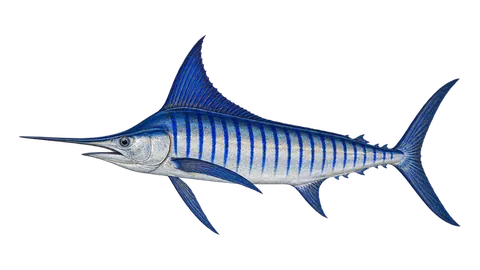
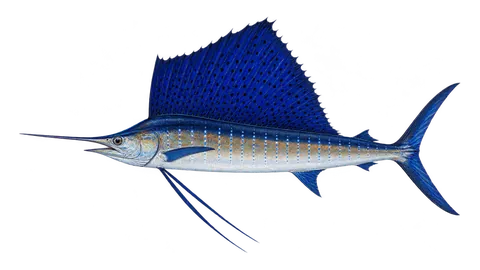
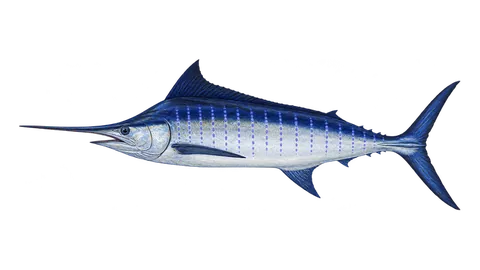
One of the smallest billfish, with a very short bill and dark blue body, which lives in open ocean in the Pacific and Indian oceans. Rarely seen in sport fishing, it turns up by chance on trolling lines offshore. It is reserved for sport fishing and should be released.
Also called: agulhão-de-bico-curto, shortbill spearfish, pez lanceta
Choose the place and the species. The index, from 0 to 100, combines weather, sun, moon and tide with each fish's habits. Up to 28 days, with each day's confidence.
location
Sample location: choose yours to see the forecast for where you fish.
period
Reading the weather across 3 global models and 31 simulations…
0—
index Score from 0 to 100 for the fishing conditions of each hour. It reads weather, sun, moon, tide and the species' habits. It doesn't promise fish: it tells you when the water is on your side. 0–24 poor · 25–44 fair · 45–64 good · 65–84 very good · 85–100 excellent.
today
—
confidence —
confidence How much you can trust the weather forecast for the day. It drops with distance and when the models disagree. It is not the chance of catching fish.
models and trend Up to 16 days, three global weather models (the European ECMWF, the American GFS and a high-resolution blend) read hour by hour; when they disagree, the light band on the chart widens. Beyond that it's a trend: 31 runs of the American GEFS model. Confirm when it's 1 week out.
window Consecutive hours with the index near the day's peak and no danger alert. It is the time to have the bait in the water.
hour by hour
slide your finger or mouse over the chart to see each hour
see hour-by-hour table
why this index at —?
next 7 days
choose the day
chart: bar height = day's index · line = variation between models · striped = trend · fainter = less confidence
Each card shows the day's index (0 to 100) and, below it, a strip with the index for each hour, from 0h to 23h. from poor to excellent.
4-week calendar
the fishing month at a glance
plan a trip
what's the best window for the crew?
Choose how many fishing days. We compare each stretch by its average index, discount days with a warning or closed season, and show the 3 best.
trend for the coming weeks
Line: the middle value of 31 simulations of the American GEFS model. Band: where 8 out of 10 fall. Narrow, firm trend; wide, high uncertainty.
the species
everything about the shortbill spearfish
overview
who is the shortbill spearfish
An open-ocean billfish of the tropical and temperate waters of the Pacific and Indian oceans, which stays in the upper layers, above the thermocline. In the eastern Pacific it ranges from California to Peru and the oceanic islands; stray individuals appear in the Atlantic, but breeding seems to occur only in the Pacific and Indian oceans. It is a highly migratory species. It eats fish, squid and crustaceans and, according to FishBase, spawns in winter, in warm currents of about 25 °C. It reaches about 2.3 m and 52 kg as published, with a common length of 1.9 m; STRI cites the IGFA record of 36.8 kg. It mostly appears as bycatch on tuna longlines, and the meat is sold frozen and as sashimi in Japan. For the sport angler it is an unexpected trophy, caught on trolling lines offshore along with marlins and tunas, and it should almost always be released.
fun facts
In Panama it is called pez lanceta, and the 2026 decrees protect it under the name pez lanceta pico corto.
The bill of adults barely exceeds 15% of body length, much less than in marlins.
FishBase describes it as a highly migratory species, with spawning areas in the Pacific and Indian oceans.
how to recognize it
identification
A very elongated, compressed body, low nape and a very short bill, usually less than 15% of total length, with small teeth in adults. The first dorsal fin has a triangular peak at the front; the pectorals are narrow and short, and the pelvic fins are thread-thin, about twice the length of the pectorals. Dark blue above, blue mottled with brown on the flanks and silvery-white below, with no spots or bars; the first dorsal is dark blue and the other fins are brown. The anus sits well before the origin of the anal fin. The sailfish has a sail-shaped dorsal fin; the longbill spearfish (Tetrapturus pfluegeri) is from the Atlantic.
Not found in Brazil. Tropical and temperate open ocean of the Pacific and Indian oceans; in the eastern Pacific, from California to Peru and the oceanic islands, passing through the waters of Mexico, Central America, Colombia, Ecuador and Chile. There are stray records in the Atlantic.
Habitat: Open ocean, in the upper layers above the thermocline; generally 0 to 350 m, with records down to 1,830 m.
calendar and clock
when to fish
best season
time of year
JanFebSeaAprMayJunJulAugSepOctNovDec
No fishing season is known for this species: it turns up by chance in marlin and tuna fishing on the open ocean. FishBase indicates winter spawning in warm currents of about 25 °C, but that does not make it a fishing season.
best time of day
Daytime. A surface and mid-water predator, most active by day. There are no time-of-day studies specific to the species.
weather, water and behavior
what affects the shortbill spearfish
sensitivity The little bars show how much each factor affects this species. Five full: it feels it a lot.
cold and cold fronts
It follows warm waters: spawning and presence are linked to currents of about 25 °C.
atmospheric pressure
No specific data; very rough seas make any trolling difficult.
moon
Small effect and no studies for the species.
rain
Little effect in open sea.
water level
Not applicable at sea.
noise
Less sensitive than coastal fish, but the boat's wake matters when trolling.
wind
Wind and heavy seas make the release maneuver difficult.
tide
Doesn't depend on the tide; in open ocean, currents and temperature fronts matter.
fluorocarbon or monofilament 80 to 130 lb, 2 to 3 m
hook
circle 7/0 to 9/0
lures
trolling skirts, 15 to 25 cm
flat-head baits for small marlin
natural baits
peixe-voador
lula
small needlefish
accessories
cutting pliers to cut the hook
luvas
tape or ruler for measuring
tip from an angler
Use a circle hook and, if the hook is deep, cut the leader close to it without taking the fish out of the water. As billfish are reserved for sport fishing and release is mandatory in Panama, treat every catch as a fish to release.
what the law says
rules for the shortbill spearfish
Summary of the regulations we found, with the source for each. Rules change; before keeping or transporting fish, check with the state environmental agency. Conservation: Insufficient data to assess the risk. It is caught mainly as bycatch on tuna longlines. Peru protects marlins and sailfish (D.S. 009-2008-PRODUCE), but the Produce page does not mention this species.
Mexico: billfish reserved for sport fishing; 1 per angler per day
1 billfish per angler per day (counts as 5 of the 10 marine fish)confirm with the agency
Within 50 nautical miles of the Mexican coast, marlins, sailfish and swordfish (the billfish) are reserved for recreational sport fishing, in all their biological varieties. The limit is 1 billfish per angler per day, which counts as 5 toward the 10-fish total limit. Filleting billfish aboard is prohibited, fish over the limit must go back alive into the water, and sport-caught fish may not be sold. The rule does not include a list of billfish species: the shortbill spearfish (marlín trompa corta) is treated as a billfish, but confirm with Conapesca. Anyone fishing from a boat needs an individual permit.
Panama: shortbill spearfish for sport fishing only, with catch and release (Executive Decree 10/2026)
Catch and release; retaining, transporting or selling prohibitedconfirm with the agency
Executive Decree 10, of Jun 10, 2026, reserves billfish (blue, white, black and striped marlins, and the shortbill spearfish, Tetrapturus angustirostris) for sport fishing, tourist sport fishing and authorized research. Catching, retaining, possessing, transporting and selling the species for commercial purposes is prohibited, and it cannot be targeted by artisanal fishing for sale. Fishing follows a catch-and-release model, with minimal handling. Anyone fishing needs an ARAP license (from age 12) and every trip must be reported. According to the press, decrees 9 and 10 were published in the Official Gazette and take full effect on Dec 10, 2026, after six months of adaptation. We could not read the text in the Gazette.
Colombia: sport fishing has ceased to exist as a category; tourist fishing applies (Law 2501/2025)
Transition period: confirm with AUNAP before fishingconfirm with the agency
In Judgment C-148 of Apr 27, 2022, the Constitutional Court declared unconstitutional the rules that provided for sport fishing, with effects postponed by one year. Law 2501, enacted on Jul 28, 2025, created the tourist fishing category, and the rules (gear, quantities, minimum sizes, methods, zones and seasons) depend on regulations from the Ministry of Agriculture with AUNAP. We have not confirmed whether the decrees have been issued: check with AUNAP and use a licensed tourism operator before fishing or keeping any fish.
catch and release Releasing the fish alive, quickly and with a wet hand. During a closed season it isn't always allowed: what the regulation says applies.
Billfish are for release: use a circle hook, keep the fish in the water while unhooking it, and cut the leader near the hook if it is deep. In Panama release is mandatory; in Mexico, any billfish beyond 1 per angler per day goes back alive into the water.
in the kitchen
The meat is used: in Japan it is sold frozen, as sashimi and in fish cakes, and it is also made into sausage (FishBase). Where retention is restricted, the rule is to release.
calculator
how much it weighs without taking it out of the water
Length-weight relationship W = a·Lb (a = 0.00457, b = 3.21; FishBase (relação peso-comprimento bayesiana, estimativa da própria espécie)). It's an average: a fat or lean fish can vary by 10% to 20%.
estimated weight
—
sources and references
The season weights (months), the time of day and the sensitivities (cold, pressure, moon, wind, rain, tide, strong light, murky water and noise) are the app's editorial estimates, based on the literature below and on the field experience of anglers and guides. They are not official data nor a measurement made for this species, and they may vary by region and year. Closed seasons and legal rules appear in the rules section, with the norm and a link.
scientificFishBase: Tetrapturus angustirostris (ficha da espécie)Size, length-weight relationship, depth, habitat, distribution, biology and IUCN status. Page checked on Oct 13, 2026. The common size range in this entry is an editorial estimate around FishBase's common length (190 cm). FishBase's length-weight relationship overestimates this species' weight (it predicts more than 100 kg at 2.3 m), so the entry's common weight (15 to 30 kg) is an editorial estimate below the published weight (52 kg) and the IGFA record (36.8 kg) cited by STRI.
officialDOF: Modificação da NOM-017-PESC-1994, para regular a pesca deportivo-recreativa em águas de jurisdição federal do México (publicada em 25/11/2013)Reserves species for sport fishing (item 0.3), permits (4.3 and 4.14), rods and hooks (4.6), bait (4.7), chumming in tournaments (4.8), daily limits at sea (4.9.1) and in fresh water (4.9.2), catch and release (4.9.5), closed zones, seasons and protected areas (4.10), a ban on selling the catch (4.11) and filleting (4.12). Text checked on Oct 13, 2026; the DOF records publication on Nov 25, 2013 and signature on Oct 14, 2013. We found no specific Conapesca federal closed season for this species.
officialLei Geral de Pesca e Aquacultura Sustentáveis (México), art. 68Article 68 reserves marlin, sailfish, swordfish, sábalo, roosterfish and dorado, in all their biological varieties, for recreational sport fishing within 50 nautical miles. We checked the article in a transcript of the current text (leyes-mx.com, updated Oct 12, 2026); the official PDF did not open for checking.
officialProduce (Peru): Especies protegidasThe page lists marlins (blue, black and striped) and sailfish under D.S. 009-2008-PRODUCE, with commercial extraction prohibited and sport fishing only with catch and release. The shortbill spearfish does not appear on the list; we could not read the text of the decree.
pressAgenda del Mar: Pesca de turismo, qué se aprobó y qué falta (Lei 2501 de 2025)Reports the enactment of Law 2501 on Jul 28, 2025 and the regulatory deadlines (six months for tourism and one year for zones, species, methods and seasons). We could not open the official text of the law or confirm whether the decrees have been issued.
The weather comes from three independent global models, cross-checked hour by hour: when they agree, confidence goes up; when they diverge, the band between them shows on the chart. Beyond 16 days, we use the GEFS ensemble of 31 simulations: if 20 of the 31 predict rain, the chance of rain is 65%. Sun and moon are calculated astronomically, with no uncertainty.
The index adds up, weighted for each species: time of day (species curve anchored to real sunrise and sunset), moon (transits, rise and set, phase), pressure (3 h trend and 24 h swing), water temperature (in rivers, estimated from air temperature; at sea, estimated by an ocean model), wind, rain, clouds, tide and the month in the species' cycle.
Accuracy measured in the reference project (4 regions, 93 days, forecast vs. observed): maximum temperature is off by 0.6 °C on average the next day and 1.7 °C at 7 days; rain of 5 mm or more is detected 76% of the time the next day and 57% at 7 days. Detection isn't everything: the false alarm rate isn't published here yet, and 93 days in 4 regions is still a small sample. We now also measure every day, at the app's destinations:
where are you going fishing?
Your location is saved only on this device and feeds the forecast, the map and the "today" on the home page.