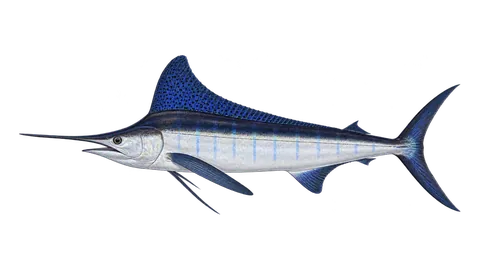
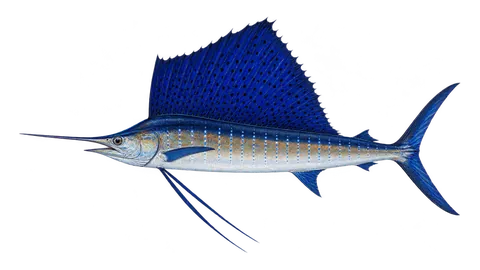
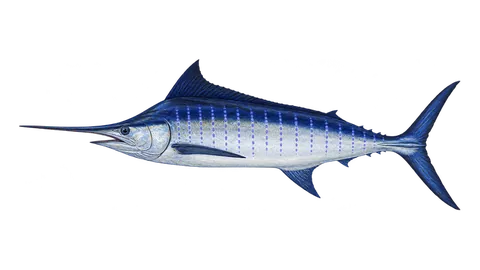
Oceanic billfish with a long, slender bill, a smaller relative of the marlins. In Puerto Rico and US federal waters it may not be kept; in Brazil the first dorsal and first anal fins must stay intact until landing.
Also called: agulhão-verde, agulhão-estilete, agulhão-marli, longbill spearfish
Choose the place and the species. The index, from 0 to 100, combines weather, sun, moon and tide with each fish's habits. Up to 28 days, with each day's confidence.
location
Sample location: choose yours to see the forecast for where you fish.
period
Reading the weather across 3 global models and 31 simulations…
0—
index Score from 0 to 100 for the fishing conditions of each hour. It reads weather, sun, moon, tide and the species' habits. It doesn't promise fish: it tells you when the water is on your side. 0–24 poor · 25–44 fair · 45–64 good · 65–84 very good · 85–100 excellent.
today
—
confidence —
confidence How much you can trust the weather forecast for the day. It drops with distance and when the models disagree. It is not the chance of catching fish.
models and trend Up to 16 days, three global weather models (the European ECMWF, the American GFS and a high-resolution blend) read hour by hour; when they disagree, the light band on the chart widens. Beyond that it's a trend: 31 runs of the American GEFS model. Confirm when it's 1 week out.
window Consecutive hours with the index near the day's peak and no danger alert. It is the time to have the bait in the water.
hour by hour
slide your finger or mouse over the chart to see each hour
see hour-by-hour table
why this index at —?
next 7 days
choose the day
chart: bar height = day's index · line = variation between models · striped = trend · fainter = less confidence
Each card shows the day's index (0 to 100) and, below it, a strip with the index for each hour, from 0h to 23h. from poor to excellent.
4-week calendar
the fishing month at a glance
plan a trip
what's the best window for the crew?
Choose how many fishing days. We compare each stretch by its average index, discount days with a warning or closed season, and show the 3 best.
trend for the coming weeks
Line: the middle value of 31 simulations of the American GEFS model. Band: where 8 out of 10 fall. Narrow, firm trend; wide, high uncertainty.
the species
everything about the longbill spearfish
overview
who is the longbill spearfish
The longbill spearfish (agulhão-verde) is an Atlantic billfish of oceanic waters, more common on the western side, between 0 and 200 m, usually above the thermocline. It hunts pelagic fish and squid. It migrates, and females probably spawn once a year. It reaches 254 cm (fork length) and 58 kg according to FishBase, with a common length of 165 cm. FishBase lists it as a minor commercial and sport fish. The Brazilian rule mentions it alongside the marlins, and Puerto Rico and the US prohibit retaining it. Its meat is sold frozen.
fun facts
The Brazilian rule calls the species agulhão-verde (Tetrapturus pfluegeri), and FishBase lists it as agulhão-estilete and agulhão-marli.
Maturation seems to happen at the same time in the northern and southern hemispheres, which suggests a homogeneous population (FishBase).
IN SEAP/PR 12/2005 covers four billfish: the white, the black (blue), the longbill spearfish and the sailfish.
how to recognize it
identification
Slender billfish with a very long, thin bill (the extension of the upper jaw). Dark blue dorsal fin with 50 to 57 soft rays, with a rounded front lobe taller than the body, which drops suddenly after the ninth ray and keeps the same height to the end. Blue-black back, silver flanks speckled with brown and a silver-white belly. Dark brown pectorals, blue-black pelvic fins. Separated from marlins by its slimmer body and thinner bill, and from the sailfish, whose dorsal fin is shaped like a sail, taller than the body.
In open sea, along the whole Brazilian coast, well offshore, on the slope and in the ocean; FishBase says it is much more common in the western Atlantic than in the eastern. There are few records in Brazilian collections. Outside Brazil, from 44°N to 33°S, including the Caribbean and the Gulf of Mexico.
Habitat: Open sea, oceanic waters, almost always above the thermocline, from 0 to 200 m and usually around 100 m, far from the mainland.
coast
North CoastNortheast CoastSoutheast CoastSouth Coastoceanic
calendar and clock
when to fish
best season
time of year
JanFebSeaAprMayJunJulAugSepOctNovDec
There is no well-documented seasonality for the species. It lives in the same warm, blue oceanic water as the marlins and the sailfish.
best time of day
Daytime. Hunts by day, in the upper water column; it shows up on the trolling line during daylight hours.
weather, water and behavior
what affects the longbill spearfish
sensitivity The little bars show how much each factor affects this species. Five full: it feels it a lot.
cold and cold fronts
Prefers warm, blue water; a cold front that cools the surface scatters the fish.
atmospheric pressure
Little direct effect; rough seas after the front are what stop fishing.
moon
Small effect.
rain
Not very relevant in open sea; a storm is a danger for anyone on board.
water level
Follows the blue, clear water, away from river mouths and bars.
noise
Engine noise has little effect on fish in open sea.
wind
Rough seas rule out trolling with natural bait.
depth
Much of the time above the thermocline, near the surface.
circle hook 7/0 to 9/0, which injures less and makes release easier
lures
trolling skirts, 6 to 8 inches
teasers
artificial squid lures
natural baits
prepared ballyhoo (needlefish)
lula
cavalinha
accessories
cutting and release pliers
luvas
ruler
tip from an angler
With a circle hook, wait for the fish to swallow the bait and only then tighten the drag; release it without lifting it out of the water whenever possible.
what the law says
rules for the longbill spearfish
Summary of the regulations we found, with the source for each. Rules change; before keeping or transporting fish, check with the state environmental agency. Conservation: Not on the Brazilian national list (Portaria GM/MMA nº 1.667/2026). Brazil, Puerto Rico, the US and Mexico treat billfish under their own rules; see the rules above.
Brazil: cutting the first dorsal and first anal fins on board is banned
the first dorsal and first anal fins may be cut only after landingconfirm with the agency
IN SEAP/PR 12/2005 expressly covers the longbill spearfish (Tetrapturus pfluegeri). It bans removing and cutting the first dorsal and first anal fins; on board only gutting, heading and cutting the other fins are allowed. Any other processing is considered altering the species' identity. The fins may leave the boat only after landing at port or at a fishing terminal. The duty to release live fish and the sales ban apply to white and blue marlin, not to the longbill spearfish. Text read from a reproduction of the rule; confirm that it is in force with the MPA.
Puerto Rico (local waters): keeping on board or landing the longbill spearfish is banned
return to the sea, alive or dead
In Puerto Rico's waters, Reglamento 7949 bans keeping on board or landing the 'aguja picuda' (Tetrapturus pfluegeri), which must go back to the sea alive or dead. The same regulation bans selling any billfish caught in Puerto Rico's waters.
Puerto Rico (federal waters): fishing for or keeping the longbill spearfish is banned
retention and possession banned in the Atlantic EEZ (includes the Caribbean)
Under the US federal rule for Atlantic highly migratory species, no longbill spearfish may be fished for, kept or possessed within the EEZ, which includes the federal waters around Puerto Rico. A hooked fish must be released with the least possible harm.
Mexico: billfish reserved for sport fishing; 1 per angler per day
1 billfish per angler per dayconfirm with the agency
Within the 50 nautical mile strip off the Mexican coast, marlins, sailfish and swordfish are reserved for sport and recreational fishing. The limit is 1 billfish per angler per day, counted as 5 toward the 10 marine fish limit, and the excess must be released alive. The rule does not list billfish by scientific name; by common usage the agujas fall in the group, but confirm with Conapesca whether it applies to the longbill spearfish. Sport-caught fish may not be sold, and billfish may not be filleted ashore.
catch and release Releasing the fish alive, quickly and with a wet hand. During a closed season it isn't always allowed: what the regulation says applies.
In Puerto Rico and the US the rule is to release. Cut the line close to the hook if it has been swallowed, keep the fish in the water and do not cut the fins. In Brazil, the dorsal and anal fins stay intact until landing.
in the kitchen
The meat is sold frozen (FishBase). Because retention is banned in Puerto Rico and US federal waters, this profile has no recipe.
calculator
how much it weighs without taking it out of the water
Length-weight relationship W = a·Lb (a = 0.00447, b = 3.14; FishBase (relação peso-comprimento bayesiana, estimativa)). It's an average: a fat or lean fish can vary by 10% to 20%.
estimated weight
—
sources and references
The season weights (months), the time of day and the sensitivities (cold, pressure, moon, wind, rain, tide, strong light, murky water and noise) are the app's editorial estimates, based on the literature below and on the field experience of anglers and guides. They are not official data nor a measurement made for this species, and they may vary by region and year. Closed seasons and legal rules appear in the rules section, with the norm and a link.
scientificFishBase: Tetrapturus pfluegeri (ficha da espécie)Size, length-weight, depth, habitat, distribution, biology and IUCN status. Page checked Oct 13, 2026. FishBase gives no common weight: this profile leaves the common weight blank and uses the common length of 165 cm (FishBase 'OT' measure) as reference.
scientificFishBase: nomes populares de Tetrapturus pfluegeriNames by country and language. FishBase gives 'agulhão-estilete' and 'agulhão-marli' as Portuguese names; the Brazilian rule (IN SEAP/PR nº 12/2005) uses 'agulhão-verde'.
scientificGBIF: registros de Tetrapturus pfluegeri no BrasilChecked Oct 13, 2026 in GBIF's open database (country = Brazil). Records come from collections and observations and show where the species has been seen, not how abundant it is. There are few Brazilian records in collections (one occurrence with a state recorded, in Pernambuco).
The weather comes from three independent global models, cross-checked hour by hour: when they agree, confidence goes up; when they diverge, the band between them shows on the chart. Beyond 16 days, we use the GEFS ensemble of 31 simulations: if 20 of the 31 predict rain, the chance of rain is 65%. Sun and moon are calculated astronomically, with no uncertainty.
The index adds up, weighted for each species: time of day (species curve anchored to real sunrise and sunset), moon (transits, rise and set, phase), pressure (3 h trend and 24 h swing), water temperature (in rivers, estimated from air temperature; at sea, estimated by an ocean model), wind, rain, clouds, tide and the month in the species' cycle.
Accuracy measured in the reference project (4 regions, 93 days, forecast vs. observed): maximum temperature is off by 0.6 °C on average the next day and 1.7 °C at 7 days; rain of 5 mm or more is detected 76% of the time the next day and 57% at 7 days. Detection isn't everything: the false alarm rate isn't published here yet, and 93 days in 4 regions is still a small sample. We now also measure every day, at the app's destinations:
where are you going fishing?
Your location is saved only on this device and feeds the forecast, the map and the "today" on the home page.