

- common size
- 100 cm
- maximum
- 150 cm
- common weight
- —
- record/max.
- 12.2 kg
- depth
- 18–200 m
- ideal water
- 16–24 °C

the right time
to be on the water
Choose the place and the species. The index, from 0 to 100, combines weather, sun, moon and tide with each fish's habits. Up to 28 days, with each day's confidence.
Loading the forecast…
—
Looking for alerts within 30 km…
Looking for what anglers have logged near here…
what you need to fish herelicense, certification and boat documents
fish likely at this spot
Tap a fish to see its forecast.
hour by hour
slide your finger or mouse over the chart to see each hoursee hour-by-hour table
why this index at —?
choose the day
the fishing month at a glance
what's the best window for the crew?
Choose how many fishing days. We compare each stretch by its average index, discount days with a warning or closed season, and show the 3 best.
trend for the coming weeks
Line: the middle value of 31 simulations of the American GEFS model. Band: where 8 out of 10 fall. Narrow, firm trend; wide, high uncertainty.
everything about the dusky smooth-hound
how to recognize it
Small, slender smooth-hound. Its dorsal fins have a strongly serrated trailing edge, and the second is nearly the size of the first. Like other Mustelus, it has low, mosaic-pattern teeth suited to crushing crustaceans. FishBase warns that one of two newly recognized species of the canis-norrisi type in the region is often confused with this one; M. norrisi lives alongside it. The Brazilian smooth-hound (M. schmitti), from the south, often has small white spots, and the school shark (Galeorhinus galeus) has a large, distinct lobe on its tail. In Brazil, all of them are protected.
Also called: cação-sebastião, cação-bico-doce, cação-canejo, tolo, bodinho, tubarão-angolista
where found
open on the large mapWhere to look: Continental shelf and upper slope, from the intertidal zone to about 200 m, near the bottom. It occasionally enters fresh water but rarely stays there for long (FishBase).
Western Atlantic, from Massachusetts to Florida (USA), in the northern and western Gulf of Mexico, Venezuela, Cuba, Jamaica, Barbados, Bermuda and the Bahamas; and from southern Brazil to northern Argentina (FishBase). One subspecies, M. c. insularis, lives in Caribbean islands. Older records may be of other Mustelus: FishBase warns that similar species in the region are confused with this one.
coast
when to fish
best season
Estimate: no known season for Brazil. FishBase says the species migrates along the U.S. Atlantic coast. Legal note: in Brazil, catch is banned year-round.
best time of day
Any time. Swims actively and hunts on the bottom, in groups; FishBase gives no preferred time of day.
what affects the dusky smooth-hound
cold and cold fronts
Migrates following temperature along the U.S. coast; in Brazil, the effect is poorly documented.
atmospheric pressure
Not well known.
moon
Not well known.
rain
Not very relevant.
water level
Not applicable at sea.
noise
Not well known.
wind
Rough seas prevent surf fishing and fishing from small boats.
tide
Not well known.
depth
From 0 to 800 m, usually 18 to 200 m (FishBase).
how to fish
tip from an angler
If a shark from this group is hooked, release it in the water, cut the line close to the hook if it does not come off easily, and do not try to tell the species apart by appearance.
- rod
- Catch prohibited in Brazil.
- spinning / baitcasting reel
- Not applicable.
- line
- Not applicable.
- leader
- Not applicable.
- hook
- When fishing from shore or a boat on the bottom, prefer a barbless circle hook (or one with the barb flattened): it makes releasing what cannot be kept easier.
accessories
- cutting pliers
- long-handled hook remover
catch and release
In Brazil, only release of an accidental catch. Leave it in the water, cut the line near the hook if it does not come off easily, and release it within a few minutes, without touching the gills.
rules for the dusky smooth-hound
Rules change; before keeping or transporting fish, check with the state environmental agency.
Threatened species in Brazil: catch banned
full protection details
The smooth dogfish (Mustelus canis) is on the national list as Endangered (EN) (Portaria GM/MMA nº 1.667/2026, item 335 of Annex I). Portaria GM/MMA nº 1.666/2026 (art. 3) bans catch, transport, storage, keeping, processing and trade throughout Brazil. Anyone who hooks one by accident must release the live animal right away (art. 3, § 4). For species not on the previous list, the bans started 180 days after publication (art. 12), on Oct 25, 2026 (Fiperj gives Oct 27, 2026); we did not check whether this species was already on the previous list, so when in doubt, release it. The rule does not authorize directed fishing, even with release: in Brazil, do not target this species. Mustelus are easily confused with one another, and M. fasciatus and M. schmitti are also on the list (CR).
Source: Portaria GM/MMA nº 1.666/2026, art. 3º, and Portaria GM/MMA nº 1.667/2026
Finning prohibited: shark only whole, with its fins
fins naturally attached to the body details
Finning is banned in Brazil (catching sharks and rays and keeping only the fins, discarding the rest of the body). The rule covers landing, transport and trade by fishing vessels: every shark or ray must arrive with its fins naturally attached to the body (partial cutting to fold them against the body is allowed); it is forbidden to carry on board an animal without fins or with loose fins, and to transfer sharks and rays between vessels. This does not authorize catching this species, which is prohibited.
Mexico: no more than 1 shark per angler per day
1 specimen per angler per day (counts as 5 against the quota of 10) details
In recreational sport fishing in Mexican marine waters, the shark limit is one specimen per angler per day, which counts as five toward the total limit of ten fish (no more than five of the same species). Specimens beyond the quota may only be released alive, in good survival condition (catch and release), and sport-caught fish may not be sold. Sport fishing is also not allowed in closed zones and seasons or in protected natural areas without the proper permits. For NOM-017, Mustelus sharks are listed as "tiburón".
Mexico: NOM-029-PESC-2006 regulates commercial shark and ray fishing
details
NOM-029 is the rule for shark and ray fishing at commercial scale: it applies to holders of permits for directed fishing of these animals and to those who catch them by chance (section 1.2), and covers commercial fishing vessels (section 4.2.1); sport fishing has its own rule, NOM-017. It prohibits keeping only the fins of sharks (section 4.2.1) and provides closed seasons and closed zones, set by notice in the DOF, for directed fishing (sections 4.2.3 and 4.3.4: no directed fishing during closed seasons, within 5 km of coral reefs, in front of river mouths and lagoons, in front of turtle nesting beaches, and near sea lion colonies). The species is listed in Normative Appendix A, on the Gulf of Mexico and Caribbean Sea shark list ("tiburón mamón").
Mexico: annual closed seasons for sharks and rays (check the dates for the year)
confirm with the agency details
NOM-017 (item 4.10 a) prohibits recreational fishing in closed zones and seasons, and NOM-029 (item 4.2.3) requires the authority to set closed seasons for sharks and rays by notice in the DOF; the dates change and vary by coast. On Aug 1, 2025, the Secretaría de Agricultura and Conapesca announced, for the Pacific coast, the use of sharks and rays from August 1 to April 30 (May to July are excluded, our interpretation from the announcement) and, in Tabasco, Campeche, and Yucatán, a closed season from August 1 to 29. We did not find the official notice in force in 2026: confirm the dates with Conapesca before fishing.
Colombia: marine sharks and rays are not fishery resources
commercial or sport extraction not permittedconfirm with the agency details
In 2021 Colombia stopped considering sharks and marine rays a fishery resource and began treating them as a hydrobiological resource; the recitals of Decree 281/2021 state that they may not be extracted for commercial or sport purposes, and the decree created an environmental protection plan. Later AUNAP rules dealt with incidental catch in artisanal fishing; we did not check the consolidated text. When in doubt, release it into the water.
Bahamas: sharks protected since 2011, release them all
shark fishing not permitted; a shark hooked must be released unharmedconfirm with the agency details
The official fishing guide of the Bahamas states that shark fishing is not allowed, that sharks have been protected since a 2011 amendment, that they may only be taken under special permits for very specific purposes, and that a shark hooked in any fishing must be released unharmed. The page does not cite the number of the rule.
other rules that mention the dusky smooth-hound (1)
Threatened sharks and rays: catching prohibited
North CoastNortheast CoastSoutheast CoastSouth Coast details
Many sharks and rays are on the national list (CR, EN or VU), with catching, keeping and transport prohibited, including those listed here. Species added to the list only in 2026 had the 180-day deadline, which has passed: the bans have been in force since Oct 25, 2026. If unsure of the species, release it.
Source: Portaria GM/MMA nº 1.666/2026 (art. 3º) and nº 1.667/2026 (Annex I)
Conservation: On the national list of threatened species as EN; catch banned throughout Brazil. IUCN global assessment: NT (A2bd), Jun 21, 2019 (via FishBase).
how much it weighs without taking it out of the water
estimated weight
—
how we calculate
Length-weight relationship W = a·Lb (a = 0.002, b = 3.12; FishBase (relação peso-comprimento bayesiana, estimativa da própria espécie)). It's an average: a fat or lean fish can vary by 10% to 20%.
more about the dusky smooth-hound
The smooth dogfish is a small, slender shark of the western Atlantic, from Canada to northern Argentina. It lives on the bottom of shelves and the upper slope, from the intertidal zone down to 200 m (sometimes much deeper), swims actively in groups, and hunts on the bottom, mainly crabs and lobsters. The female has 4 to 20 live young, attached to the mother by a yolk-sac placenta. It is Near Threatened worldwide (IUCN, 2019), but it is on Brazil's list as Endangered, with catch banned. Because Mustelus are easily confused with one another, any shark from this group caught in southern and southeastern Brazil must be released. In other countries, the species is a commercial and sport fish (FishBase).
Family: Triakidae · predator
fun facts
- Hunts crabs and also lobsters, in large numbers (FishBase).
- One subspecies, Mustelus canis insularis, lives on several Caribbean islands.
- Mustelus sharks have no spines on their dorsal fins and have mosaic-pattern teeth suited to crushing crustaceans.
in the kitchen
Catch and trade are banned in Brazil. FishBase records fresh, salted-dried and smoked consumption. If you are unsure of the origin of the "cação" on sale, don't buy it.
similar species
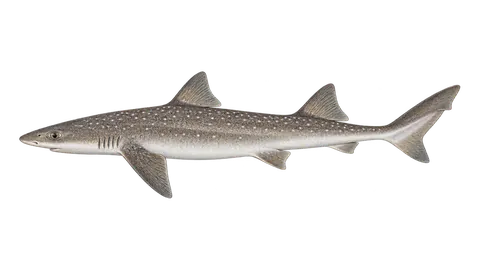
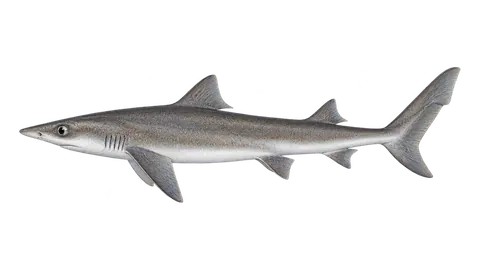


sources and references (11)
The seasonal weights (months), the time of day, the sensitivities (cold, pressure, moon, wind, rain, tide, strong light, murky water and noise), the water temperature range and the common size range are the app's editorial estimates, supported by FishBase and by the literature cited below, with no measurements of our own for this species. The months show when an angler may find the species near the coast, not a catch season. They are not official data and may vary by region and year. Legal rules appear in the rules section, with the norm and a link.
- scientific FishBase: Mustelus canis (ficha da espécie)Size, length-weight, depth, habitat, distribution, biology, and IUCN status. Page checked on Oct 13, 2026.
- scientific FishBase: nomes populares de Mustelus canisNames by country and language.
- official Portaria GM/MMA nº 1.667, de 27 de abril de 2026: Lista Nacional Oficial de Espécies da Fauna Ameaçadas de Extinção (peixes e invertebrados aquáticos)The species is listed as EN (item 335 of Annex I); M. fasciatus (item 336) and M. schmitti (item 337) are listed as CR. Checked in the DOU of Apr 28, 2026.
- official Portaria GM/MMA nº 1.666, de 27 de abril de 2026: regras e restrições para as espécies ameaçadas da lista nacionalArt. 3: full protection for EW, CR, EN, and VU species (catching, transporting, storing, holding, handling, processing, and trading are banned); § 4: the restriction does not apply to incidental catch when the animal is released alive; art. 12: for species added to the list by a new ordinance, the art. 3 bans start 180 days after publication. Text checked in the DOU on Oct 13, 2026.
- official Fiperj: Peixes cartilaginosos marinhos ameaçados de extinção (Portarias GM/MMA 1.666 e 1.667/2026), atualizado em 11/05/2026Poster from the Fundação Instituto de Pesca do Estado do Rio de Janeiro, with common names and categories of the cartilaginous fish species on the list; it states that the changes apply from Oct 27, 2026. Checked on Oct 13, 2026.
- official Instrução Normativa Interministerial MPA/MMA nº 14, de 26 de novembro de 2012: desembarque, transporte, armazenamento e comércio de tubarões e raias (proibição do finning)Text from Sislegis/MAPA (DOU of Nov 28, 2012), checked on Oct 13, 2026. § 6 of art. 3 (allowing the tail of rays to be discarded on board) was added by IN Interministerial 6/2013.
- official México: Modificación a la NOM-017-PESC-1994 (pesca deportivo-recreativa), DOFOfficial text in the Diario Oficial de la Federación; items 4.9.1, 4.9.5, 4.10, and 4.11 checked on Oct 13, 2026.
- official México: NOM-029-PESC-2006, pesca responsável de tubarões e raias (DOF de 14/02/2007)Copy of the text published in the DOF, on the standardization platform of the Secretaría de Economía. Items 1.2, 4.2.1, 4.2.3, and 4.3.4 and Normative Appendix A checked on Oct 13, 2026. The standard was written for commercial fishing; recreational fishing has its own standard, NOM-017.
- press Crónica: Anuncian periodos de veda y aprovechamiento de especies marinas (Agricultura e Conapesca, 01/08/2025)Press note reproducing the announcement by the Secretaría de Agricultura and Conapesca for sharks and rays in the Pacific and in Tabasco, Campeche, and Yucatán. The official notice in force in 2026 was not found; confirm the dates with Conapesca.
- official Colômbia: Decreto 281 de 2021 (proteção e conservação de tubarões, raias marinhas e quimeras), Gestor Normativo da Função PúblicaRecitals and rules of the decree on marine sharks and rays. Later AUNAP changes on incidental catch were not checked.
- official Bahamas: Fishing Regulations & FAQ, Ministry of Tourism, Investments & AviationOfficial fishing guide of the Bahamas: it says sharks have been protected since a 2011 amendment to the fisheries law, and that a hooked shark must be released unharmed. The page does not cite the rule's number.
how we calculatewhere each number comes from
The weather comes from three independent global models, cross-checked hour by hour: when they agree, confidence goes up; when they diverge, the band between them shows on the chart. Beyond 16 days, we use the GEFS ensemble of 31 simulations: if 20 of the 31 predict rain, the chance of rain is 65%. Sun and moon are calculated astronomically, with no uncertainty.
The index adds up, weighted for each species: time of day (species curve anchored to real sunrise and sunset), moon (transits, rise and set, phase), pressure (3 h trend and 24 h swing), water temperature (in rivers, estimated from air temperature; at sea, estimated by an ocean model), wind, rain, clouds, tide and the month in the species' cycle.
sources for this lookup
how accurate the forecast is
Accuracy measured in the reference project (4 regions, 93 days, forecast vs. observed): maximum temperature is off by 0.6 °C on average the next day and 1.7 °C at 7 days; rain of 5 mm or more is detected 76% of the time the next day and 57% at 7 days. Detection isn't everything: the false alarm rate isn't published here yet, and 93 days in 4 regions is still a small sample. We now also measure every day, at the app's destinations: