Skip to content
fishing forecast

african pompano

Alectis ciliaris · Carangidae · predator

Sea

Deep-bodied, flattened carangid with an almost straight forehead and, in juveniles, long fin filaments. Grows to 150 cm and 22.9 kg, lives in deep shelf and open-sea waters, and is a sport fish.

Also called: galo-de-penacho, galo-do-alto, galo-de-fita, abacataia, african pompano

Scientific illustration of African pompano
common size
70–110 cm
maximum
150 cm
common weight
4–14.4 kg
record/max.
22.9 kg
depth
60–100 m
ideal water
23–28 °C
location

Sample location: choose yours to see the forecast for where you fish.

period

Reading the weather across 3 global models and 31 simulations…

the species

everything about the african pompano

overview

who is the african pompano

The African pompano is one of the largest deep-bodied jacks in the Atlantic. It is circumglobal in tropical, subtropical and temperate seas and, in the western Atlantic, ranges from Massachusetts and Bermuda to Santos (SP), including the Caribbean and the Gulf of Mexico. It lives in coastal and oceanic waters; adults stay near the bottom, at depths of tens of meters (FishBase cites 60 to 100 m), and juveniles, much smaller, stay near the coast while they have long filaments on the dorsal and anal fins (the 'penacho', or plume). It eats slow-moving crustaceans, small crabs and sometimes fish. It reaches 150 cm and 22.9 kg, with a common fork length of 100 cm. The flesh is excellent, but FishBase records ciguatera cases. FishBase classifies it as a sport fish.

fun facts

  • Juveniles have long filaments on the dorsal and anal fins, the 'penacho' (plume); hence the name galo-de-penacho.
  • Juveniles are sold as aquarium fish, but do poorly in captivity (FishBase).
  • It is circumglobal: it lives in the Atlantic, the Indian Ocean and the eastern Pacific.
how to recognize it

identification

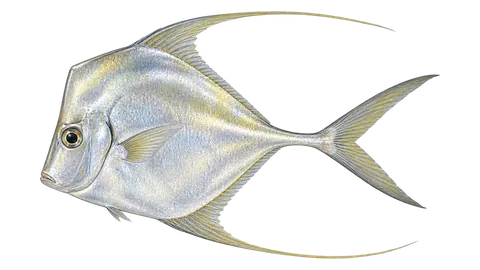
Very deep-bodied, flattened fish with a nearly straight forehead profile and a small, low mouth. Silvery, with bluish reflections on the back. In juveniles, the dorsal and anal fin rays become long filaments that shorten as the fish grows. First dorsal with 7 to 8 spines, second dorsal with 18 to 22 rays; anal fin with 3 spines and 15 to 20 rays. The lookdown (Selene vomer) also has filaments when young and is much smaller; in the Northeast, both are called galo-de-penacho.

distribution

where found

open on the large map

In Brazil, from the North to the Southeast, down to Santos (SP), according to FishBase; artisanal fishers in Ceará and Pernambuco know it. In Latin America, FishBase's list includes Mexico, Central America, the Caribbean, Colombia, Venezuela, the Guianas, Ecuador, Peru and El Salvador.

Habitat: Shelf and oceanic waters; shipwrecks, reefs and hard bottoms from 60 to 100 m; juveniles near the coast.

coast

North CoastNortheast CoastSoutheast Coastshelfoceanic
calendar and clock

when to fish

best season

time of yearbest: Dec–Mar
JanFebSeaAprMayJunJulAugSepOctNovDec

Caught all year in tropical waters; most frequent with warm water from late spring into summer.

best time of day

0h6h12h18h sunrise ~6amsunset ~6pm

Daytime, with peaks at dawn and dusk. Feeds by day, most active early in the morning and late in the afternoon; near the bottom, its activity follows the current.

weather, water and behavior

what affects the african pompano
sensitivity The little bars show how much each factor affects this species. Five full: it feels it a lot.

cold and cold fronts

Warm-water fish: it disappears when the water cools or turns green.

atmospheric pressure

A cold front with rough seas shuts fishing down for a day or two.

moon

Small effect; large tides increase the current over the hard bottom.

rain

Little effect in open sea.

water level

Not applicable at sea. The equivalent is clear blue water over the wreck or reef.

noise

Small effect; avoid knocking the hull over the spot.

wind

Rough seas make it hard to hold precisely over the wreck.

tide

Moderate current over the wreck or reef brings bait and fish; without current, the fish stays put.

depth

40 to 100 m for most catches, near hard bottom.

technique, gear and bait

how to fish

rod
6'6" to 7', fast action, 30 to 50 lb
spinning / baitcasting reel
8000 to 10000 reel or jigging reel
line
braided line 50 to 80 lb
leader
fluorocarbon 60 to 100 lb, 1.5 to 2 m
hook
circle 6/0 to 9/0 on bait; assist hooks 3/0 to 5/0 on the jig

lures

  • jig 100 to 250 g
  • silicone lure 20 to 30 cm

natural baits

  • live bait (xixarro, garapau, sardine)
  • whole squid
  • fish pieces

accessories

  • alicate
  • luvas
  • boga-grip
  • fighting belt

tip from an angler

Over wrecks and reefs, drop the bait or jig close to the bottom and reel in fast over the first few meters: the fish strikes on the way up. The galo-de-penacho tries to return to the bottom, so keep the pressure on.

what the law says

rules for the african pompano

Summary of the regulations we found, with the source for each. Rules change; before keeping or transporting fish, check with the state environmental agency.
Conservation: Not on the Brazilian national list (Portaria GM/MMA nº 1.667/2026). Outside Puerto Rico and Mexico we found no specific rule for the species.

Puerto Rico (federal waters): up to 5 per person per day

5 per person per day; 15 per boat with 3 or more people

In federal waters around Puerto Rico (outside territorial waters, from 9 miles offshore), a recreational angler may keep at most 5 fish per day, counting angelfish, grunts, jacks and other carangids, surgeonfish, triggerfish and wrasses (up to 15 per boat when there are 3 or more people aboard; at most 1 surgeonfish per person). The African pompano is on the jack (carangid) list of the US federal management plan for Puerto Rico. The limit does not apply to anyone holding a commercial license from Puerto Rico or the US Virgin Islands.

Source: 50 CFR 622.444(a)(2) (NOAA Fisheries, US), wording from 90 FR 26940, of Jun 25, 2025
Mexico: up to 5 per species and 10 saltwater fish per day

5 specimens of the species per angler per day, within the limit of 10 saltwater fish

In recreational fishing in Mexican federal waters, each angler may keep up to 10 marine fish per day, no more than 5 of the same species. The African pompano is not among the species reserved for recreational fishing and has no quota of its own. Fish over the limit go back into the water alive, and fish caught in recreational fishing may not be sold. Anyone fishing from a boat needs the recreational fishing permits set out in the rule.

Source: Amendment to NOM-017-PESC-1994 (recreational sport fishing in federal waters of Mexico), published in the DOF on Nov 25, 2013, items 4.3, 4.9.1, 4.9.5 and 4.11 (Sagarpa/Conapesca)

catch and release
catch and release Releasing the fish alive, quickly and with a wet hand. During a closed season it isn't always allowed: what the regulation says applies.

Strong fighter that tires quickly: revive it with the boat moving slowly, holding the fish by the tail with its head in the water, and release it when it swims strongly. If it comes from 60 m or deeper, it may suffer barotrauma (swollen swim bladder): release it quickly, using a descending device if you have one.

in the kitchen

White, firm, highly prized flesh; FishBase rates it excellent, sold fresh, dried or salted. It also records ciguatera cases, so check with local fishers, especially in the Caribbean.

calculator

how much it weighs without taking it out of the water

Length-weight relationship W = a·Lb (a = 0.02291, b = 2.84; FishBase (relação peso-comprimento bayesiana, estimativa da própria espécie)). It's an average: a fat or lean fish can vary by 10% to 20%.

estimated weight

—

sources and references

The season weights (months), the time of day and the sensitivities (cold, pressure, moon, wind, rain, tide, strong light, murky water and noise) are the app's editorial estimates, based on the literature below and on the field experience of anglers and guides. They are not official data nor a measurement made for this species, and they may vary by region and year. Closed seasons and legal rules appear in the rules section, with the norm and a link.

  1. scientific FishBase: Alectis ciliaris (ficha da espécie)Size, length-weight, depth, habitat, distribution, biology and IUCN status. Page checked on 13/10/2026. The common size range is an editorial estimate around the common length of 100 cm (fork length) reported by FishBase.
  2. scientific FishBase: nomes populares de Alectis ciliarisNames by country and language.
  3. official Portaria GM/MMA nº 1.667, de 27 de abril de 2026: Lista Nacional Oficial de Espécies da Fauna Ameaçadas de Extinção (peixes e invertebrados aquáticos)The species is not on the list. Checked in the DOU of April 28, 2026.
  4. scientific Pinto, M. F.; Mourão, J. S.; Alves, R. R. N. (2015). Use of ichthyofauna by artisanal fishermen at two protected areas along the coast of Northeast Brazil. Journal of Ethnobiology and Ethnomedicine.Common names recorded from artisanal fishers in Tamandaré (PE) and the Batoque Extractive Reserve (CE).
  5. official 50 CFR Part 622, Subpart S: FMP for the EEZ around Puerto Rico (NOAA Fisheries, EUA), § 622.444(a)(2), redação de 90 FR 26940 (25/06/2025)Recreational catch limit in federal waters around Puerto Rico and species list from the management plan. Text checked Oct 13, 2026.
  6. official NOM-017-PESC-1994 (pesca deportivo-recreativa em águas de jurisdição federal do México), modificação publicada no DOF em 25/11/2013 (Sagarpa/Conapesca)Limit of 10 marine fish per angler per day, no more than 5 of the same species (item 4.9.1), return of the excess (4.9.5) and ban on selling sport-caught fish (4.11). Text checked Oct 13, 2026. The rule sets no quota of its own for this species.
don't confuse

similar species