

crevalle jack
Caranx hippos
The toughest fight among coastal fish. It explodes on the popper, dives and pulls in circles until the end.
- common size
- 50–90 cm
- maximum
- 124 cm
- common weight
- 2–10 kg
- record/max.
- 32.0 kg
- depth
- 0.5–50 m
- ideal water
- 23–29 °C
how to recognize it
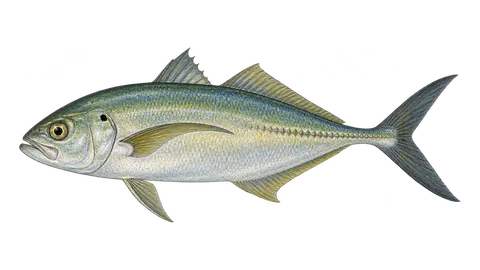
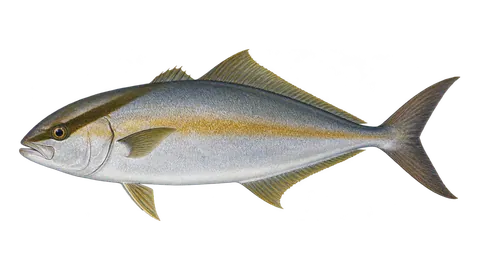
Tall body, large head and a very rounded front profile. Strong bony scutes on the straight part of the lateral line, near the tail. Black spot on top of the gill cover and another at the base of the pectoral fin; anal fin and lower lobe of the tail yellowish. Chest without scales, except for a small area in the middle. Difference from the blue runner: it is smaller, slimmer and lacks the pectoral spot. From greater amberjack: that one has no scutes.
Also called: xaréu, cabeçudo (jovem)
don't confuse with:
where found
open on the large mapWhere to look: Inlets, rocky shores, beaches, bays, estuaries, pilings and coastal offshore reefs.
From the whole coast of Amapá to Santa Catarina, most common in the Northeast and Southeast. Juveniles in estuaries and coastal rivers.
coast
states
Amapá, Pará, Maranhão, Piauí, Ceará, Rio Grande do Norte, Paraíba, Pernambuco, Alagoas, Sergipe, Bahia, Espírito Santo, Rio de Janeiro, São Paulo, Paraná, Santa Catarina
when to fish
next 7 days
Loading the next 7 days…
best season
In the South and Southeast, from November to April, with warm water. In the Northeast all year, peaking in calm-sea months.
best time of day
Daytime, with peaks at dawn and dusk. Surface strikes at dawn and dusk; during the day it hunts in schools when bait is concentrated.
what affects the crevalle jack
cold and cold fronts
Water below 20 °C greatly reduces its presence inshore.
atmospheric pressure
Not very sensitive; a cold front ends the season in the South.
moon
Spring tides concentrate bait at inlets and usually produce.
rain
Rain doesn't hurt; runoff in the estuary brings bait to the inlet.
water level
Choppy sea doesn't bother the crevalle jack, which hunts in the foam; it bothers the angler.
noise
A school feeding tolerates a boat at a distance; don't pass over it with the motor.
wind
Moderate wind helps form foam and current at the rocky points.
tide
Current is everything: at inlets, the ebb releases bait from the estuary and the crevalle jack waits at the mouth; on the flood it moves in behind the school. At slack tide the hunts stop.
depth
Surface to 10 m inshore; down to 50 m on the offshore reefs.
how to fish
lures
- popper 12 to 18 cm
- large zara
- metal jig 40 to 120 g
- mid-water
natural baits
- blue runner or live sardine
- live small mullet
tip from an angler
Work the popper with hard strikes and short pauses where bait is on the surface. After the hookset, hold on: it will dive and spin, and whoever gives line for no reason loses the fish on the rocks.
- rod
- 7'0" to 8'0", 20 to 50 lb; 9 to 11 ft on the rocky shore
- spinning / baitcasting reel
- 6000 to 10000 spinning reel with strong drag
- line
- braid 40 to 65 lb
- leader
- fluorocarbon or monofilament 60 to 80 lb, 1.5 m
- hook
- reinforced 3X treble hooks or single hook 5/0 to 7/0
accessories
- alicate
- luvas
- fighting belt for large fish
catch and release
Hold it by the tail and under the chest; watch the tail scutes, which cut. Revive it in the water until it kicks hard.
rules for the crevalle jack
Rules change; before keeping or transporting fish, check with the state environmental agency.
We found no species-specific rule beyond the region's general rules.
Conservation: Not on the national list of threatened species.
how much it weighs without taking it out of the water
estimated weight
—
how we calculate
Length-weight relationship W = a·Lb (a = 0.01622, b = 2.96; FishBase (estimativa bayesiana, comprimento total)). It's an average: a fat or lean fish can vary by 10% to 20%.
more about the crevalle jack
The crevalle jack is the toughest fight in coastal fishing. It travels in schools that surround manjubas and sardines and burst at the surface, at inlets, rocky shores, beaches, bays and estuaries, and the big ones go alone or in pairs along the offshore reefs. Juveniles, called cabeçudos, enter estuaries and even rivers. It hits poppers and zaras hard, then dives, pulling in circles until the end. It doesn't jump, but it wears the angler out. It prefers warm water: in the South and Southeast it shows from late spring to autumn; in the Northeast, all year. On the table, dark, strong meat that improves a lot if the fish is bled right away.
Family: Carangidae · predator
fun facts
- It grunts when taken out of the water.
- Juveniles move up rivers and are caught even in fresh water.
in the kitchen
Dark meat with a strong flavor. Bled and well chilled, it's good grilled, in moqueca or smoked.
similar species
sources and references (6)
The season weights (months), the time of day and the sensitivities (cold, pressure, moon, wind, rain, tide, strong light, murky water and noise) are the app's editorial estimates, based on the literature below and on the field experience of anglers and guides. They are not official data nor a measurement made for this species, and they may vary by region and year. Closed seasons and legal rules appear in the rules section, with the norm and a link.
- scientific FishBase — Caranx hippos (ficha da espécie)Names, distribution, biology, length-weight relationship and references. Page checked on October 13, 2026.
- official Portaria GM/MMA nº 1.667, de 27 de abril de 2026 — Lista Nacional Oficial de Espécies da Fauna Ameaçadas de Extinção (peixes e invertebrados aquáticos)Most recent national list. The species is not on it (search by scientific name in the text published in the DOU, checked on October 13, 2026).
- official ICMBio/SALVE — Ficha de Caranx hippos (avaliação nacional do risco de extinção)National assessment by ICMBio, published in 2023. DOI verified on Crossref.
- scientific IUCN Red List — Caranx hippos (avaliação global: Pouco Preocupante, LC, 10/09/2018)Global assessment. Link given on the FishBase entry (Red List, version 2025-2).
- scientific Carpenter, K. E. (org.) (2002). The living marine resources of the Western Central Atlantic. Vol. 3: Bony fishes part 2 (Opistognathidae to Molidae). FAO Species Identification Guide for Fishery Purposes. Roma: FAO.Chapter Carangidae (Smith-Vaniz, W. F.).
- scientific Menezes, N. A.; Buckup, P. A.; Figueiredo, J. L.; Moura, R. L. (orgs.) (2003). Catálogo das espécies de peixes marinhos do Brasil. São Paulo: Museu de Zoologia da USP. 160 p.List of the marine species recorded in Brazil. Printed work; the URL is the bibliographic record in FishBase, which cites the catalogue for the species.