


the right time
to be on the water
Choose the place and the species. The index, from 0 to 100, combines weather, sun, moon and tide with each fish's habits. Up to 28 days, with each day's confidence.
Loading the forecast…
—
hour by hour
slide your finger or mouse over the chart to see each hoursee hour-by-hour table
why this index at —?
choose the day
the fishing month at a glance
what's the best window for the crew?
Choose how many fishing days. We compare each stretch by its average index, discount days with a warning or closed season, and show the 3 best.
trend for the coming weeks
Line: the middle value of 31 simulations of the American GEFS model. Band: where 8 out of 10 fall. Narrow, firm trend; wide, high uncertainty.
everything about the southern sennet
how to recognize it
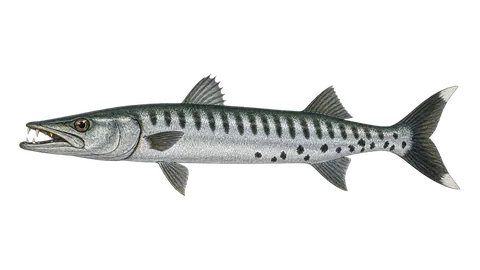
Elongated, nearly cylindrical body, pointed head with protruding lower jaw and large teeth. Two widely separated dorsal fins; FishBase counts 6 spines and 9 soft rays in the dorsals and 2 spines and 9 soft rays in the anal fin (the goirana, S. guachancho, has 8 anal rays). It is much smaller and slimmer than the great barracuda (S. barracuda), which has oblique bars and black spots on the flanks. Reliable separation of the goirana-pequena requires counting scales and rays: check in a guide.
Also called: goirana-pequena, goirana, barracuda-pequena, southern sennet, little barracuda
don't confuse with:
where found
open on the large mapWhere to look: Coastal waters from 1 to 65 m: rocky and coral reefs and, more often, mud bottoms. Juveniles in seagrass.
According to FishBase, it ranges from Bermuda, Florida and the Bahamas to Uruguay. In Brazil, the species' latitude range (33°N to 35°S) covers all four coasts, and ICMBio has a national assessment record. In Latin America, FishBase lists Mexico, the Caribbean coast of Central America, Colombia, Venezuela, the Guianas, the Caribbean and Uruguay.
coast
when to fish
best season
A species of tropical and subtropical waters, fished all year. We found no harvest calendar; the app's weights are estimates.
best time of day
Daytime. A sight-hunting predator: it attacks by day, in schools near the surface or along reef edges. Editorial estimate; we found no study of its activity rhythm.
what affects the southern sennet
cold and cold fronts
Warm-water fish: cold water makes the school slow and drives it deeper.
atmospheric pressure
Small effect; a cold front with rough seas shuts fishing down for a day or two.
moon
Small effect.
rain
Heavy rain muddies coastal water and makes sight hunting harder.
water level
Not applicable at sea. The equivalent is water clarity.
noise
Wary of noise in shallow, clear water; approach slowly.
wind
Light wind hides the line; strong wind makes casting hard.
tide
The moving tide carries bait to reef edges and channels.
depth
1 to 65 m; schools sometimes stay near the surface.
how to fish
lures
- small metal spoons and jigs of 7 to 20 g
- midwater plugs and poppers 7 to 10 cm
- silver streamers for fly fishing
natural baits
- small sardine
- agulhinha
tip from an angler
Reel in quickly: the small goirana follows the bait and strikes what flees. Fine steel in the leader prevents teeth cuts.
- rod
- 6' to 7', 6 to 12 lb
- spinning / baitcasting reel
- spinning reel 2500 to 3500
- line
- braided line 10 to 20 lb
- leader
- fine steel leader of 20 to 30 lb, 15 to 25 cm, or 40 lb fluorocarbon (the teeth cut ordinary line)
- hook
- simple hook 1/0 to 2/0 or small treble hooks
accessories
- long-nose pliers
- luvas
catch and release
Hold it with a damp cloth and remove the hook with long-nose pliers, away from the teeth. A fragile fish that loses scales: don't linger for the photo.
rules for the southern sennet
Rules change; before keeping or transporting fish, check with the state environmental agency.
Mexico: up to 5 per species and 10 saltwater fish per day
5 specimens of the species per angler per day, within the limit of 10 saltwater fish details
In recreational fishing in Mexican federal waters, each angler may keep up to 10 marine fish per day, no more than 5 of the same species. The small goirana is not among the species reserved for recreational fishing (marlin, sailfish, swordfish, tarpon, roosterfish and dorado, up to 50 nautical miles from shore, item 0.3 of the rule) nor among those with their own limit (billfish, sharks, seatrout, tarpon, dorado, roosterfish and baya), and it has no quota of its own. Fish over the limit go back into the water alive, and the recreational fish may not be sold.
Colombia: AUNAP license and catch-and-release in sport fishing
Individual AUNAP license; catch-and-release guidanceconfirm with the agency details
AUNAP Resolution 0549 of 2022 sets the guidelines for recreational sport fishing in Colombia. Anglers need a permit: for an individual, Colombian or foreign, it is a personal, non-transferable card. The rule makes "catch and release" the guidance and admits keeping only part of the catch for personal consumption, respecting the minimum sizes it sets. We did not confirm the daily limit or the minimum sizes by species: check with AUNAP before keeping fish.
Conservation: Not on the Brazilian national list (Portaria GM/MMA nº 1.667/2026). The IUCN has not assessed the species. ICMBio published a national assessment record in 2025; the category was not checked for this entry. We found no specific federal rule for the species.
how much it weighs without taking it out of the water
estimated weight
—
how we calculate
Length-weight relationship W = a·Lb (a = 0.00603, b = 2.92; FishBase (relação peso-comprimento bayesiana, estimativa da própria espécie)). It's an average: a fat or lean fish can vary by 10% to 20%.
more about the southern sennet
The goirana-pequena (Sphyraena picudilla), the 'southern sennet' of English-speaking fishers and the 'picudilla' of Spanish-speaking ones, is a small barracuda of the western Atlantic: it ranges from Bermuda, Florida and the Bahamas to Uruguay. It lives in coastal waters from 1 to 65 m, over rocky and coral reefs and, more often, mud bottoms; juveniles stay in seagrass. It usually travels in large schools, sometimes near the surface. It reaches 61 cm fork length and 1.1 kg, and is common at 36 cm. It has a small commercial fishery (sold fresh and frozen) and FishBase lists it as a sport fish; ciguatera has been reported in the species.
Family: Sphyraenidae · predator
fun facts
- The Spanish name picudilla is a diminutive of 'picuda', the barracuda.
- FishBase notes that the schools sometimes stay near the surface.
- More abundant over mud bottoms than on reefs, according to FishBase.
in the kitchen
FishBase records it as sold fresh and frozen. Ciguatera has been reported in the species, which is common among reef barracudas: follow local health guidance.
similar species


sources and references (7)
The season weights (months), the time of day and the sensitivities (cold, pressure, moon, wind, rain, tide, strong light, murky water and noise) are the app's editorial estimates, based on the literature below and on the field experience of anglers and guides. They are not official data nor a measurement made for this species, and they may vary by region and year. Closed seasons and legal rules appear in the rules section, with the norm and a link.
- scientific FishBase: Sphyraena picudilla (ficha da espécie)Size, length-weight, depth, habitat, distribution, biology and IUCN status (the FishBase entry reports 'Not Evaluated' on the Red List, version 2025-2, meaning the species has not been assessed). Page checked on 13/10/2026.
- scientific FishBase: nomes populares de Sphyraena picudillaNames by country and language. Barracuda and goirana appear in the Portuguese list.
- official Portaria GM/MMA nº 1.667, de 27 de abril de 2026: Lista Nacional Oficial de Espécies da Fauna Ameaçadas de Extinção (peixes e invertebrados aquáticos)The species is not on the list. Checked in the DOU of April 28, 2026.
- official ICMBio/SALVE: Ficha de Sphyraena picudilla (avaliação nacional do risco de extinção)National assessment by ICMBio, published in 2025. DOI checked in Crossref on Oct 13, 2026; the assigned category was not checked for this profile.
- scientific Carpenter, K. E. (org.) (2002). The living marine resources of the Western Central Atlantic. Vol. 3: Bony fishes part 2 (Opistognathidae to Molidae). FAO Species Identification Guide for Fishery Purposes. Roma: FAO.Reference identification guide for the species' families in the western Atlantic. Index checked Oct 13, 2026.
- official DOF: Modificação da NOM-017-PESC-1994, para regular a pesca deportivo-recreativa em águas de jurisdição federal do MéxicoText signed Oct 14, 2013. Species reservation for sport fishing (item 0.3), daily quotas at sea (4.9.1), catch and release of the surplus (4.9.5) and a ban on selling the fish (4.11). Text checked Oct 13, 2026; the DOF publication date does not appear in the text consulted. The daily limit was confirmed only for Mexico; for other countries we did not confirm species-specific rules.
- official AUNAP (Colômbia): Resolução 0549 de 2022, lineamientos de ordenación pesquera para la pesca deportiva con fines recreativosWe checked, in a partial transcription of the text, what the rule says about the personal license (art. 6) and about "catch and release" as the premise, with retention for personal consumption only within minimum sizes (art. 8). We could not read the articles on the daily quota and minimum sizes, so those figures are left out.
how we calculatewhere each number comes from
The weather comes from three independent global models, cross-checked hour by hour: when they agree, confidence goes up; when they diverge, the band between them shows on the chart. Beyond 16 days, we use the GEFS ensemble of 31 simulations: if 20 of the 31 predict rain, the chance of rain is 65%. Sun and moon are calculated astronomically, with no uncertainty.
The index adds up, weighted for each species: time of day (species curve anchored to real sunrise and sunset), moon (transits, rise and set, phase), pressure (3 h trend and 24 h swing), water temperature (in rivers, estimated from air temperature; at sea, estimated by an ocean model), wind, rain, clouds, tide and the month in the species' cycle.
sources for this lookup
how accurate the forecast is
Accuracy measured in the reference project (4 regions, 93 days, forecast vs. observed): maximum temperature is off by 0.6 °C on average the next day and 1.7 °C at 7 days; rain of 5 mm or more is detected 76% of the time the next day and 57% at 7 days. Detection isn't everything: the false alarm rate isn't published here yet, and 93 days in 4 regions is still a small sample. We now also measure every day, at the app's destinations: