Skip to content
fishing forecast

coney

Cephalopholis fulva · Epinephelidae · predator

Sea

A reef grouper (garoupinha) covered with blue spots, common on the rocky shores and corals of the Northeast. It changes color, lives in harems and takes small natural bait.

Also called: jabu, piraúna, catuá, garoupinha, garoupa-pintada-da-bahia, coney

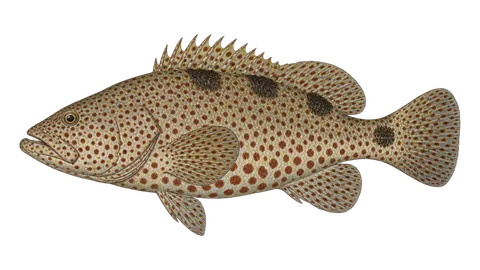
Scientific illustration of Coney
common size
20–30 cm
maximum
44 cm
common weight
0.1–0.5 kg
record/max.
1.2 kg
depth
1–150 m
ideal water
24–28 °C
location

Sample location: choose yours to see the forecast for where you fish.

period

Reading the weather across 3 global models and 31 simulations…

the species

everything about the coney

overview

who is the coney

The jabu is a small grouper of the western Atlantic, from South Carolina and Bermuda to southern Brazil. It lives on coral reefs and rocky shores of clear water, usually down to 40 m, and spends the day in holes and under ledges. It eats small fish and crustaceans, and sometimes follows morays to catch the prey they flush out. It is born female and turns male at about 20 cm; each male defends a territory with several females and spawns with them at sunset. On the central coast of Brazil it reaches 43 cm and 24 years of age. It is common in rocky-shore and boat fishing with small natural bait.

fun facts

  • Born female, turns male at about 20 cm; each male has a harem.
  • Sometimes hunts together with morays, taking advantage of the prey they flush out of the holes.
how to recognize it

identification

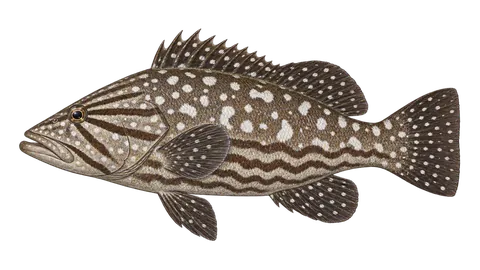
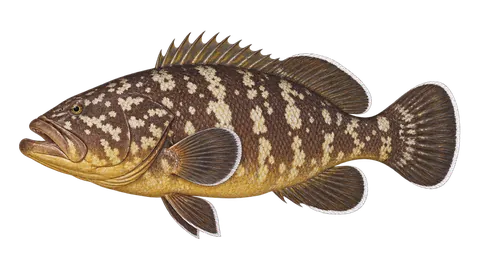
Body red, orange or brownish, sometimes bright yellow or two-tone, covered in blue dots with black edges. Two black spots at the top of the tail peduncle and two at the tip of the chin. Tail with a rounded edge and angled tips. The rock hind (garoupa-gato) has red spots on a pale background; the true grouper (garoupa-verdadeira) and the badejo-mira are much larger and lack blue dots.

distribution

where found

open on the large map

In Brazil, from the Northeast to the South, common on reefs and rocky shores of the Northeast and Bahia.

Habitat: Coral reefs and rocky shores of clear water, with holes, ledges and crevices.

coast

Northeast CoastSoutheast CoastSouth Coastcoastalshelf

states

Ceará, Rio Grande do Norte, Paraíba, Pernambuco, Alagoas, Sergipe, Bahia, Espírito Santo, Rio de Janeiro, São Paulo, Paraná, Santa Catarina

calendar and clock

when to fish

best season

time of year
JanFebSeaAprMayJunJulAugSepOctNovDec

Fished year-round on the Northeast reefs.

best time of day

0h6h12h18h sunrise ~6amsunset ~6pm

Dawn and dusk. Most active at dawn and dusk; by day it usually stays in its hole.

weather, water and behavior

what affects the coney
sensitivity The little bars show how much each factor affects this species. Five full: it feels it a lot.

cold and cold fronts

A tropical reef fish; cold water reduces its activity.

atmospheric pressure

A churned sea after a cold front makes the rocky shore difficult.

moon

Small effect.

rain

Minor; a storm on the rocky shore is a danger.

water level

Surf muddies the reef water for days.

noise

Wary: footsteps on the rocks and a motor in the shallows make it hide in its hole.

wind

A strong sea wind makes the rocky coast dangerous.

tide

Moving tide brings food to the mouth of the hole.

depth

From the shallows down to about 40 m for most catches.

technique, gear and bait

how to fish

rod
shore: 7' to 9', 15 to 30 lb; boat: 6', 12 to 25 lb
spinning / baitcasting reel
spinning reel 3000 to 4000
line
braid 20 to 30 lb
leader
fluorocarbon 30 to 40 lb, 50 cm
hook
hook 1/0 to 2/0 or circle 1/0

lures

  • small jig head with shad
  • jig 20 to 40 g

natural baits

  • shrimp
  • fish or squid strip
  • piece of sardine

accessories

  • small sinker
  • alicate

tip from an angler

A small bait right at the mouth of the hole: the jabu bites and goes back in, so hold firm on the first pull.

what the law says

rules for the coney

Summary of the regulations we found, with the source for each. Rules change; before keeping or transporting fish, check with the state environmental agency.
Conservation: Not on the national list (Portaria GM/MMA 1.667/2026). We found no specific federal rule for this species.

Mexico: grouper closed season from Feb 1 to Mar 31

catch prohibited from Feb 1 to Mar 3101/02 to 31/03

In Mexico, catching all grouper species, a group in which the official standard includes the jabu (cherna cabrilla), is prohibited from February 1 to March 31 in federal waters of the Gulf of Mexico and the Caribbean off Tabasco, Campeche, Yucatán and Quintana Roo, up to the Belize border. Bottom longlines are also prohibited during the period.

Source: Grouper closed-season agreement (DOF Feb 14, 2007), amended Mar 3, 2017 (Sagarpa/Conapesca); NOM-065-SAG/PESC-2014

Puerto Rico (federal waters): up to 5 per person per day

5 per person per day; 15 per boat with 3 or more people

In federal waters around Puerto Rico, beyond 9 miles from the coast, the recreational angler may keep a maximum of 5 fish per day from groupers, snappers and parrotfish combined (up to 15 per boat when there are 3 or more people aboard). The limit does not apply to anyone with a commercial license from Puerto Rico or the U.S. Virgin Islands.

Source: 50 CFR 622.444(a)(1) (NOAA Fisheries, US)

catch and release
catch and release Releasing the fish alive, quickly and with a wet hand. During a closed season it isn't always allowed: what the regulation says applies.

A shallow hole-dwelling fish: remove the hook quickly and release it near the rock. If it came from deeper than 20 m, use a descender.

in the kitchen

White, delicate flesh, good fried or in moqueca. Ciguatera has been recorded in the Caribbean.

calculator

how much it weighs without taking it out of the water

Length-weight relationship W = a·Lb (a = 0.01175, b = 3.04; FishBase (estimativa bayesiana, comprimento total)). It's an average: a fat or lean fish can vary by 10% to 20%.

estimated weight

—

sources and references

The season weights (months), the time of day and the sensitivities (cold, pressure, moon, wind, rain, tide, strong light, murky water and noise) are the app's editorial estimates, based on the literature below and on the field experience of anglers and guides. They are not official data nor a measurement made for this species, and they may vary by region and year. Closed seasons and legal rules appear in the rules section, with the norm and a link.

  1. scientific FishBase — Cephalopholis fulva (ficha da espécie)Names, distribution, biology, length-weight relationship, country list and references. Page checked October 13, 2026. Size and age for the central coast of Brazil (16° to 21°30' S) come from the population traits section of the profile. FishBase also lists Uruguay, with a marginal record that we did not include. The maximum weight was estimated from the length-weight relationship.
  2. official Portaria GM/MMA nº 1.667, de 27 de abril de 2026 — Lista Nacional Oficial de Espécies da Fauna Ameaçadas de Extinção (peixes e invertebrados aquáticos)Most recent national list. The species is not on it (search by scientific name in the text published in the DOU, checked on October 13, 2026).
  3. official ICMBio/SALVE — Ficha de Cephalopholis fulva (avaliação nacional do risco de extinção)National assessment by ICMBio, published in 2024. DOI verified on Crossref.
  4. scientific IUCN Red List — Cephalopholis fulva (avaliação global: Pouco Preocupante, LC, 22/03/2018)Global assessment. Link given on the FishBase entry (Red List, version 2025-2).
  5. scientific Heemstra, P. C.; Randall, J. E. (1993). FAO species catalogue. Vol. 16. Groupers of the world (family Serranidae, subfamily Epinephelinae). FAO Fisheries Synopsis 125(16). Roma: FAO.
  6. scientific Carpenter, K. E. (org.) (2002). The living marine resources of the Western Central Atlantic. Vol. 2: Bony fishes part 1 (Acipenseridae to Grammatidae). FAO Species Identification Guide for Fishery Purposes. Roma: FAO.Chapter Serranidae (Heemstra, P. C.; Anderson, W. D.; Lobel, P. S.).
  7. official México — NOM-065-SAG/PESC-2014, para regular o aproveitamento das espécies de mero e espécies associadas no Golfo do México e no Mar do Caribe (DOF de 03/07/2015)Text published in the Official Journal of the Federation, in a copy from the Secretaría de Economía. Item 4.1 (list of grouper species), 4.8 (minimum size of red grouper) and 4.13 (fishing for domestic consumption).
  8. official México — Acordo que modifica a veda de todas as espécies de mero no Golfo do México e no Caribe (DOF de 03/03/2017; acordo original de 14/02/2007)Sets the closed season from February 1 to March 31, since 2018, in federal waters off Tabasco, Campeche, Yucatán and Quintana Roo. We found no later amendment; confirm each season with Conapesca.
  9. official Code of Federal Regulations, 50 CFR Part 622, Subpart S — Regulations specific to the Puerto Rico Management Area (NOAA Fisheries, EUA)Consolidated text in the eCFR, checked October 13, 2026: §622.438 (prohibited species), §622.439 (area and time closures) and §622.444 (quotas). It applies in federal waters, beyond 9 miles from the coast.
don't confuse

similar species