Skip to content
catalog Epinephelidae · predator

sharpnose grouper

Mycteroperca acutirostris

Seanational list: EN · endangered

A rocky-shore and ledge grouper of the Southeast and South, with dark streaks running from the eye. It entered the national list in 2026 as Endangered: catch is prohibited from October 25, 2026.

Also called: badejo-mira, mira, saltão, badejete, serigado-tapoã, comb grouper

Scientific illustration of Sharpnose grouper
common size
40–65 cm
maximum
80 cm
common weight
2–7 kg
record/max.
10.0 kg
depth
3–70 m
ideal water
19–25 °C
overview

who is the sharpnose grouper

The badejo-mira is a medium-sized grouper of the western Atlantic, from Bermuda and the northwest Gulf of Mexico to Brazil. Juveniles live in seagrass beds, mangroves and shallow reefs; adults stay on rocky shores and rock bottoms with strong relief, from 3 to 70 m. It is a traditional species in rocky-shore, boat and spearfishing in the Southeast and South of Brazil, where specimens of 4 to 7 kg are common. In 2026 it was added to the national list of threatened species as Endangered. Since it was not on the previous list, the ban on catch, transport and trade starts 180 days after publication, around October 25, 2026. From then on, if you catch one, release it alive.

fun facts

  • FishBase considers the 4 kg maximum weight given in old sources too low: in southern Brazil, fish of 4 to 7 kg are common.
  • The spearfishing record cited by FishBase is 10.1 kg.
how to recognize it

identification

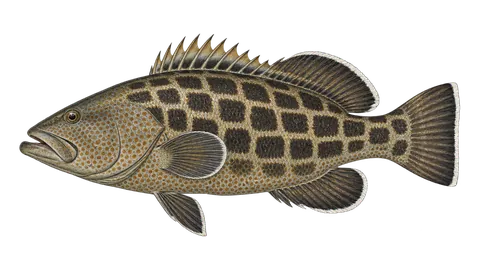
Elongated, compressed body, grayish brown, with irregular white spots and blotches. Three or four dark brown streaks run from the eye backwards and continue as wavy lines on the lower half of the body; another streak runs from the mouth corner to the edge of the preopercle. Dark fins with white spots. The badejo-quadrado has rectangular blotches; the true grouper (garoupa-verdadeira) has a deeper body and large pale spots.

how sharpnose grouper fishing looks

Loading the next 7 days…

Each card shows the day's index (0 to 100) and, below it, a strip with the index for each hour, from 0h to 23h. from poor to excellent.

distribution

where found

open on the large map

In Brazil it is a traditional fish of the rocky shores, islands and ledges of the Southeast and South.

Habitat: Rocky shores, islands and rock bottoms with strong relief; juveniles in seagrass, mangroves and shallow reefs.

coast

Southeast CoastSouth Coastcoastalshelf

states

Espírito Santo, Rio de Janeiro, São Paulo, Paraná, Santa Catarina

calendar and clock

when to fish

best season

time of yearbest: Nov–Apr
JanFebSeaAprMayJunJulAugSepOctNovDec

In the Southeast and South, the clear water of late summer and autumn is usually the best time to find it. From October 25, 2026, only for those who photograph and release.

best time of day

0h6h12h18h sunrise ~6amsunset ~6pm

Daytime, with peaks at dawn and dusk. An ambush hunter by day, with peaks at dawn and dusk, near the rocks.

weather, water and behavior

what affects the sharpnose grouper
sensitivity The little bars show how much each factor affects this species. Five full: it feels it a lot.

cold and cold fronts

Cold upwelling shuts down activity on the rocky shores.

atmospheric pressure

Right after a cold front, with a churned sea, fishing drops off.

moon

Small effect; spring tides increase the current on the rocky shore.

rain

Not much relevant at sea; a storm on the rocky shore is dangerous.

water level

Surge muddies the water and stops rocky-shore fishing for days.

noise

Very sensitive to motor noise over shallow rock.

wind

Strong onshore wind makes the rocky shore dangerous and hampers drifting.

tide

Current at a rock corner brings bait and pulls the fish out of its hole.

depth

On the rocky shore, from 3 to 20 m; on ledges, down to about 50 m.

technique, gear and bait

how to fish

rod
shore: 9' to 11', 30 to 50 lb; boat: 6' to 6'6", 30 to 50 lb
spinning / baitcasting reel
spinning reel 6000 to 8000 or baitcasting reel 300
line
braid 40 to 65 lb
leader
fluorocarbon 60 to 80 lb
hook
circle 4/0 to 7/0, preferably barbless

lures

  • jig 40 to 120 g
  • jig head with shad

natural baits

  • live sardine
  • lula
  • shrimp

accessories

  • descender (fish descender)
  • long-nose pliers
  • luvas

tip from an angler

From October 25, 2026, the badejo-mira may not be kept: if it takes your bait, bring it up quickly, remove the hook in the water and release it with a descender if there is barotrauma.

what the law says

rules for the sharpnose grouper

Summary of the regulations we found, with the source for each. Rules change; before keeping or transporting fish, check with the state environmental agency.
Conservation: Entered the list in 2026; the prohibitions apply from about October 25, 2026 (Portaria 1.666/2026, art. 12). Global assessment: LC (IUCN, 2016).

Endangered: catch, transport, and sale prohibited from October 25, 2026

catch prohibited from ~October 25, 2026North CoastNortheast CoastSoutheast CoastSouth Coast

The badejo-mira entered the national list in 2026 as Endangered (EN). Under Portaria 1.666/2026, VU, EN and CR species have full protection: catch, transport, storage, processing and trade are prohibited. For species not on the previous list, the prohibitions apply 180 days after publication (April 28, 2026), i.e., around October 25, 2026. Incidental catch: release alive immediately.

Source: Portaria GM/MMA nº 1.667/2026 (list); Portaria GM/MMA nº 1.666/2026, arts. 3º and 12
Minimum size of 23 cm until the prohibition takes effect

23 cm (TL)ESRJSPPRSCRSSoutheast CoastSouth Coast

Until the national list prohibition takes effect, IN MMA 53/2005 prohibited fishing for, keeping on board and landing badejo-mira under 23 cm total length on the coast from Espírito Santo to Rio Grande do Sul (the rule does not apply to trawling). After October 25, 2026, no specimen may be kept.

Source: Instrução Normativa MMA nº 53/2005, art. 2º and Annex I

catch and release
catch and release Releasing the fish alive, quickly and with a wet hand. During a closed season it isn't always allowed: what the regulation says applies.

Release alive and quickly: bring the fish up without delay, remove the hook with the fish in the water and, if it comes from more than 15 m with barotrauma, release it with a descender. Do not puncture the swim bladder.

in the kitchen

White, highly prized flesh, but from October 25, 2026 the species may not be kept.

calculator

how much it weighs without taking it out of the water

Length-weight relationship W = a·Lb (a = 0.01023, b = 3.03; FishBase (estimativa bayesiana para o gênero e o formato do corpo, comprimento total)). It's an average: a fat or lean fish can vary by 10% to 20%.

estimated weight

—

sources and references

The season weights (months), the time of day and the sensitivities (cold, pressure, moon, wind, rain, tide, strong light, murky water and noise) are the app's editorial estimates, based on the literature below and on the field experience of anglers and guides. They are not official data nor a measurement made for this species, and they may vary by region and year. Closed seasons and legal rules appear in the rules section, with the norm and a link.

  1. scientific FishBase — Mycteroperca acutirostris (ficha da espécie)Names, distribution, biology, length-weight relationship, country list and references. Page checked on Oct 13, 2026.
  2. official Portaria GM/MMA nº 1.667, de 27 de abril de 2026 — Lista Nacional Oficial de Espécies da Fauna Ameaçadas de Extinção (peixes e invertebrados aquáticos)The species is listed as EN (verified in the text published in the DOU of April 28, 2026, section 1, p. 96). Marked with an asterisk in the annex, like the species added to the list in 2026.
  3. official Portaria GM/MMA nº 1.666, de 27 de abril de 2026 — regras e restrições para as espécies ameaçadas de peixes e invertebrados aquáticosArts. 3, 11 and 12: full protection for threatened species; current recovery plans remain in force during the review; for species newly added to the list, the prohibitions start 180 days after publication.
  4. official Instrução Normativa MMA nº 53, de 22 de novembro de 2005 — tamanho mínimo de captura de espécies marinhas e estuarinas do litoral Sudeste e SulAnnex I: badejo-mira (Mycteroperca acutirostris), 23 cm total length, from Espírito Santo to Rio Grande do Sul. Text checked October 13, 2026.
  5. official ICMBio/SALVE — Ficha de Mycteroperca acutirostris (avaliação nacional do risco de extinção)National assessment by ICMBio, published in 2024. DOI verified on Crossref.
  6. scientific IUCN Red List — Mycteroperca acutirostris (avaliação global: Pouco Preocupante, LC, 20/11/2016)Global assessment. Link given on the FishBase entry (Red List, version 2025-2).
  7. scientific Heemstra, P. C.; Randall, J. E. (1993). FAO species catalogue. Vol. 16. Groupers of the world (family Serranidae, subfamily Epinephelinae). FAO Fisheries Synopsis 125(16). Roma: FAO.
don't confuse

similar species